
What Is an Integrated Circuit? Types and Applications
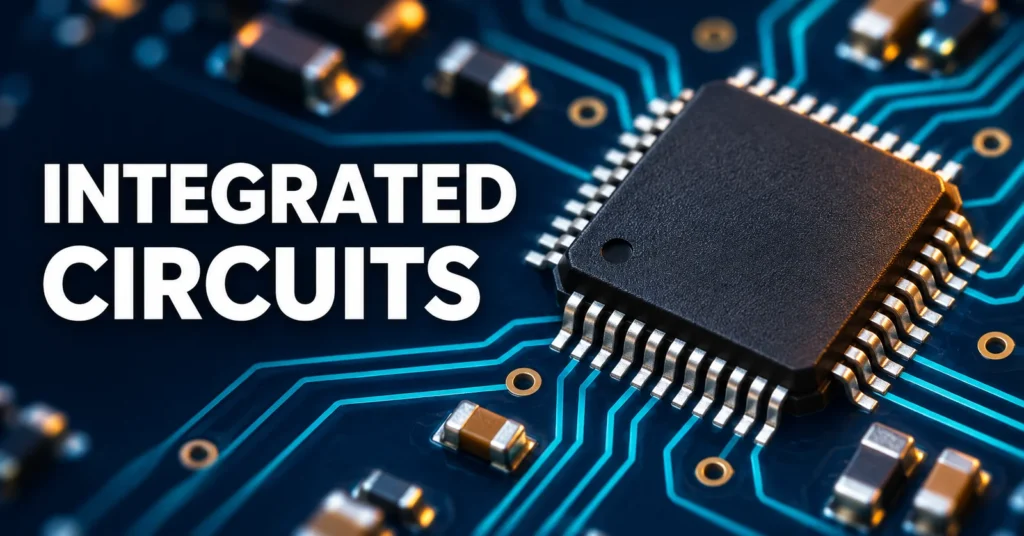
Your phone can record your voice, clean up the sound, and send it across the world. Several tiny chips do the work, each handling a different part of the job.
So what is an integrated circuit? An integrated circuit, or IC, is a complete electronic circuit built into a small piece of semiconductor material, usually silicon. It can amplify a signal, store data, regulate a voltage, or perform millions of calculations in the time it takes you to blink.
What’s inside an integrated circuit?
Pick up a small black chip and look at its pins. The part you’re holding is the package. Inside it is the die, the thin piece of semiconductor that carries the working circuit. The package protects the die, helps move heat away, and gives you a way to connect the circuit to a board.
Under a microscope, the die looks like a city seen from above. The blocks perform different tasks, and layers of tiny metal lines connect them. A simple voltage regulator may contain a reference, an amplifier, and a power transistor. A microcontroller can contain a processor, memory, and several peripheral blocks on the same die.
- Transistors control current and act as switches or amplifiers.
- Resistors and capacitors help set operating points, shape signals, and store small amounts of charge.
- Metal interconnects carry power and signals between components and blocks.
- Package terminals connect the internal circuit to the outside world. They may be pins, flat pads, or solder balls.
A printed circuit board, or PCB, connects packaged components across a larger surface. An integrated circuit brings many of those connections down to the scale of a single die. Most boards use both approaches because chips still need a place to connect to batteries, connectors, sensors, and other parts.
How does an integrated circuit work?
An IC does the job its designer wired it to do. Some chips work as soon as you connect power and an input. Others need a clock, configuration commands, or software before they’ll do anything useful.
Follow a signal through an IC
- Apply power. The supply pins establish the operating voltage. A ground pin provides a reference and a return path for current.
- Feed in a signal. A pin might receive a tiny microphone voltage, a logic signal from a button circuit, or a stream of bits from another chip.
- Process the input. Internal transistors steer current. In an amplifier, this produces an output that follows changes in the input. In a logic gate, transistor networks pull the output toward the supply or ground according to the input levels.
- Use the result. An output might send data to a processor, drive the input of another chip, or control an external component. Some ICs also store results internally for later use.
Consider a light sensor connected to a microcontroller. The sensor circuit produces a voltage that changes with the light level. An analog-to-digital converter inside the microcontroller samples that voltage and represents it as a number. Your program can compare the number with a threshold and turn on an LED when the room gets dark.
Types of integrated circuits
The easiest way to classify an integrated circuit is by the kind of signal it handles. Analog ICs work with continuously varying quantities, digital ICs work with discrete logic states, and mixed-signal ICs bring both together.
| IC type | What it handles | Common examples | Typical job |
|---|---|---|---|
| Analog | Continuously varying voltages or currents | Op-amp, linear voltage regulator | Amplify a microphone signal or provide a steady supply |
| Digital | Discrete logic states, usually binary | Logic gate, memory chip, processor | Store bits, count pulses, or execute instructions |
| Mixed-signal | Analog signals and digital data | ADC, DAC, audio codec | Turn a sensor voltage into digital data or recreate an audio signal |
Analog integrated circuits
An analog IC responds to how much a voltage or current changes. If you connect a microphone to an op-amp circuit, the amplifier can boost the small waveform so another stage can use it. External resistors often set the gain, which is how much the signal grows.
A linear voltage regulator is another example. It senses its output and adjusts an internal transistor to hold that voltage near a target as the load changes. The input voltage, current demand, and heat still have to stay within the regulator’s operating limits.
Digital integrated circuits
A digital integrated circuit interprets ranges of voltage as logic states. The exact thresholds depend on the chip. An output that looks like a valid high to one logic family may be too low for another, so check both devices’ specifications when you connect them.
A simple digital chip can hold a few logic gates. A memory IC stores bits, and a processor executes instructions. You’ll also see programmable digital devices such as FPGAs, which let you configure the logic hardware to perform tasks in parallel.
Mixed-signal integrated circuits
A mixed-signal integrated circuit is useful where a physical quantity meets software. An ADC turns a sampled voltage into a digital code. A DAC goes the other way and produces an analog output level from a digital code.
An audio codec often combines both. It converts an incoming microphone waveform into digital samples for recording, then converts digital samples back into an analog signal for playback. A separate power amplifier may still be needed to drive a speaker.
How are ICs made?
Chip fabrication builds many copies of a circuit on a round silicon wafer. Each copy occupies a defined area that becomes a separate die. The process repeats a series of steps to build up the devices and the wiring that joins them.
- Design and verify the circuit. Engineers choose the circuit blocks, test how they behave in simulation, and lay out the devices and wiring.
- Pattern the wafer. Photolithography transfers patterns into a light-sensitive coating. Etching, deposition, and other processes use those patterns to remove or add material.
- Form the devices and connections. Selected regions receive impurities that change how they conduct. Insulating layers and metal wiring are added in carefully aligned stages.
- Test, separate, and package the dies. Electrical tests on the wafer help identify working dies. The wafer is cut, usable dies are packaged, and the packaged chips are tested again.
Fabrication technology varies with the job. A dense processor benefits from packing many small transistors into a limited area. A power chip may need larger structures that handle higher voltages and currents, plus a package designed to carry heat away.
Where are integrated circuits used?
You’ll find an integrated circuit wherever a product needs to sense, calculate, communicate, or control power. Most devices divide those jobs among several chips. That division makes it easier to choose parts that match the electrical and thermal demands of each job.
- Phones and laptops. Processors run software, memory holds data, and power-management ICs supply the different voltages each section needs.
- Cars. Sensor interface chips read quantities such as pressure and temperature, while microcontrollers handle tasks like adjusting cabin controls or managing a motor.
- Home appliances. A washing machine controller reads switches and sensors, times each cycle, and signals a driver circuit to operate the motor.
- Industrial equipment. Interface ICs help machines exchange data, while motor driver ICs control the switching that sets motor speed or direction.
- Medical devices. In a digital thermometer, an interface circuit can measure a sensor signal and pass a digital reading to the controller that updates the display.
Even a USB charger divides its work. A control IC measures or receives feedback about the output and adjusts switching to maintain the desired voltage. Other parts on the board, such as capacitors and a transformer in an isolated mains charger, handle energy storage, filtering, and isolation.
How do you choose an IC?
Start with what goes into your circuit and what you need to come out. If you want to measure a sensor, look at its signal range and the speed or resolution you need. If you want to drive a motor, write down the supply voltage and the current the motor can draw at startup or when stalled.
- Check recommended operating conditions. Use these to choose your supply voltage and temperature range. Absolute maximum ratings are limits beyond which damage can occur.
- Check input and output compatibility. Compare logic thresholds, current limits, and signal levels for the parts you plan to connect.
- Check the package and pinout. A through-hole package may fit a breadboard. A surface-mount package may need an adapter, and its pin order can differ from another package of the same part.
- Read the typical application diagram. It shows where to put supporting components such as bypass capacitors, feedback resistors, and protection parts.
For example, if you’re using a 3.3 V controller to talk to a 5 V peripheral, check the receiving pin’s minimum high-level input voltage. Also check what the peripheral sends back. A level shifter can help when the signal levels don’t match or a pin can’t tolerate the other supply voltage.
Advantages and limits of integration
An integrated circuit can replace many separate components and solder joints. That saves board space, reduces assembly work, and often improves consistency. Short connections on the die can also help high-speed signals travel with less delay and lower parasitic capacitance.
Integration has trade-offs. Heat is concentrated in a smaller area, and certain parts, such as large capacitors and high-energy inductors, are often more practical outside the chip. If an internal component fails, the usual repair is to replace the whole IC. Separate parts can also make a simple circuit easier to probe or modify while you’re learning.
Comments
Comments are currently closed.