
Frequency, Period, and Waveforms (Sine and Square)
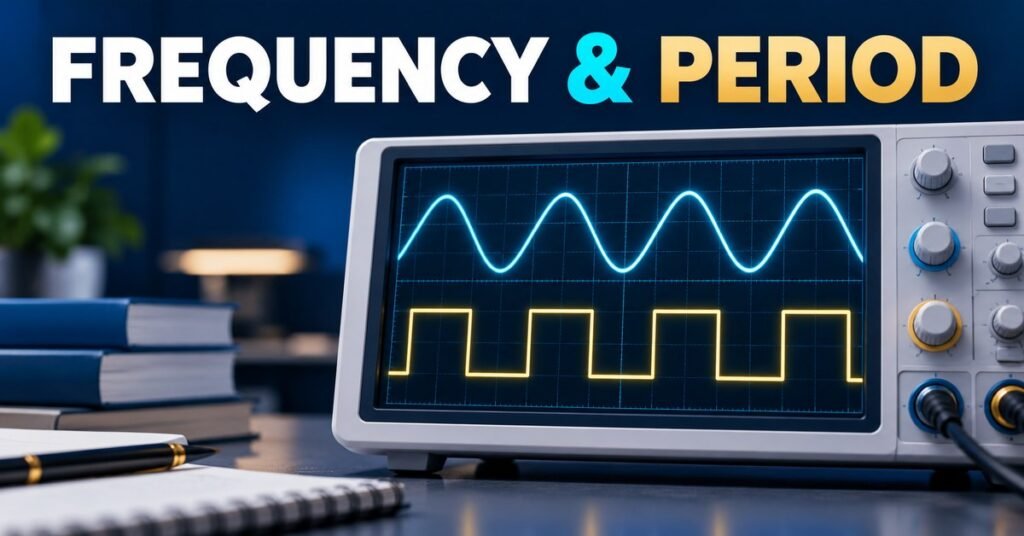
A fan turns slowly enough to watch. An audio signal can repeat thousands of times each second. A digital clock may repeat millions of times.
Frequency and period describe that repetition from opposite directions. Frequency tells you how many cycles occur per second. Period tells you how long one cycle takes.
Once you understand those two quantities, sine waves, square waves, audio signals, and microcontroller timing become much less mysterious. You can also read an oscilloscope screen with a clear question in mind: what repeats, and how long does it take?
What is frequency?
Frequency is the number of complete repeating cycles per second. Its SI unit is the hertz, written Hz.
A 50 Hz waveform completes fifty cycles in one second. A 1 kHz waveform completes one thousand, and a 1 MHz waveform completes one million.
The word complete matters. A sine wave’s positive half and negative half together form one full cycle. Counting each half separately would double the frequency incorrectly.
Frequency doesn’t describe how large a signal is. A small 1 V sine wave and a large 10 V sine wave can both repeat at 1 kHz.
Likewise, frequency doesn’t necessarily describe the speed of individual electrons through a wire. It describes the repetition of the measured electrical quantity, such as voltage or current.
What is period?
Period, written T, is the time for one complete cycle. Its unit is the second, although milliseconds, microseconds, and nanoseconds are often more convenient.
Choose a recognizable point on the waveform, such as a rising zero crossing. Measure to the next occurrence of the same point moving in the same direction.
For a square wave, measuring from one rising edge to the next rising edge gives the period. Measuring from a rising edge to a falling edge usually gives only the high time.
An irregular signal may not have one constant period. You can sometimes describe local cycle times, average frequency, or a spectrum instead.
That distinction keeps the concept useful. Frequency and period describe a periodic waveform cleanly, but not every changing signal repeats in exactly the same way.
The frequency and period formula
For a periodic waveform, f = 1/T and T = 1/f. Use seconds when you want the result in hertz.
If T = 0.020 s, frequency is 1/0.020 = 50 Hz. If frequency is 1000 Hz, period is 0.001 s, or 1 ms.
A 25 kHz signal has period 1/25,000 = 0.000040 s, which is 40 µs. Writing units at every step makes the conversion easier to check.
Frequency and period move in opposite directions. Doubling frequency halves period; doubling period halves frequency.
A handy reference is 1 kHz ↔ 1 ms and 1 MHz ↔ 1 µs. Don’t mix milliseconds with microseconds, because that produces a factor-of-one-thousand error.
Sine waves: smooth, repeating change
A sine wave varies smoothly and repeats. A mathematical description is v(t) = Voffset + Vpeak sin(2πft + φ).
Voffset shifts the waveform up or down. Vpeak describes the sinusoidal amplitude around that offset. Frequency f controls repetition, and phase φ describes its relative timing.
An ideal sine wave contains one frequency component. That makes it a useful test signal for studying filters, amplifiers, and AC circuit behavior.
Many physical oscillations are approximately sinusoidal, but real signals often contain noise and distortion. A measured waveform can resemble a sine without being a mathematically perfect one.
For a zero-offset sine wave, positive and negative peaks have equal magnitude. Peak-to-peak voltage is twice the peak magnitude. A 3 V peak sine therefore spans 6 V peak to peak.
Square waves: high and low states
A square wave switches between two levels. An ideal 50% duty-cycle square wave spends equal time high and low during each period.
Digital electronics uses high and low voltage ranges to represent logic states. A real logic waveform has finite transition times rather than perfectly vertical edges.
A 0 V to 5 V square wave has 5 V peak-to-peak amplitude, but its midpoint is 2.5 V. It is not the same waveform as a −5 V to +5 V square wave.
Square waves contain a fundamental frequency plus higher-frequency components called harmonics. An ideal symmetric 50% square wave has odd harmonics of its fundamental.
This is why a fast edge can demand much more circuit bandwidth than the repetition rate alone suggests. A 1 MHz square wave isn’t equivalent to a pure 1 MHz sine wave.
Duty cycle and pulse width
Duty cycle is the fraction of each period spent in the specified active state. For an active-high waveform, D = thigh/T.
Multiply by 100 to express it as a percentage. A 40 µs period with a 10 µs high time has a duty cycle of 25%.
If the high time changes while the period remains fixed, frequency stays the same and duty cycle changes. That is a common form of pulse-width modulation, or PWM.
For an ideal 0-to-5 V pulse train at 25% duty, average voltage is 1.25 V. The waveform still reaches 5 V during each high pulse.
Don’t use average voltage as a universal description of its effects. Heating, motor behavior, switching losses, and filtered output depend on the load and circuit. RMS and peak values may matter as well.
Amplitude, RMS, average, and frequency aren’t interchangeable
Amplitude tells you signal size. Frequency tells you repetition rate. Phase tells you relative timing. These are separate properties.
A zero-offset sine has zero average over complete cycles, but it can still heat a resistor. Its RMS value is nonzero.
For a pure zero-offset sine, Vrms = Vpeak/√2. That conversion depends on waveform shape; it isn’t the right formula for every periodic signal.
For an ideal symmetric square wave alternating between +A and −A, RMS is A. Its average remains zero, even though its heating effect is not zero.
When comparing two waveforms, state which voltage quantity you mean. Saying a signal is 5 V without specifying peak, peak to peak, RMS, or logic levels can leave the description ambiguous.
Measure frequency and period on an oscilloscope
First, set a suitable voltage scale so the waveform fits vertically. Then choose a time scale that shows a few complete cycles.
Use a stable trigger, often on a rising edge at a suitable threshold. A drifting display can make a simple timing measurement unnecessarily confusing.
Count horizontal divisions between identical points on adjacent cycles. Multiply by time per division to obtain period, then calculate frequency as its reciprocal.
For example, a cycle spanning four divisions at 0.5 ms per division has period 2 ms. Its frequency is 500 Hz.
Automatic measurements are helpful, but verify that the instrument is measuring the waveform you intend. Noise, ringing, insufficient sampling, or the wrong trigger source can produce misleading readings.
Sampling, bandwidth, and misleading waveforms
A digital oscilloscope samples the signal at discrete times. If the sampling is inadequate, a fast waveform can appear to have a slower, incorrect pattern called aliasing.
The instrument also has finite analog bandwidth. A square wave may look rounded when the scope, probe, or circuit cannot reproduce its higher-frequency content.
Sampling rate and bandwidth are different specifications. A high sample rate doesn’t compensate for every limitation in the analog input path.
Probe setup matters too. Use the correct attenuation setting and suitable connections. Long probe ground leads can introduce ringing that belongs to the measurement setup rather than the original circuit.
For beginner practice, use low-voltage sources within the instrument’s ratings. Ordinary oscilloscope ground clips can be earth-referenced, so connecting them arbitrarily to mains circuits can create a dangerous short.
Where you’ll use frequency and period
In audio, frequency relates to pitch for a simple tone, while amplitude relates to signal level. Real musical sounds combine many frequencies rather than one perfect sine.
In a microcontroller, a timer counts clock cycles. If one tick takes 1 µs, one thousand ticks represent 1 ms, assuming the timer configuration really produces that tick duration.
In filters, the response changes with frequency. A low-pass filter may preserve slower signal variations while reducing faster components.
In power electronics, switching frequency influences component sizes, losses, ripple, and electromagnetic behavior. Raising it can improve one aspect while worsening another.
These examples show why frequency isn’t just an isolated formula. It’s a link between a signal’s timing and the way a real circuit responds.
Practice without memorizing a table
Try three questions: what is the period at 2 kHz, what is the frequency for a 5 ms period, and what is the duty cycle for 8 µs high time in a 20 µs period?
The answers are 0.5 ms, 200 Hz, and 40%. For each, write the starting units before entering numbers into a calculator.
Then change only one property in your mental picture. Increase amplitude without changing period. Increase frequency without changing peak-to-peak voltage. Change duty cycle without changing frequency.
That exercise separates ideas that often get mixed together when you first see waveforms.
If a result feels wrong, check whether you measured a half cycle, inverted the wrong quantity, or forgot a unit prefix. Those three checks catch a large share of beginner errors.
Frequently asked questions
What is the difference between frequency and period?
Frequency counts cycles per second. Period measures seconds per cycle. For a periodic signal, each is the reciprocal of the other.
What is the period of a 50 Hz waveform?
It is 1/50 second, or 0.020 s. That’s 20 ms for one complete cycle, including both halves of a sinusoidal waveform.
Does a square wave have only one frequency?
No. A repeating square wave has a fundamental repetition frequency and harmonic components. Its fast edges are related to that higher-frequency content.
Can duty cycle change without changing frequency?
Yes. Keep the total period fixed while changing the time spent high. That changes duty cycle while leaving the repetition frequency unchanged.
Does higher frequency mean higher voltage?
No. Frequency and voltage amplitude are independent signal properties. A circuit can generate a higher-frequency waveform at the same amplitude, subject to its operating limits.
Quick reference and practice checklist
| Property | Sine wave | Ideal 50% square wave |
|---|---|---|
| Shape | Smooth variation | Two levels |
| Frequency content | Single frequency | Fundamental and harmonics |
| Period | One full smooth cycle | Rising edge to rising edge |
| Edges | No abrupt transitions | Instantaneous in ideal model |
Use this three-step routine when you review the examples:
- Identify one complete repeating cycle.
- Measure its duration with consistent units.
- Take the reciprocal to calculate frequency.
Before moving on, check these details:
- Write units beside every number.
- State the assumptions behind your calculation.
- Check the result against the physical behavior described above.
Make timing a habit
Frequency and period become intuitive when you measure one and calculate the other. Waveform shape, amplitude, and duty cycle then add the rest of the description.
Pick a safe test signal and write down its period, frequency, high and low levels, and duty cycle. A complete description is much more useful than calling it simply a fast wave.

Comments
Comments are currently closed.