
What Is a Battery? How a Power Source Works

A torch can light up far from any wall socket. A phone can play music while you walk. Both depend on stored chemical energy.
So, what is a battery? It’s an electrochemical power source that converts chemical energy into electrical energy during discharge. Understanding it helps you choose suitable cells, estimate runtime, and avoid common charging mistakes.
A battery doesn’t simply hold a tank of electrons waiting to pour out. The useful story involves chemical reactions, two electrodes, an electrolyte, and a complete external circuit.
Battery, cell, and battery pack
A cell is one electrochemical unit. It contains electrodes and an electrolyte arranged so that a chemical reaction can support an electrical potential difference.
A battery traditionally means one or more cells used as a power source. Everyday language often calls a single AA cell a battery, and that usage is widely understood.
A battery pack may include several cells plus wiring, protection, temperature sensing, balancing electronics, and a case. The cells provide electrochemical storage; the other parts help manage it.
This distinction matters when replacing a pack. Matching the outside dimensions and connector doesn’t guarantee compatible chemistry, voltage, current capability, or protection.
Always use the equipment maker’s compatibility requirements. A loose collection of cells with a similar voltage isn’t automatically an equivalent replacement for a protected pack.
Battery working principle: what happens inside?
During discharge, a chemical oxidation reaction releases electrons at one electrode. A reduction reaction accepts electrons at the other.
Electrons flow through the external circuit, supplying the connected load. Ions move through the electrolyte inside the cell, helping maintain charge balance as reactions proceed.
The electrolyte allows ionic conduction. It doesn’t normally provide a direct electron path between electrodes. A separator helps keep electrodes apart while allowing necessary ionic transport.
The energy driving the process comes from the chemical system. The electrode materials and electrolyte influence voltage, energy capacity, temperature behavior, cost, and safety characteristics.
As reactants are converted, the cell’s state of charge changes. Eventually its voltage or available capacity reaches the permitted discharge limit, and it can no longer support the intended load effectively.
Why a complete circuit is needed
Connect a suitable lamp across a cell and current can flow through a closed path. Open a switch in that path and sustained external current stops.
An unused battery can still show voltage because its chemistry maintains a potential difference between the terminals. Voltage doesn’t require a large external current to exist.
The amount of current depends on both source behavior and the connected load. A battery labelled with a large current capability doesn’t force that current through every device.
However, a short circuit presents a very low resistance path. Current may then rise dangerously, limited by internal resistance, connections, protection, and chemistry.
Don’t test batteries by bridging their terminals with wire or a meter in current mode. That creates the kind of low-resistance path a proper load and protection system are meant to prevent.
Voltage: nominal, open circuit, and under load
Nominal voltage is a convenient reference value. Actual terminal voltage changes with chemistry, state of charge, temperature, load current, and age.
Open-circuit voltage is measured with almost no load. Loaded voltage is measured while current is being supplied. The latter can be lower because of internal losses and electrochemical effects.
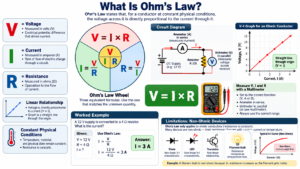
A simple model represents the battery as an ideal voltage source in series with internal resistance. The terminal voltage is approximately V = E − Ir during discharge.
Suppose E is 1.5 V, internal resistance is 0.2 Ω, and current is 0.5 A. The simple model predicts 1.4 V at the terminals.
Real battery behavior isn’t a fixed resistor at every operating point. The model is useful for intuition, but a manufacturer’s discharge curves give a better picture over time.
Common types of batteries
Primary cells are intended for single use. Familiar examples include alkaline cells and several lithium primary chemistries. They aren’t designed for ordinary recharging.
Secondary cells are rechargeable. Common families include lead-acid, nickel-metal hydride, and lithium-ion. Each requires a charging method suited to its chemistry and design.
Alkaline cells are common in low-to-moderate drain household equipment. Nickel-metal hydride cells are useful rechargeable replacements in compatible devices, although their nominal voltage differs.
Lead-acid batteries are used where their weight, cost, high-current behavior, and established technology suit the application. They need charging and ventilation arrangements appropriate to their construction.
Lithium-ion is a family, not one universal cell. Different chemistries have different nominal voltages, charge limits, and thermal behavior. Lithium iron phosphate, for example, shouldn’t be charged using arbitrary settings intended for another lithium-ion chemistry.
Capacity: ampere-hours are not watt-hours
Ampere-hour capacity describes charge delivery under specified test conditions. One ampere-hour equals 3600 coulombs.
A 2 Ah rating suggests 2 A for one hour in a simple arithmetic model. Actual usable capacity depends on discharge rate, cutoff voltage, temperature, age, and how the rating was measured.
Watt-hours describe energy. A rough nominal estimate is Wh = nominal voltage × Ah. A nominal 3.7 V, 2 Ah cell therefore has an estimated nominal energy of 7.4 Wh.
That number isn’t an exact promise of delivered energy. Voltage changes during discharge, and conversion circuits waste some energy.
Compare energy in watt-hours when batteries have different voltages. Comparing only mAh can make a lower-energy battery look larger simply because its charge is specified at a lower voltage.
Estimate battery runtime with a realistic example
Suppose a pack provides 20 Wh of usable energy to its output electronics. A device consumes a steady 4 W, and conversion efficiency is 85%.
Energy reaching the load is approximately 20 × 0.85 = 17 Wh. Estimated runtime is 17/4 = 4.25 hours.
If the 20 Wh figure already refers to usable energy at the device output, don’t apply the efficiency loss again. Define where each quantity is measured.
A variable load needs an average power estimate. A radio that spends most of its time asleep can run much longer than one that transmits continuously, even with the same peak current.
Use runtime calculations as planning estimates. Leave margin for low temperature, aging, cutoff behavior, and unexpected workload rather than designing around the last theoretical minute.
Series and parallel connections
Connecting compatible cells in series adds their voltages. Two 1.2 V, 2 Ah cells in series form a nominal 2.4 V, 2 Ah arrangement.
Connecting suitable matched cells in parallel keeps nominal voltage the same while adding charge capacity. Two 1.2 V, 2 Ah cells would ideally form a 1.2 V, 4 Ah arrangement.
Both examples contain about 4.8 Wh nominally. Series and parallel change how voltage and current capability are arranged; they don’t create free energy.
Real packs need appropriate matching, interconnections, protection, and sometimes balancing. Differences between cells can create unequal loading or circulating current.
Don’t directly parallel cells with different voltages or improvise lithium-ion packs as a beginner exercise. Use a properly designed protected pack that meets your device’s requirements.
Charging and battery protection
A rechargeable battery needs a charger designed for its chemistry, cell count, voltage limits, and current limits. A power supply with a matching nominal voltage isn’t necessarily a charger.
Charging may involve controlled current, controlled voltage, temperature monitoring, and termination logic. The required sequence depends on the battery type.
A battery management system can supervise operating limits and disconnect a pack under certain faults. It may also balance series cells. Its exact functions depend on the design.
A protection board doesn’t replace a suitable charger, and a charger doesn’t eliminate every possible fault. Cells, charger, protection, wiring, and enclosure have to work together.
Stop using a pack that is swollen, leaking, unusually hot, physically damaged, or behaving abnormally. Follow the maker’s handling and disposal instructions rather than trying to repair damaged cells yourself.
Why batteries age and why cold changes performance
Battery aging includes calendar aging over time and cycling-related changes from charging and discharging. Heat, storage state of charge, depth of discharge, and charging conditions can influence the rate.
Aging can reduce usable capacity and increase internal resistance. A battery may still show plausible voltage with no load yet sag badly when a motor starts.
Cold temperatures can reduce available power and capacity temporarily. Charging limits can also become more restrictive in cold conditions, especially for some lithium-ion systems.
Don’t apply one storage rule to every chemistry. Follow the manufacturer’s recommended storage temperature and state of charge for the particular battery.
If equipment shuts down early, check the complete power path. A poor connector, thin wire, or undersized protection circuit can create voltage drop that looks like a weak battery.
Frequently asked questions
What is a battery in simple words?
A battery is a chemical power source. During discharge, reactions inside its cells drive electrons through an external circuit, allowing electrical energy to reach a lamp, motor, or electronic device.
Does a battery store electricity or chemical energy?
Its useful stored energy is primarily chemical energy. That energy is converted to electrical energy during discharge. Calling it stored electricity is a common shortcut, but it hides the electrochemical mechanism.
What is the difference between a cell and a battery?
A cell is one electrochemical unit. A battery can use one or more cells, and a battery pack may also contain protection, monitoring electronics, connections, and an enclosure.
Does a higher Ah rating mean more voltage?
No. Ah is a charge-capacity rating, while volts describe potential difference. Energy depends on both, so watt-hours are more useful when comparing batteries with different nominal voltages.
Can every battery be recharged?
No. Only rechargeable cells should be charged, using compatible equipment and settings. Primary cells aren’t designed for ordinary recharging and can become hazardous if you try it.
Quick reference and practice checklist
| Rating | Unit | What it tells you |
|---|---|---|
| Voltage | V | Potential difference |
| Charge capacity | Ah | Charge delivered under test conditions |
| Energy | Wh | Energy available under stated conditions |
| Current capability | A | Permitted discharge rate |
Use this three-step routine when you review the examples:
- Match chemistry and voltage to the equipment.
- Compare energy in watt-hours.
- Use the specified charger and protection arrangement.
Before moving on, check these details:
- Write units beside every number.
- State the assumptions behind your calculation.
- Check the result against the physical behavior described above.
Choose by the whole specification
What is a battery really offering your project? A combination of voltage, usable energy, current capability, charging requirements, and operating limits.
Before buying a replacement, write down all five. Then estimate runtime in watt-hours and check the device maker’s compatibility guidance. That habit is far more reliable than choosing the largest mAh number on a label.

Comments
Comments are currently closed.