
What Is a Short Circuit? Causes, Effects, and Protection
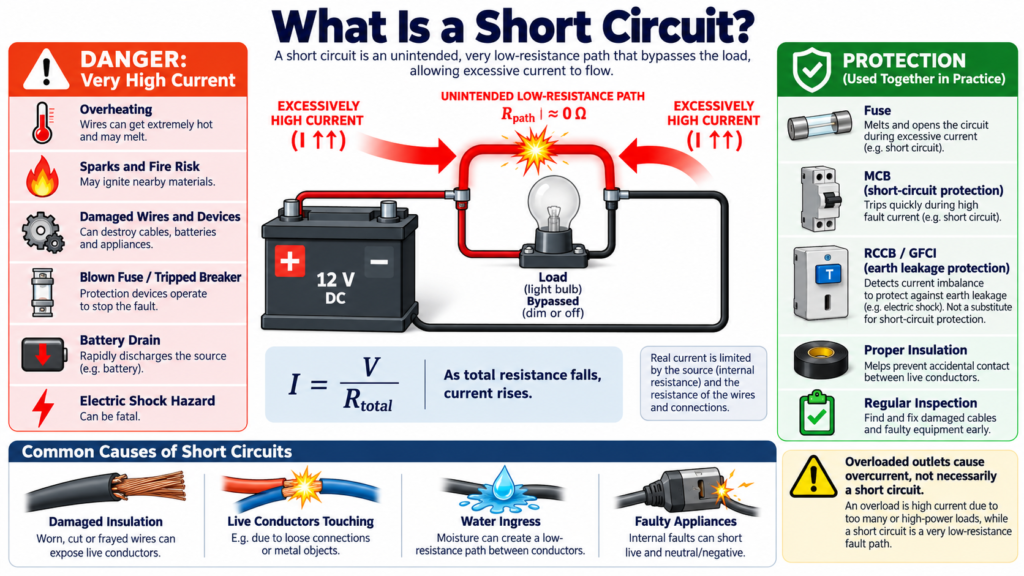
A short circuit is an unintended connection that creates a low-impedance path between points at different electrical potentials. Instead of following the designed route through a load, current takes an additional path that may bypass that load. The resulting current can be far above the normal operating value, heating conductors and damaging equipment before protection disconnects the supply.
Imagine a classroom lamp connected to a battery. The lamp limits current while turning electrical energy into light and heat. If damaged insulation allows the outgoing and return wires to touch, the lamp may be bypassed. Understanding what changes in that simple example helps explain faults in everything from breadboards to electrical distribution systems.
What is a short circuit in electrical engineering?
In circuit analysis, a short circuit is often represented by an ideal wire with zero resistance. The voltage across that ideal connection is zero, although current through it need not be zero. This mathematical model is useful for solving circuits, but real fault paths always have some impedance.
A practical short circuit may involve copper conductors, damaged insulation, a conducting tool, moisture, or an electrical arc. Its impedance can be small compared with the intended load, yet large enough to influence the fault current substantially. The source and supply conductors also contribute impedance, so a real fault never produces physically infinite current.
The important comparison is between the intended current path and the unwanted path. A short circuit across a small signal resistor may disrupt a measurement. A fault across a high-energy battery or supply can release enough energy to cause severe damage. The same basic concept applies, but the available energy changes the consequences.
How does a short circuit increase current?
For a simplified resistive DC loop, current equals source voltage divided by total loop resistance. If the total resistance falls sharply while voltage remains approximately constant, current rises. In AC systems, engineers use the total fault-loop impedance because inductance can significantly affect the result.
Consider a 12 V source with a 12 ohm load. Ignoring small wiring and source resistance for the normal calculation, the load current is 1 A. Now suppose an unintended connection bypasses the load and the total source-plus-fault-path resistance is 0.3 ohm. The simplified initial estimate becomes 12 divided by 0.3, or 40 A.
This calculation illustrates the mechanism; it is not a prediction for every 12 V source. A current-limited bench supply may reduce its voltage, a battery voltage may sag, and a protective device may operate. Actual fault analysis also considers changing impedance, source characteristics, and the time before interruption.
Short circuit, overload, and open circuit compared
A short circuit and an overload can both cause overcurrent, but they describe different conditions. An overload occurs when an otherwise intact circuit carries more load current than it is designed to carry. Connecting too many appliances to a circuit is a familiar example.
An open circuit has a break in the conducting path. In a simple steady DC loop, that break prevents sustained current, although voltage may remain across the open points. A healthy closed circuit provides the intended continuous path and includes enough impedance to keep current within its design range.
| Condition | Current path | Typical effect |
|---|---|---|
| Normal closed circuit | Through the intended load | Expected operating current |
| Open circuit | Interrupted | No sustained loop current |
| Short circuit | Unwanted low-impedance path | Potentially very high fault current |
| Overload | Intended path, excessive demand | Excess current without a direct bypass |
These distinctions help when interpreting a problem statement. A lamp that goes out does not prove a short circuit exists. Its filament may have opened, a switch may be off, or the supply may have shut down. Symptoms need to be connected to the actual circuit arrangement.
Common causes of a short circuit
Insulation separates conductors that must remain electrically distinct. Heat, abrasion, aging, or mechanical damage can compromise it. A loose strand of wire may bridge adjacent terminals, while an incorrectly placed jumper can connect power rails on a breadboard.
- Damaged cables can expose conductors to one another.
- Incorrect wiring can join supply and return directly.
- Conductive debris can bridge circuit-board tracks.
- Moisture and contamination can create leakage paths that develop into faults.
- Failed components can become low resistance internally.
Not every contamination fault starts as a solid metallic connection. Some begin with tracking or arcing, where current and heat progressively damage insulating surfaces. Such faults may behave differently from the ideal zero-resistance short used in introductory calculations.
Types of short-circuit faults
In a basic DC circuit, a common example is a connection between positive and negative supply conductors. In an AC system, faults can occur between line conductors or between a line conductor and an earthed conductive part. Three-phase systems also have phase-to-phase and three-phase faults.
The return path matters. A ground fault does not automatically have negligible impedance, because grounding arrangements, contact resistance, and the complete return loop affect current. This is one reason overcurrent protection and residual-current protection serve different purposes.
A short circuit can also be local to a component. Shorting one resistor in a series network changes the network resistance but does not necessarily connect the source terminals directly together. Always identify exactly which two nodes have been joined before deciding what happens next.
Why short-circuit current causes damage
Conductors dissipate heat according to I squared R. If current becomes ten times larger, the heating rate in a conductor of unchanged resistance becomes one hundred times larger. The duration matters too: energy released before disconnection contributes to the resulting temperature rise.
High fault current can also create strong magnetic forces that move conductors. An electrical arc can produce intense heat and hazardous pressure. Batteries add another concern because some can deliver large currents even when their nominal voltage appears modest.
A protective device therefore needs more than the correct everyday current rating. Its voltage rating and interrupting capacity must suit the installation. The ability to carry normal current is a different specification from the ability to safely break a large fault current.
How fuses and circuit breakers protect a circuit
A fuse interrupts current when its element melts under specified overcurrent conditions. A circuit breaker opens contacts through an appropriate trip mechanism. Many small breakers combine a thermal element for overloads with a magnetic element for high overcurrents, although designs vary.
Protection is coordinated with conductor capacity, expected load behavior, and the available fault current. A device should allow normal operation while disconnecting faults within the required conditions. Motor starting current, for example, must be distinguished from a sustained fault rather than treated as evidence that all high current is abnormal.
A conventional overcurrent breaker does not detect every dangerous leakage current. An RCD or RCCB responds to imbalance between outgoing and returning current; an RCBO combines residual-current and overcurrent functions. These terms describe different protective functions, not interchangeable names for the same device.
A safe way to study short-circuit behavior
Use circuit simulation to compare normal and faulted conditions. A simulator lets you inspect current, voltage, and dissipated power without deliberately creating a physical short circuit. Include source resistance or current limiting so the model remains meaningful.
- Draw a low-voltage source, resistor, and return conductor.
- Calculate the normal current before running the simulation.
- Add a switch-controlled bypass across the load.
- Include realistic source resistance or a current limit.
- Compare load current, source current, and terminal voltage.
For physical learning, use supervised, current-limited low-voltage training equipment. Never short a battery, wall outlet, or capacitor to demonstrate the idea. If installed wiring repeatedly trips protection, disconnect the affected equipment where safe and have a qualified electrician investigate rather than repeatedly resetting the device.
Frequently asked questions
Does electricity only take the path of least resistance?
Current divides among all available conducting branches according to their impedances. A low-resistance branch may carry most of the current, but the other branches do not automatically carry none. A short across a load often reduces the load voltage, which further changes its current.
Can a short circuit happen at low voltage?
Yes. Low voltage does not prevent a short circuit, and some low-voltage sources can deliver substantial fault current. Hazard depends on available current, energy, contact conditions, and other factors as well as voltage.
Is every breaker trip caused by a short circuit?
No. A breaker can trip because of overload, certain equipment faults, or other conditions appropriate to its protective function. An RCBO may also trip because of residual current. The reason requires investigation.
Why does a shorted lamp go dark?
An almost zero-resistance bypass across the lamp makes the voltage across it very small. Without sufficient voltage, the lamp receives little power, while the source may supply excessive current through the bypass.
Conclusion
A short circuit is an unintended low-impedance connection that changes a circuit’s current paths and can produce dangerous overcurrent. Distinguish it from an overload and an open circuit, include source impedance in calculations, and remember that correct protection depends on both current ratings and fault-interruption capability. These habits turn a simple definition into useful engineering judgment.
Comments
Comments are currently closed.