An open circuit is an electrical circuit in which the path for the flow of electric current is incomplete or broken. Since the circuit is not complete, electric current cannot flow from the power source to the electrical device and back to the source. Open circuits are one of the basic concepts in electricity and electronics. Understanding open circuits helps students learn how electrical systems work, why devices sometimes stop functioning, and how electrical faults can be identified and repaired.
Electrical circuits are used in homes, schools, industries, and electronic devices. Every circuit needs a complete path for electricity to travel. If this path is interrupted by a broken wire, an open switch, or a damaged component, the circuit becomes an open circuit. As a result, the connected device, such as a light bulb, fan, or motor, will not operate.
Definition of an Open Circuit
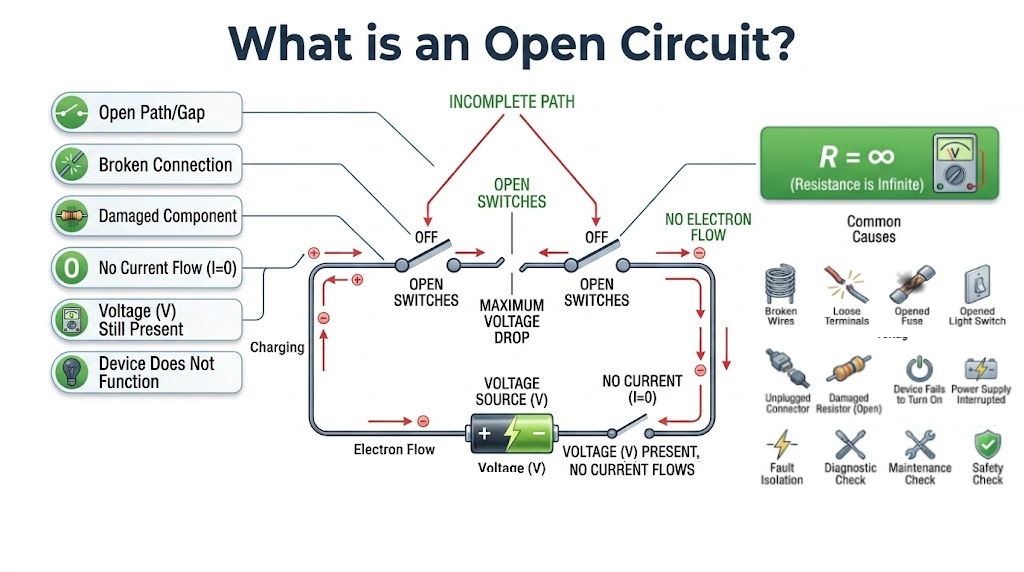
An open circuit is a circuit in which there is a break or gap that prevents the flow of electric current. Although voltage may still be present in the circuit, no current flows because the electrical path is incomplete.
For example, when a light switch is turned OFF, the switch opens the circuit. Since the path is broken, electricity cannot reach the bulb, and the bulb remains off.
How an Open Circuit Works
Electric current flows only when there is a closed path connecting the positive and negative terminals of a power source. In an open circuit, this path is interrupted.
The working process is as follows:
- The battery or power supply provides electrical energy.
- A wire carries electricity toward the electrical device.
- If the circuit is broken anywhere, the current cannot continue its path.
- Since current cannot flow, the electrical device stops working.
Even though the battery still has voltage, the absence of a complete path prevents electricity from moving through the circuit.
Components of an Open Circuit
An open circuit usually consists of the following components:
- Power Source: Supplies electrical energy, such as a battery or generator.
- Conducting Wires: Connect the components together.
- Load: The electrical device that uses electricity, such as a bulb or motor.
- Switch: Controls whether the circuit is open or closed.
- Break or Gap: Prevents the flow of current and creates the open circuit.
Causes of an Open Circuit
An open circuit can occur for several reasons:
1. Open Switch
When a switch is turned OFF, it creates a gap in the circuit.
2. Broken Wire
A damaged or cut wire interrupts the flow of electricity.
3. Loose Connection
Loose terminals or connectors prevent proper electrical contact.
4. Blown Fuse
A fuse melts when excessive current flows, opening the circuit to protect electrical equipment.
5. Damaged Components
Faulty resistors, bulbs, or electronic components may create an open circuit.
Characteristics of an Open Circuit
An open circuit has several important characteristics:
- No electric current flows.
- The electrical path is incomplete.
- Voltage may still be present across the open section.
- Electrical devices connected to the circuit do not operate.
- Power is not delivered to the load.
Examples of Open Circuits
Open circuits are common in everyday life. Some examples include:
Example 1: Light Switch OFF
When the switch is turned off, the bulb does not glow because the circuit is open.
Example 2: Broken Charging Cable
A damaged phone charger cannot carry current, preventing the phone from charging.
Example 3: Burnt Light Bulb
When the filament inside a bulb breaks, the circuit becomes open, and the bulb stops glowing.
Example 4: Blown Fuse
A blown fuse interrupts the electrical path and protects appliances from damage.
Example 5: Broken Extension Cord
If the internal wire breaks, electricity cannot reach connected devices.
Open Circuit Diagram
A simple open circuit consists of:
- Battery
- Switch (Open)
- Bulb
- Connecting wires
When the switch is open, the bulb does not light because current cannot flow.
Simple representation:
Battery (+) → Open Switch → Bulb → Battery (−)
The gap at the switch prevents the completion of the circuit.
Difference Between Open Circuit and Closed Circuit
| Open Circuit | Closed Circuit |
|---|---|
| Path is incomplete. | Path is complete. |
| Current does not flow. | Current flows normally. |
| Device does not work. | Device operates properly. |
| Switch is OFF. | Switch is ON. |
| Electrical energy is not delivered to the load. | Electrical energy reaches the load. |
Advantages of an Open Circuit
Although an open circuit stops current flow, it has several useful applications:
- Prevents unnecessary power consumption.
- Allows safe switching of electrical appliances.
- Protects electrical equipment during maintenance.
- Helps prevent electric shocks while repairing circuits.
- Used in safety devices such as switches and circuit breakers.
Disadvantages of an Open Circuit
Some disadvantages include:
- Electrical devices stop working.
- Interrupts industrial and household operations.
- May indicate equipment failure.
- Can lead to inconvenience if caused by damaged wiring.
- Requires troubleshooting and repair.
Applications of Open Circuits
Open circuits are intentionally used in many electrical systems, including:
1. Light Switches
Switches open and close circuits to control lights.
2. Circuit Breakers
Circuit breakers automatically open circuits during overloads or short circuits.
3. Emergency Stop Systems
Machines use open circuits to stop operation immediately during emergencies.
4. Safety Disconnects
Electricians open circuits before repairing equipment to ensure safety.
5. Electronic Devices
Power buttons create open or closed circuits to turn devices on or off.
How to Detect an Open Circuit
Several methods are used to identify an open circuit:
- Checking whether the device operates.
- Inspecting wires for visible damage.
- Using a multimeter to test continuity.
- Measuring voltage across components.
- Looking for loose or disconnected wires.
Safety Precautions
When working with open circuits, the following precautions should be followed:
- Switch off the power supply before repairs.
- Use insulated tools.
- Avoid touching exposed wires.
- Wear protective equipment if necessary.
- Test the circuit before reconnecting power.
Importance of Understanding Open Circuits
Learning about open circuits is important because it helps people:
- Understand the basic principles of electricity.
- Troubleshoot electrical problems.
- Repair electrical equipment safely.
- Design reliable electrical systems.
- Improve electrical safety at home and in industries.
Open circuits are a fundamental concept in electrical engineering, electronics, and everyday electrical maintenance.
Conclusion
An open circuit is an electrical circuit with a broken or incomplete path that prevents the flow of electric current. Although voltage may still exist, no current reaches the electrical device, so it cannot function. Open circuits may occur intentionally through switches or unintentionally because of broken wires, loose connections, or damaged components. Understanding open circuits is essential for students, electricians, engineers, and anyone working with electrical systems. This knowledge helps ensure the safe operation, maintenance, and troubleshooting of electrical equipment in homes, industries, and electronic devices.