Inductance is one of the fundamental concepts in electrical and electronics engineering. It describes the property of an electrical conductor or circuit that opposes any change in the flow of electric current. This property is caused by the magnetic field that forms around a conductor whenever electric current passes through it. When the current changes, the magnetic field also changes, creating an induced voltage that resists the change in current. This phenomenon is based on the principles of electromagnetic induction.
Inductance plays a vital role in the operation of many electrical devices, including transformers, motors, generators, relays, filters, and power supplies. It is also widely used in communication systems, signal processing, and energy storage applications. The concept of inductance was developed from the work of the British scientist Michael Faraday, who discovered electromagnetic induction in 1831. Later, the unit of inductance was named the henry (H) in honor of the American physicist Joseph Henry for his significant contributions to electromagnetism.
Understanding inductance is essential for students of physics, electrical engineering, and electronics because it helps explain how electrical circuits respond to changing currents and magnetic fields.
Definition of Inductance
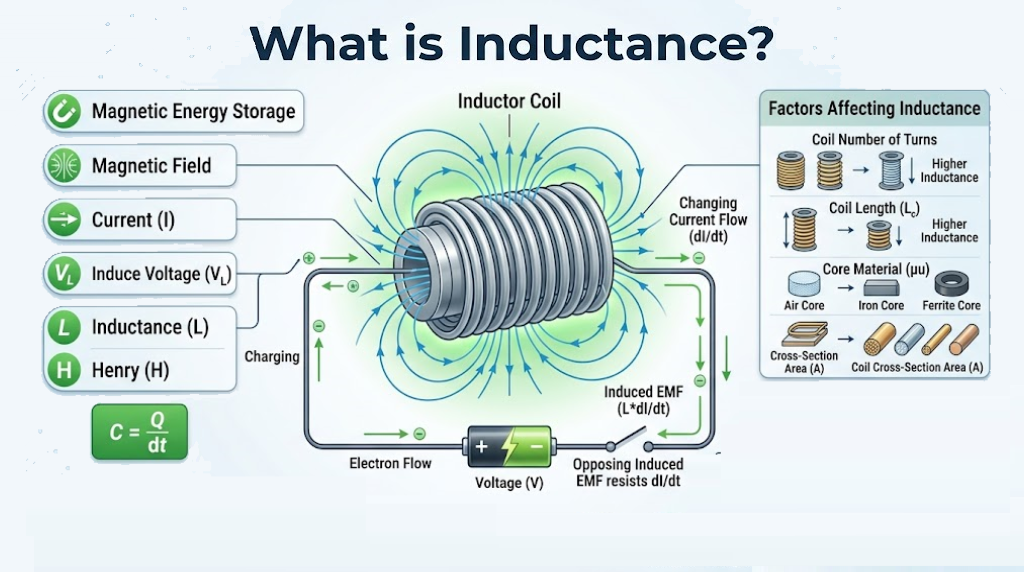
Inductance is the property of an electrical conductor or coil that opposes changes in electric current by producing an induced electromotive force (EMF). According to Faraday’s Law of Electromagnetic Induction, a changing magnetic field induces a voltage in a conductor. This induced voltage always acts in a direction that opposes the change in current, as stated by Lenz’s Law.
The mathematical expression for inductance is:
V = L (di/dt)
Where:
- V = Induced voltage (volts)
- L = Inductance (henry)
- di/dt = Rate of change of current with respect to time
This equation shows that the induced voltage is directly proportional to both the inductance and the rate at which the current changes.
Principle of Inductance
Whenever electric current flows through a conductor, it creates a magnetic field around it. If the current remains constant, the magnetic field also remains constant. However, if the current increases or decreases, the magnetic field changes accordingly. This changing magnetic field induces a voltage in the conductor itself or in a nearby conductor.
The induced voltage always opposes the change in current. For example, if the current increases rapidly, the induced voltage acts against the increase. Similarly, when the current decreases, the induced voltage attempts to maintain the current flow. This opposition to current change is the fundamental principle of inductance.
The ability of a conductor or coil to produce this opposing voltage determines its inductance.
Unit of Inductance
The SI unit of inductance is the henry (H).
One henry is defined as the inductance of a conductor in which a current changing at the rate of one ampere per second induces an electromotive force of one volt.
In practical applications, smaller units are often used:
- 1 millihenry (mH) = 0.001 H
- 1 microhenry (µH) = 0.000001 H
Large electrical machines and transformers often have inductance values measured in henries, while electronic circuits usually use millihenries or microhenries.
Types of Inductance
Inductance is generally classified into two main types.
1. Self-Inductance
Self-inductance is the property of a coil in which a change in current flowing through the coil induces a voltage within the same coil. The induced voltage opposes the change in current.
For example, when the current through an electromagnet changes, the coil produces an opposing voltage due to self-inductance.
2. Mutual Inductance
Mutual inductance occurs when two coils are placed close together. A changing current in one coil produces a changing magnetic field, which induces a voltage in the second coil.
Mutual inductance is the working principle of transformers, wireless charging systems, and many communication devices.
Factors Affecting Inductance
Several factors influence the value of inductance.
Number of Turns
The inductance increases with the square of the number of turns in a coil. More turns create a stronger magnetic field, resulting in greater inductance.
Core Material
A coil wound around an iron or ferrite core has much higher inductance than one wound around an air core because magnetic materials concentrate magnetic flux.
Cross-Sectional Area
A larger cross-sectional area allows more magnetic flux to pass through the coil, increasing inductance.
Length of the Coil
A longer coil generally has lower inductance because the magnetic field spreads over a greater distance.
Permeability of the Material
Materials with higher magnetic permeability produce stronger magnetic fields, increasing inductance.
Inductor
An inductor is an electrical component specifically designed to provide inductance. It usually consists of insulated wire wound into a coil. Some inductors contain magnetic cores made of iron or ferrite to increase their inductance.
When alternating current flows through an inductor, it stores energy in its magnetic field. When the current decreases, the stored energy is released back into the circuit.
Inductors are available in different shapes and sizes depending on their application, such as air-core inductors, iron-core inductors, ferrite-core inductors, and toroidal inductors.
Energy Stored in an Inductor
An inductor stores energy in the magnetic field created by current flowing through it.
The energy stored is given by the equation:
Energy = ½LI²
Where:
- L = Inductance (henry)
- I = Current (ampere)
This stored energy is useful in many electronic circuits, including power supplies and energy conversion systems.
Applications of Inductance
Inductance has numerous practical applications in electrical and electronic engineering.
Transformers
Transformers operate on the principle of mutual inductance to transfer electrical energy between two coils.
Electric Motors
Electric motors use inductance to generate rotating magnetic fields that produce mechanical motion.
Generators
Generators convert mechanical energy into electrical energy using electromagnetic induction.
Filters
Inductors are used in electronic filters to block high-frequency signals while allowing low-frequency signals to pass.
Power Supplies
Inductors smooth the output voltage of switching power supplies and reduce electrical noise.
Radio and Communication Systems
Inductance is used in tuning circuits that select specific radio frequencies.
Electromagnetic Relays
Relays use coils with inductance to operate switches electrically.
Wireless Charging
Wireless charging systems use mutual inductance to transfer energy without direct electrical contact.
Sensors
Many sensors rely on inductive principles for detecting metal objects and measuring position.
Advantages of Inductance
Inductance offers several important advantages:
- Stores energy efficiently in a magnetic field.
- Reduces sudden changes in current.
- Filters unwanted electrical noise.
- Improves power supply performance.
- Enables wireless power transfer.
- Essential for transformers and electrical machines.
- Increases circuit stability.
- Provides electrical isolation in transformer circuits.
Disadvantages of Inductance
Despite its advantages, inductance also has some limitations:
- Inductors can be bulky and heavy.
- High inductance components are often expensive.
- Energy losses occur due to resistance in the coil.
- Magnetic cores may become saturated at high currents.
- Inductors can generate electromagnetic interference.
- Large inductors occupy significant circuit space.
Importance of Inductance
Inductance is essential in modern electrical and electronic systems. Without inductance, devices such as transformers, motors, generators, communication equipment, and power converters would not function efficiently. It allows electrical energy to be transferred, stored, filtered, and controlled effectively.
In renewable energy systems, electric vehicles, industrial automation, robotics, and wireless communication, inductance continues to play a major role. Engineers carefully design inductors to achieve the desired performance while minimizing losses and improving efficiency.
Conclusion
Inductance is a fundamental electrical property that enables conductors and coils to oppose changes in electric current through electromagnetic induction. It results from the interaction between electric current and magnetic fields and is measured in henries. Self-inductance and mutual inductance are the two primary types, both of which are widely used in electrical and electronic systems.
Inductance is essential in transformers, motors, generators, filters, communication equipment, wireless charging, and power electronics. By storing energy in magnetic fields and controlling current changes, inductance contributes significantly to the safe, efficient, and reliable operation of modern electrical technology. A thorough understanding of inductance provides a strong foundation for studying advanced topics in electrical engineering and electromagnetic systems.