Resistance is one of the most important concepts in electricity and electronics. It is the property of a material that opposes or restricts the flow of electric current through it. Every electrical device, from a small flashlight to a large industrial machine, contains components that offer some amount of resistance. Understanding resistance is essential for studying electrical circuits, designing electronic devices, and ensuring the safe operation of electrical systems.
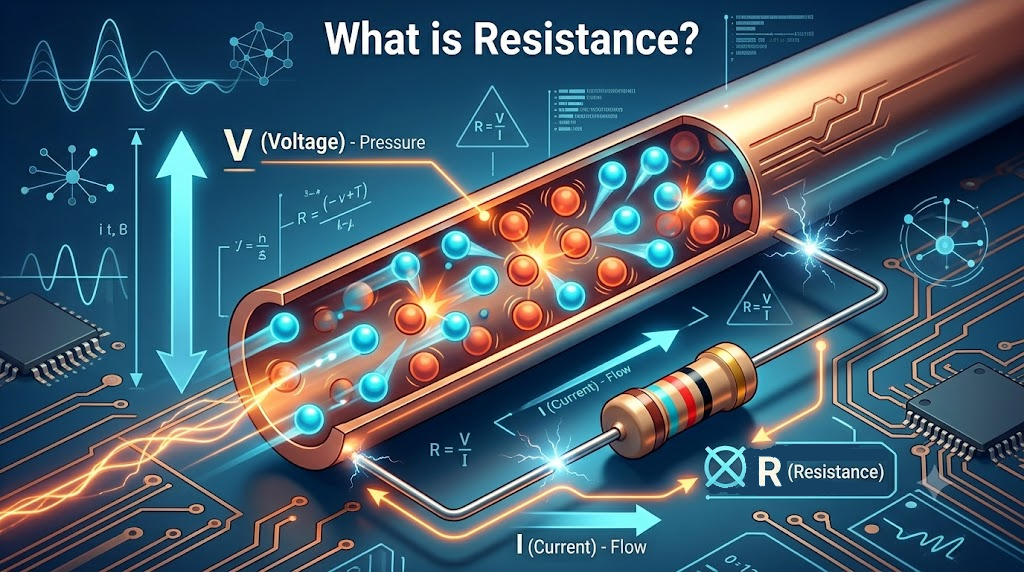
When an electric current flows through a conductor, the electrons move through the material. During this movement, they collide with atoms and other particles within the conductor. These collisions slow down the movement of electrons and create opposition to the flow of current. This opposition is known as electrical resistance.
Resistance is measured in a unit called the ohm (Ω), named after the German physicist Georg Simon Ohm, who developed the fundamental laws relating voltage, current, and resistance.
Definition of Resistance
Electrical resistance can be defined as the property of a conductor that opposes the flow of electric current. In simple words, it determines how difficult it is for electricity to pass through a material.
A material with high resistance allows only a small amount of current to flow, while a material with low resistance allows a larger amount of current to flow. For example, rubber and glass have very high resistance and are called insulators, whereas copper and aluminum have very low resistance and are called conductors.
The relationship between voltage, current, and resistance is explained by Ohm’s Law.
According to Ohm’s Law, the current flowing through a conductor is directly proportional to the voltage applied across it and inversely proportional to its resistance.
This means:
- Increasing voltage increases current.
- Increasing resistance decreases current.
- Decreasing resistance increases current.
Factors Affecting Resistance
Several factors influence the resistance of a conductor:
1. Length of the Conductor
The resistance of a conductor increases with its length. A longer wire provides more obstacles for electrons to pass through, resulting in greater resistance.
For example, a 10-meter copper wire has more resistance than a 5-meter copper wire of the same thickness.
2. Cross-Sectional Area
The resistance of a conductor decreases as its cross-sectional area increases. A thicker wire provides more space for electrons to move, reducing opposition to current flow.
For example, a thick copper cable has less resistance than a thin copper wire of the same length.
3. Material of the Conductor
Different materials have different resistivities. Resistivity is a measure of how strongly a material opposes electric current.
Examples:
- Silver has very low resistance.
- Copper has low resistance and is commonly used in wiring.
- Iron has higher resistance than copper.
- Rubber has extremely high resistance.
4. Temperature
For most metallic conductors, resistance increases with temperature. As temperature rises, atoms vibrate more vigorously, causing more collisions with electrons.
However, some materials such as semiconductors show a decrease in resistance when temperature increases.
Types of Resistance
Resistance can be classified into different types based on the nature of the material and application.
Fixed Resistance
Fixed resistors have a constant resistance value that does not change under normal operating conditions. They are widely used in electronic circuits.
Examples:
- Carbon resistors
- Metal film resistors
- Wire-wound resistors
Variable Resistance
Variable resistors allow the resistance value to be adjusted manually.
Examples:
- Potentiometers
- Rheostats
These are commonly used in volume controls, light dimmers, and laboratory equipment.
Thermistors
Thermistors are resistors whose resistance changes significantly with temperature.
Applications:
- Temperature sensors
- Electronic thermometers
- Protection circuits
Photoresistors
Photoresistors change their resistance according to the intensity of light falling on them.
Applications:
- Automatic street lights
- Camera exposure controls
- Light-sensitive devices
Importance of Resistance
Resistance plays a vital role in electrical and electronic systems. Some of its important functions are:
Controlling Current
Resistance limits the amount of current flowing through a circuit. Without resistance, excessive current could damage electrical devices.
Producing Heat
Many appliances use resistance to generate heat.
Examples:
- Electric heaters
- Toasters
- Electric irons
- Water heaters
In these devices, electrical energy is converted into heat energy through resistance.
Voltage Division
Resistors can divide voltage in a circuit, allowing different components to receive the required voltage levels.
Protecting Components
Resistance helps protect sensitive electronic components from excessive current and voltage.
Applications of Resistance
Resistance has numerous practical applications in everyday life.
Household Appliances
Many household appliances depend on resistance for proper operation. Heating elements in irons, kettles, and heaters use resistive materials to produce heat.
Electronic Circuits
Resistors are essential components in electronic devices such as:
- Computers
- Televisions
- Radios
- Mobile phones
They regulate current and voltage within the circuit.
Industrial Equipment
Factories and industries use resistors in control systems, motors, and automation equipment to ensure efficient operation.
Measurement Instruments
Resistance is used in instruments such as:
- Ammeters
- Voltmeters
- Multimeters
These instruments help measure electrical quantities accurately.
Advantages of Resistance
Resistance offers several benefits:
- Controls the flow of electric current.
- Protects electrical devices from damage.
- Enables efficient circuit design.
- Helps convert electrical energy into heat when required.
- Supports accurate measurement and control in electronic systems.
Disadvantages of Resistance
Although resistance is useful, it also has some disadvantages:
- Causes energy loss in the form of heat.
- Reduces circuit efficiency.
- Excessive resistance can limit device performance.
- High resistance in power transmission lines results in power loss.
Engineers therefore aim to minimize unwanted resistance while utilizing useful resistance where necessary.
Conclusion
Resistance is the property of a material that opposes the flow of electric current. It is measured in ohms and plays a crucial role in controlling current, protecting electronic components, generating heat, and ensuring the safe operation of electrical systems. The resistance of a conductor depends on factors such as length, cross-sectional area, material, and temperature. From household appliances to advanced electronic devices, resistance is an essential concept that forms the foundation of electrical and electronic engineering. Understanding resistance helps us design efficient circuits, improve energy usage, and develop reliable electrical technologies.