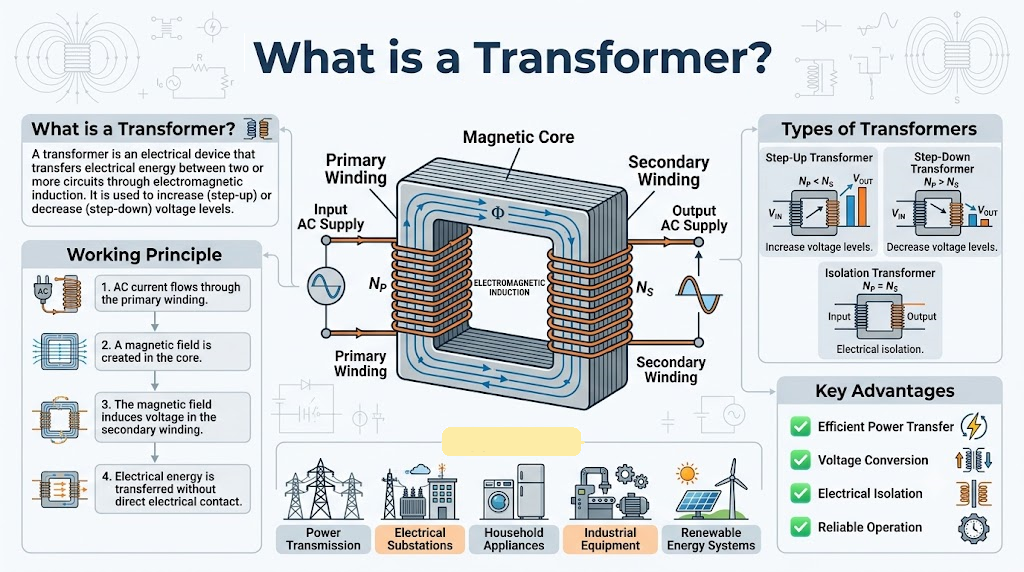
A transformer is a static electrical device that transfers electrical energy from one circuit to another through electromagnetic induction. It changes the voltage level of alternating current (AC) power without changing its frequency.
Transformers are essential components in electrical power systems because they allow electricity to be transmitted efficiently over long distances and delivered safely to homes, industries, and commercial buildings.
Key Features
- Operates on AC supply only
- Transfers energy through magnetic induction
- No moving parts
- High efficiency (up to 98–99%)
- Used for voltage conversion
Basic Structure
- Primary Winding
- Magnetic Core
- Secondary Winding
Illustration: Large labeled transformer diagram showing primary coil, magnetic core, and secondary coil.
Page 2: Working Principle of Transformer
How Does a Transformer Work?
A transformer works on the principle of electromagnetic induction discovered by Michael Faraday.
Step-by-Step Process
- Alternating current flows through the primary winding.
- A changing magnetic field is produced in the iron core.
- The magnetic field links both windings.
- Voltage is induced in the secondary winding.
- Electrical energy is transferred from primary to secondary circuit.
Transformer Equation
Vp / Vs = Np / Ns
Where:
- Vp = Primary Voltage
- Vs = Secondary Voltage
- Np = Number of Primary Turns
- Ns = Number of Secondary Turns
Types Based on Voltage Change
Step-Up Transformer
- Increases voltage
- Secondary turns > Primary turns
Step-Down Transformer
- Decreases voltage
- Secondary turns < Primary turns
Illustration: Energy flow diagram showing magnetic flux and voltage transformation.
Page 3: Types and Applications of Transformers
Common Types of Transformers
Power Transformer
Used in generating stations and transmission networks.
Distribution Transformer
Supplies electricity to homes and businesses.
Isolation Transformer
Provides electrical isolation between circuits.
Instrument Transformer
Used for measurement and protection systems.
Auto Transformer
Uses a single winding for both primary and secondary functions.
Applications
Power Systems
Voltage transmission and distribution.
Industries
Operating heavy machinery and equipment.
Homes
Adapters, chargers, and appliances.
Renewable Energy
Solar and wind power systems.
Electronics
Power supplies and communication devices.
Illustration: Icons representing power plants, industries, homes, solar panels, and electronic devices.
Page 4: Advantages, Disadvantages, and Importance
Advantages
✅ High efficiency
✅ Reliable operation
✅ No moving parts
✅ Low maintenance
✅ Safe voltage conversion
✅ Electrical isolation
Disadvantages
❌ Works only with AC
❌ Large transformers are bulky
❌ Core losses and copper losses occur
❌ Cost increases with capacity
Importance in Modern Life
Transformers make modern electrical power systems possible. Without transformers, efficient long-distance transmission of electricity would be impossible. They ensure that power generated at power plants can be safely delivered to industries, offices, schools, hospitals, and homes at suitable voltage levels.
Conclusion
A transformer is one of the most important devices in electrical engineering. By using electromagnetic induction, it efficiently transfers electrical energy and changes voltage levels, making power generation, transmission, and distribution practical and economical.
Final Visual: Modern power grid showing generation, transmission, substation transformer, and household electricity supply.