
11 Types of Sensors in Electronics: Working and Uses
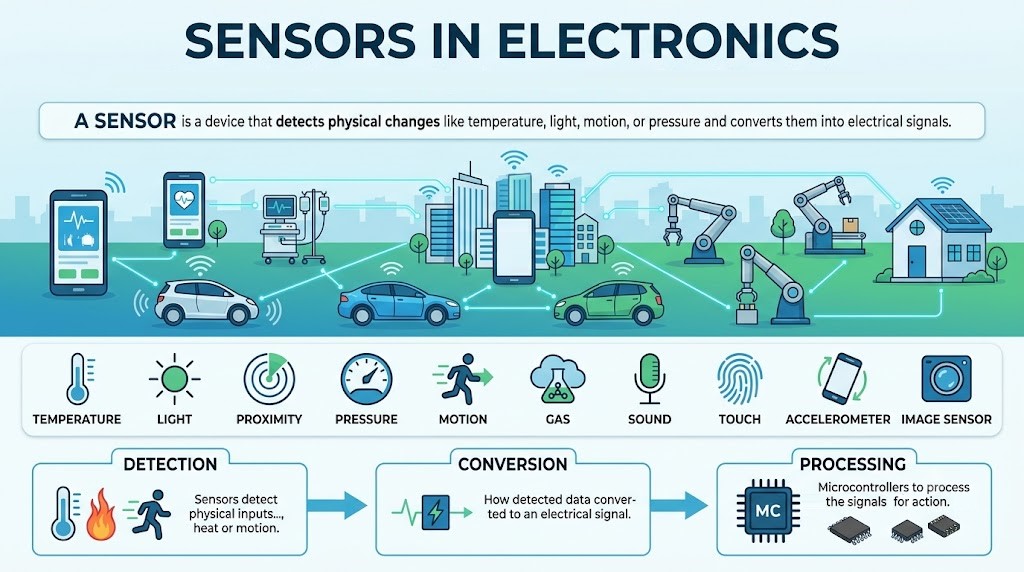
Sensors turn physical conditions into signals that an electronic system can measure. A controller can then display the measurement, record it or operate an actuator. The sensor, signal conditioning, conversion and software all contribute to the accuracy of the final result.
Contents
11 types of sensors in electronics
| Type | What it measures | Typical principle and use |
|---|---|---|
| Temperature | Temperature, not heat flow directly | Thermistors and RTDs change resistance; thermocouples generate a voltage related to a temperature difference; IC sensors provide conditioned outputs |
| Light | Light level or optical radiation in a specified range | Photodiodes generate photocurrent; LDR resistance changes with illumination; used in light meters and brightness control |
| Proximity | Presence or distance of nearby objects | Inductive, capacitive, optical and ultrasonic methods suit different targets |
| Pressure | Force per unit area | Common designs sense diaphragm deformation electrically; used for fluid pressure and barometric measurements |
| Motion | Movement within a sensing region | PIR detects changing received infrared patterns; microwave and ultrasonic designs use different physical mechanisms |
| Humidity | Relative humidity or another specified moisture quantity | Common sensing elements change capacitance or resistance; useful in HVAC and environmental monitoring |
| Gas | Presence or concentration of specified gases | Metal-oxide, electrochemical, optical and other methods; select by the actual gas and range |
| Sound | Acoustic pressure variations | Microphones convert sound into electrical signals for audio recording and acoustic measurement |
| Acceleration | Acceleration along specified axes | MEMS accelerometers often measure displacement of a small proof mass; used in orientation and motion systems |
| Touch | Contact or proximity associated with a user action | Capacitive or resistive sensing supports buttons, panels and touchscreens |
| Image | Spatial distribution of light | CMOS and CCD arrays convert light into electrical charge, followed by readout and processing |
Ultrasonic sensing uses sound
An ultrasonic distance sensor transmits sound and measures the return from a target. It does not use infrared or an electromagnetic field. In a simple round-trip timing model, d = ct/2, where c is sound speed and t is round-trip travel time. Using 343 m/s as an illustrative air sound speed and 2 ms travel time gives d ≈ 0.343 m. Temperature, target shape, air conditions and the sensor’s minimum range affect the result.
Temperature and motion need careful wording
A temperature sensor measures temperature; heat is energy transferred because of a temperature difference. A thermocouple needs suitable reference-junction compensation to infer the desired temperature.
An accelerometer is not a universal speed or position sensor. Its reading depends on orientation and motion, and estimating velocity or position by integration introduces drift. A PIR sensor usually detects changes in infrared patterns rather than continuously measuring the presence of a stationary person.
Analog, digital, active and passive
Analog outputs can be voltage, current or resistance and may need conditioning before an ADC. A digital sensor can include conversion and provide readings through an interface such as I²C or SPI. “Digital” does not automatically mean more accurate.
The words active and passive have different conventions. In one instrumentation convention, a self-generating transducer such as a thermocouple is called active, while an externally excited resistive element is passive. In remote sensing, active means transmitting energy toward a target, as radar does, while passive means detecting existing radiation. State the convention instead of presenting external-power requirement as a universal definition.
From measurement to action
- The sensing element responds to a physical quantity.
- Conditioning circuitry scales, filters or amplifies the response as needed.
- An ADC or digital interface makes the signal available to the controller.
- Software applies calibration, checks validity and decides on an action.
- A suitable output stage drives a display, alarm or actuator.
For a fan controller, use a temperature sensor, defined on/off thresholds and an appropriate motor driver. Include hysteresis so small fluctuations do not repeatedly switch the fan. A failed or disconnected sensor should have a defined response.
Choosing a sensor and interpreting its limits
- Match the measured quantity, range, resolution, accuracy and response time.
- Check supply voltage, output levels, interface timing and required conditioning.
- Allow for temperature drift, calibration, noise, aging and cross-sensitivity.
- Check mounting, environmental protection, target material and operating conditions.
- Distinguish measurement resolution from accuracy: extra digits do not prove a more accurate measurement.
A generic gas-sensor module is not automatically a certified life-safety alarm. Safety applications need equipment and validation appropriate to the hazard. Many gas sensors respond to more than one gas, and calibration and environmental conditions matter.
Frequently asked questions
Can every sensor connect directly to a microcontroller?
No. Some require excitation, amplification, filtering, conversion or level shifting.
Does a sensor always produce digital data internally?
No. Many sensing elements first produce an analog electrical response. The module may add conversion and a digital interface.
What makes a measurement trustworthy?
A suitable sensor, correct installation, calibration, uncertainty assessment and validation under the actual operating conditions.

Comments
Comments are currently closed.