Electronic circuits are the foundation of modern technology. They are found in smartphones, computers, televisions, medical devices, automobiles, and even household appliances. Every time you turn on a device, an electronic circuit is working behind the scenes to perform a specific task. Understanding how electronic circuits work is an important step for anyone interested in electronics, engineering, or technology.
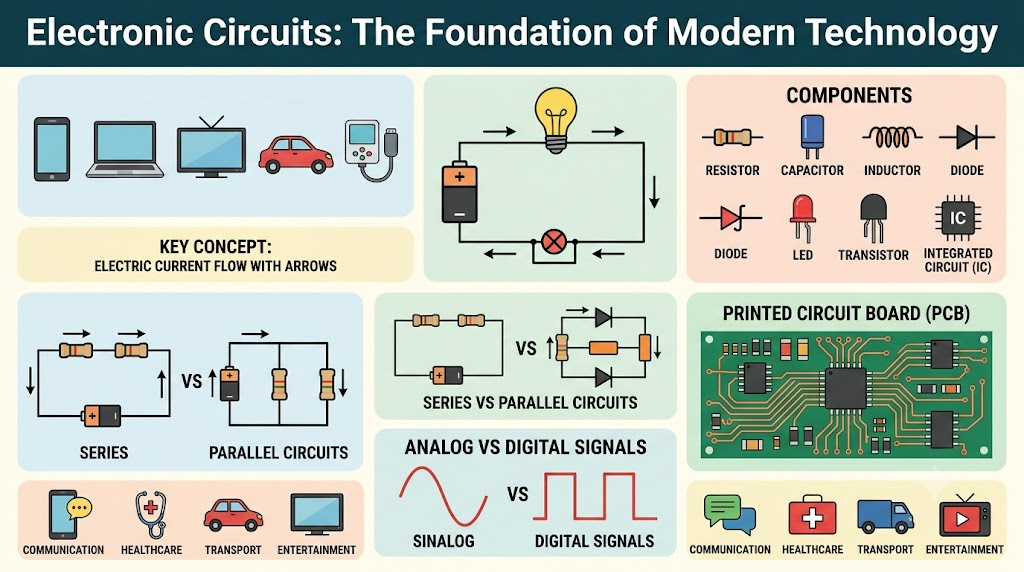
An electronic circuit is a path through which electric current flows. It consists of different electronic components connected together to control, direct, and use electrical energy. These components work as a team to perform useful functions such as lighting a bulb, amplifying sound, processing information, or sending signals.
This article explains the basic principles of electronic circuits in a simple and learner-friendly way.
What Is an Electronic Circuit?
An electronic circuit is a complete loop that allows electric current to travel from a power source, through various electronic components, and back to the source. If the path is broken, the current cannot flow, and the circuit will stop working.
A simple circuit contains three main parts:
- Power Source – Provides electrical energy. Examples include batteries and power supplies.
- Conductors – Usually wires that carry electric current.
- Load – A device that uses electrical energy, such as a light bulb, motor, or speaker.
For example, when a battery is connected to a light bulb using wires, current flows through the bulb’s filament. The filament heats up and produces light. This is one of the simplest electronic circuits.
Understanding Electric Current
To understand circuits, it is important to know what electric current is.
Electric current is the flow of tiny charged particles called electrons through a conductor. These electrons move because of a difference in electrical potential, commonly known as voltage.
Think of electricity like water flowing through a pipe:
- Voltage is similar to water pressure.
- Current is similar to the amount of water flowing.
- Resistance is similar to obstacles that restrict water flow.
When voltage pushes electrons through a circuit, current is created. The amount of current depends on the voltage and the resistance in the circuit.
One of the most important rules in electronics is Ohm’s Law:
This law helps engineers calculate how much current will flow in a circuit.
Basic Components of Electronic Circuits
Electronic circuits are built using various components. Each component performs a specific function.
1. Resistors
Resistors limit the flow of electric current. They protect components from receiving too much current and help control voltage levels.
For example, an LED can burn out if too much current flows through it. A resistor is often connected in series with the LED to prevent damage.
Common uses of resistors include:
- Limiting current
- Dividing voltage
- Controlling signal levels
2. Capacitors
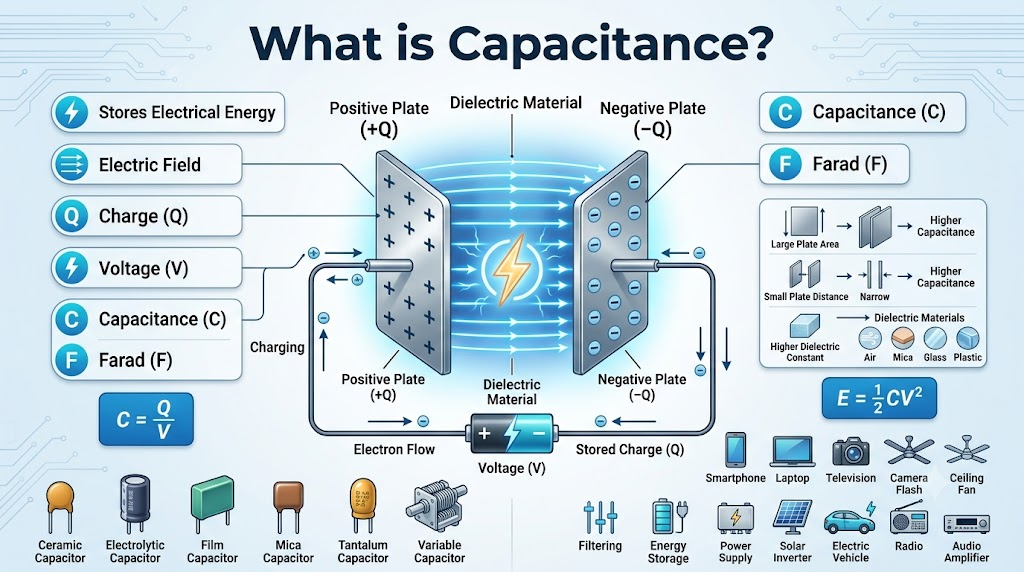
Capacitors store electrical energy temporarily and release it when needed.
A capacitor consists of two conductive plates separated by an insulating material. When voltage is applied, electrical charge accumulates on the plates.
Capacitors are used for:
- Energy storage
- Filtering unwanted signals
- Smoothing power supplies
- Timing circuits
For example, in a power supply, capacitors help reduce fluctuations in voltage and provide a more stable output.
3. Inductors
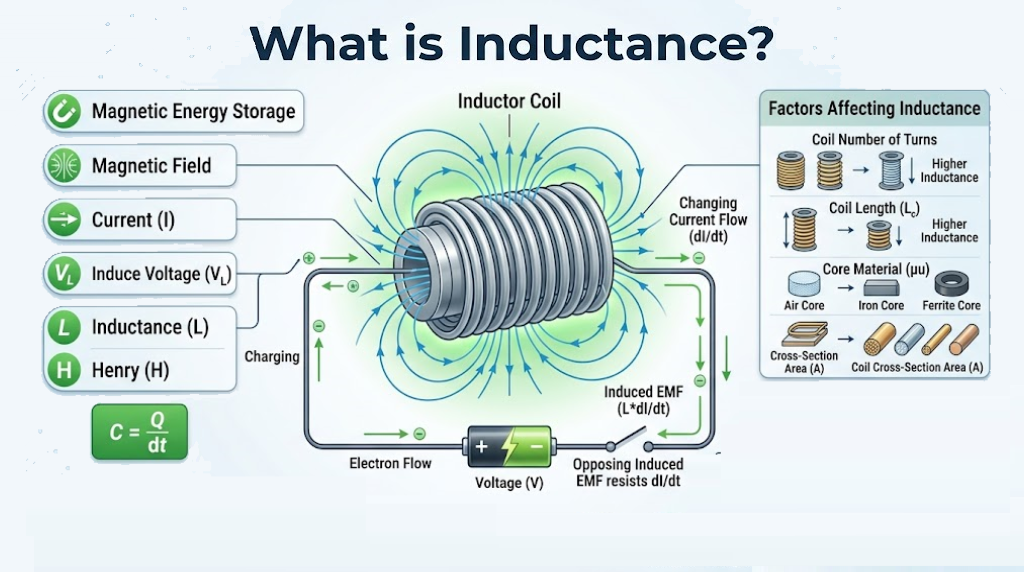
Inductors store energy in a magnetic field when current flows through them. They are usually made from coils of wire.
Inductors are used in:
- Filters
- Transformers
- Power supplies
- Radio-frequency circuits
They help control changes in current and are important in many communication systems.
4. Diodes
A diode allows current to flow in only one direction. It acts like a one-way gate for electricity.
Diodes are commonly used for:
- Converting AC to DC
- Protecting circuits from reverse polarity
- Signal detection
A special type of diode called an LED (Light Emitting Diode) produces light when current flows through it.
5. Transistors
Transistors are among the most important electronic components ever invented.
A transistor can:
- Act as a switch
- Amplify signals
- Control current flow
Modern computers contain billions of transistors working together. They form the basis of digital electronics and microprocessors.
6. Integrated Circuits (ICs)
Integrated circuits contain many electronic components built onto a single semiconductor chip.
Examples include:
- Microprocessors
- Memory chips
- Operational amplifiers
- Digital logic circuits
ICs make electronic devices smaller, faster, and more reliable.
How Current Flows Through a Circuit
When a power source is connected to a closed circuit, electrons begin moving through the conductors.
The process works as follows:
- The battery creates a voltage difference.
- This voltage pushes electrons through the wires.
- Current flows through components such as resistors and LEDs.
- Components perform their intended functions.
- Electrons return to the power source, completing the loop.
If a switch opens the circuit, the path becomes incomplete and current stops flowing.
This simple principle applies to both basic and highly complex circuits.
Series and Parallel Circuits
Electronic components can be connected in different ways.
Series Circuits
In a series circuit, components are connected one after another in a single path.
Characteristics:
- Same current flows through all components.
- If one component fails, the entire circuit stops working.
- Total resistance increases as more resistors are added.
A string of old holiday lights is an example of a series circuit.
Parallel Circuits
In a parallel circuit, components are connected across multiple paths.
Characteristics:
- Voltage is the same across each branch.
- Current divides among the branches.
- Failure of one branch usually does not affect the others.
Most household electrical systems use parallel connections because devices can operate independently.
For resistors in series:
For resistors in parallel:
Analog and Digital Circuits
Electronic circuits can be classified into two major categories.
Analog Circuits
Analog circuits process continuously varying signals.
Examples include:
- Radio receivers
- Audio amplifiers
- Temperature sensors
In analog systems, voltage can take any value within a certain range.
Digital Circuits
Digital circuits process information using two states:
- 0 (LOW)
- 1 (HIGH)
Computers, smartphones, and calculators use digital circuits.
Digital electronics is based on logic gates such as:
- AND
- OR
- NOT
- NAND
- NOR
These gates combine to perform calculations and process information.
Printed Circuit Boards (PCBs)
Most modern circuits are built on Printed Circuit Boards (PCBs).
A PCB is a flat board containing copper pathways that connect components.
Advantages of PCBs include:
- Compact design
- Reliable connections
- Easier manufacturing
- Better organization
When you open a smartphone or computer, the green board covered with components is usually a PCB.
How Circuits Perform Complex Tasks
Simple circuits can light a bulb, but modern electronic systems perform much more advanced operations.
A smartphone, for example, contains many interconnected circuits that:
- Process data
- Store information
- Control displays
- Manage wireless communication
- Capture images
- Play audio
Each circuit performs a specific function. Together, they create a powerful electronic device capable of handling millions of operations every second.
Engineers design these circuits carefully to ensure efficiency, speed, and reliability.
Importance of Electronic Circuits
Electronic circuits have transformed modern society. They are essential in:
- Communication systems
- Healthcare equipment
- Transportation
- Entertainment devices
- Industrial automation
- Scientific research
Without electronic circuits, modern computers, the internet, and mobile communication would not exist.
As technology advances, circuits continue to become smaller, faster, and more energy-efficient.
Conclusion
Electronic circuits are systems that control the flow of electrical current to perform useful tasks. They consist of components such as resistors, capacitors, diodes, transistors, and integrated circuits connected together in a complete path. Electricity flows through these components, allowing devices to operate.
By understanding basic concepts such as current, voltage, resistance, series circuits, and parallel circuits, learners can build a strong foundation in electronics. Although modern circuits can be extremely complex, they all follow the same fundamental principle: controlling electrical energy to achieve a desired function.
Learning how electronic circuits work opens the door to understanding the technology that powers our modern world and provides a foundation for future studies in electronics, engineering, and computer science.