Introduction
In the modern digital world, electronic devices have become smaller, faster, and more powerful. From smartphones and laptops to satellites and medical devices, all these systems rely on highly integrated circuits. The technology behind these compact and powerful chips is known as VLSI Design.
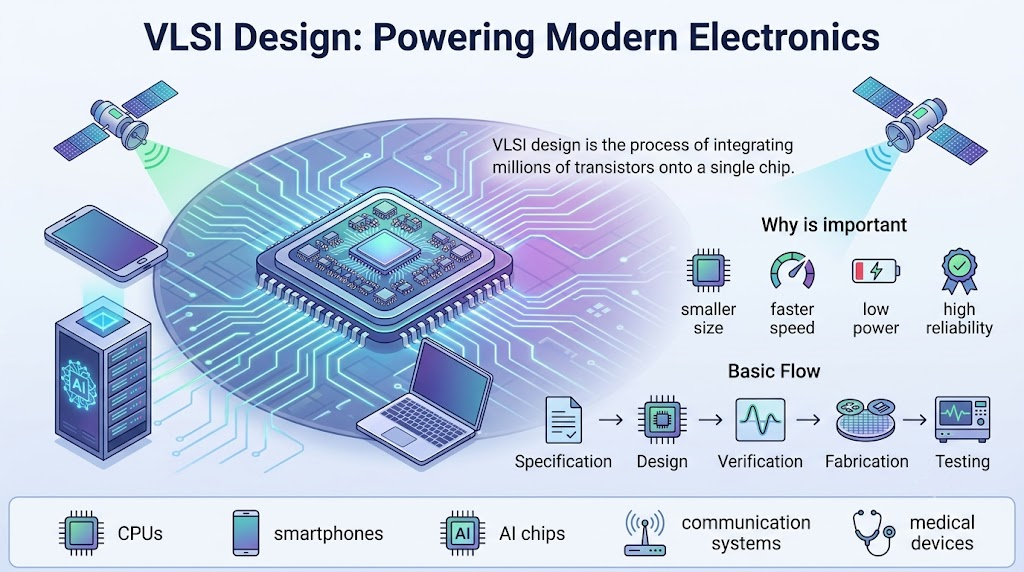
VLSI (Very Large Scale Integration) is a process in which thousands, millions, or even billions of transistors are integrated onto a single silicon chip to create complex electronic circuits. It is one of the most important fields in semiconductor and electronics engineering.
VLSI design has enabled the development of microprocessors, microcontrollers, memory chips, and system-on-chip (SoC) devices that power modern computing systems.
This guide explains what VLSI design is, its design flow, key concepts, applications, and career opportunities in a simple and structured way.
What is VLSI Design?
VLSI Design is the process of creating integrated circuits (ICs) by combining a large number of electronic components—mainly transistors—onto a single chip.
Simple Definition:
VLSI design is the technology of designing very complex integrated circuits by integrating millions of transistors on a single semiconductor chip.
Why is VLSI Important?
VLSI technology is important because it:
- Reduces the size of electronic systems
- Increases processing speed
- Reduces power consumption
- Improves reliability
- Enables complex system design on a single chip
- Supports modern computing and communication devices
Without VLSI, modern smartphones, computers, and IoT devices would not exist in their current form.
Evolution of VLSI Technology
VLSI is part of the evolution of integrated circuits:
- SSI (Small Scale Integration): Few transistors
- MSI (Medium Scale Integration): Hundreds of transistors
- LSI (Large Scale Integration): Thousands of transistors
- VLSI (Very Large Scale Integration): Millions of transistors
- ULSI (Ultra Large Scale Integration): Billions of transistors
Today’s advanced processors fall under VLSI and ULSI categories.
Basic Components of VLSI Systems
VLSI chips contain various components such as:
1. Transistors
- Basic building blocks of VLSI
- Used for switching and amplification
- MOSFETs are most commonly used
2. Logic Gates
- AND, OR, NOT, NAND, NOR
- Used to perform logical operations
3. Memory Elements
- SRAM, DRAM, Flash memory
- Store data and instructions
4. Interconnects
- Metal layers that connect components
- Ensure communication between transistors
5. System Blocks
- ALU (Arithmetic Logic Unit)
- Control Unit
- Registers
- Cache memory
VLSI Design Flow
VLSI design follows a structured flow from idea to final chip manufacturing.
1. Specification
In this stage:
- System requirements are defined
- Performance, power, and area constraints are set
- Design goals are established
2. Architecture Design
- Overall system structure is planned
- Functional blocks are identified
- Data flow and control flow are defined
Example: CPU design includes ALU, registers, cache, etc.
3. RTL Design (Register Transfer Level)
- Design is written using hardware description languages like Verilog or VHDL
- Describes how data moves between registers
- Defines logic behavior of the circuit
4. Functional Verification
- Ensures design works correctly
- Simulations are performed
- Bugs are identified and fixed
This is one of the most critical steps in VLSI.
5. Logic Synthesis
- RTL code is converted into gate-level netlist
- Uses standard logic gates
- Optimizes for speed, area, and power
6. Physical Design
This stage converts logical design into physical layout.
Includes:
- Floor planning
- Placement of components
- Routing of interconnections
7. Fabrication
- Final design is sent to fabrication plant (fab)
- Silicon wafer is manufactured
- Integrated circuits are created
8. Testing and Packaging
- Chips are tested for defects
- Functional and performance tests are performed
- Chips are packaged for use in devices
Tools Used in VLSI Design
Some commonly used tools include:
- Cadence Design Systems
- Synopsys Design Tools
- Mentor Graphics (Siemens EDA)
- Xilinx Vivado
- ModelSim
These tools help in simulation, synthesis, verification, and layout design.
Applications of VLSI Design
VLSI technology is used in almost every modern electronic system.
1. Microprocessors and CPUs
- Intel and AMD processors
- ARM-based processors
- Used in computers and servers
2. Mobile Devices
- Smartphones
- Tablets
- Smartwatches
VLSI enables compact and powerful mobile chips.
3. Communication Systems
- Routers
- Modems
- 5G systems
- Satellite communication
4. Consumer Electronics
- Smart TVs
- Gaming consoles
- Digital cameras
5. Automotive Systems
- Engine control units (ECU)
- Autonomous driving systems
- Infotainment systems
6. Medical Electronics
- MRI machines
- CT scanners
- Wearable health monitors
7. Industrial Automation
- Robotics
- Control systems
- Smart manufacturing
8. Artificial Intelligence Systems
- AI accelerators
- Machine learning chips
- GPUs and TPUs
Career Scope in VLSI Design
VLSI is one of the most in-demand fields in electronics and semiconductor industry.
1. Job Roles in VLSI Industry
Design Roles:
- RTL Design Engineer
- Digital Design Engineer
- ASIC Designer
Verification Roles:
- Verification Engineer
- Functional Test Engineer
Physical Design Roles:
- Physical Design Engineer
- Layout Engineer
Other Roles:
- FPGA Engineer
- DFT Engineer (Design for Testability)
- Embedded Hardware Engineer
2. Skills Required
To build a career in VLSI, students should learn:
- Digital electronics
- CMOS technology
- Verilog / VHDL
- C/C++ programming
- Computer architecture
- Semiconductor physics
- EDA tools
3. Educational Path
- B.E / B.Tech in Electronics or Electrical Engineering
- M.Tech in VLSI Design (optional but preferred)
- Specialized VLSI training programs
4. Salary and Growth
- Entry-level engineers: moderate to high salary
- Experienced engineers: very high salary
- Opportunities in global semiconductor companies
5. Top Companies in VLSI Field
- Intel
- AMD
- Qualcomm
- NVIDIA
- Broadcom
- Texas Instruments
- Samsung Semiconductor
Advantages of VLSI Technology
- Highly compact electronic systems
- Faster processing speeds
- Low power consumption
- High reliability
- Cost-effective mass production
Challenges in VLSI Design
- Very complex design process
- High development cost
- Requires advanced tools and skills
- Heat dissipation issues
- Design verification is time-consuming
Future of VLSI Design
The future of VLSI is very promising due to advancements in:
- Artificial Intelligence (AI) chips
- Quantum computing hardware
- IoT devices
- 5G and 6G communication systems
- Advanced microprocessors
As technology continues to grow, VLSI will remain the backbone of semiconductor innovation.
Conclusion
VLSI design is a key technology that enables the creation of modern integrated circuits by combining millions of transistors on a single chip. It plays a crucial role in developing microprocessors, memory chips, and advanced electronic systems used in every industry today.
With strong applications in computing, communication, automotive, healthcare, and AI systems, VLSI is one of the most important fields in electronics engineering.
It also offers excellent career opportunities for students interested in semiconductor design and digital electronics. As demand for faster and smaller devices increases, VLSI will continue to shape the future of technology.