
What Is Voltage? Meaning, Formula, and Examples
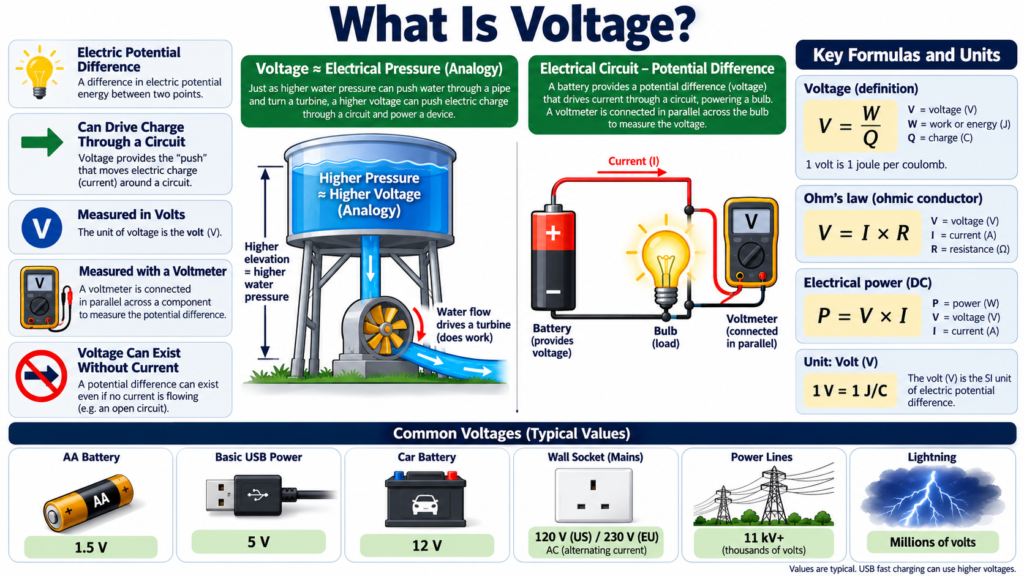
Voltage is the difference in electric potential between two points. It tells us how much energy can be transferred per unit charge as charge moves between those points. A 12 V battery has a nominal potential difference of 12 joules per coulomb between its terminals; how much current flows depends on the connected circuit.
That last distinction is essential. A battery can have voltage across its terminals while sitting on a shelf with no external circuit. Connect a suitable load, and energy can be transferred to that load. This article explains the meaning, units, formulas, polarity, and practical interpretation of voltage without treating it as a mysterious substance moving through wires.
What does voltage mean physically?
Electric potential is potential energy per unit charge at a point relative to a chosen reference. Voltage is a difference between two such potentials. If point A is at 9 V relative to a reference and point B is at 3 V relative to the same reference, A is 6 V above B.
The reference is a bookkeeping choice. Circuit diagrams often mark one node as ground and assign it zero potential. That node may be connected to protective earth, but a circuit reference and protective earth are not automatically the same thing. A battery-powered device can have a useful zero-volt reference without an earth connection.
It is therefore more precise to say that voltage exists across two points than to say a component contains voltage. An engineer asking for the voltage at a node usually means its potential relative to the selected reference. Naming the reference removes ambiguity and helps prevent sign errors.
Voltage formula and unit
For energy transferred per charge, the magnitude relationship is V = W/Q. Here W is energy in joules, Q is charge in coulombs, and V is potential difference in volts. One volt equals one joule per coulomb.
For signed electrostatic potential differences, the relationship is delta V = delta U/q, where delta U is the change in potential energy of charge q. Work done by the electric field has the opposite sign to that change. Introductory circuit calculations often use positive energy-transfer magnitudes, but signed energy questions require that distinction.
| Quantity | Symbol | Unit | Meaning |
|---|---|---|---|
| Potential difference | V | Volt | Energy per charge |
| Energy transferred | W | Joule | Amount of energy |
| Charge | Q | Coulomb | Electrical charge quantity |
| Current | I | Ampere | Charge flow per second |
Suppose 24 J of energy is transferred when 2 C passes through a load. The potential difference is 24/2 = 12 V. If another 2 C passes under the same conditions, another 24 J is transferred. The voltage remains 12 V; the total energy increases because more charge has passed.
Voltage versus current and resistance
Voltage, current, and resistance describe different features of a circuit. Current is the rate of charge flow through a cross-section. Resistance describes how strongly a resistive element opposes current under specified conditions. Voltage relates to energy per charge across two points.
For an ohmic resistor at constant physical conditions, V = IR. A 6 V potential difference across a 3 ohm resistor gives 2 A. A 12 V potential difference across the same resistor gives 4 A, provided heating does not change its resistance significantly and the source can supply that current.
The equation does not mean every device draws current in direct proportion to applied voltage. LEDs, batteries, motors, and regulated electronic devices have different relationships. A motor also develops an internal electromotive force while rotating, so treating it as a fixed resistor can give misleading results.
A water-pressure analogy can help: potential difference resembles a pressure difference, and current resembles flow rate. However, wires already contain mobile charges, and energy transfer involves electric and magnetic fields. The analogy is a starting point, not a complete physical model.
Why voltage can exist without current
An open switch interrupts a simple DC loop. Current falls to essentially zero after transients, but the source still maintains a potential difference across the open contacts. The absence of current does not mean the absence of electrical energy or a safe-to-touch condition.
A capacitor provides another example. After charging, an ideal capacitor connected to a DC source carries no steady conduction current through its dielectric, yet it retains voltage and stores energy. Real capacitors also have leakage and other nonideal behavior.
These examples explain why a voltmeter and an ammeter are connected differently. A voltmeter compares potential at two points and is designed with high input resistance. An ammeter measures current through a path and is placed in series with that path.
DC voltage and AC voltage
Ideal DC voltage has fixed polarity and constant magnitude. Real DC supplies may include ripple or changes with load, so DC does not always mean perfectly flat. A battery is a familiar DC source, although its terminal value changes with charge state and operating conditions.
AC voltage changes polarity over time. A sinusoidal waveform alternates smoothly between positive and negative values relative to its reference. Frequency describes how many complete cycles occur each second, while amplitude describes the size of the waveform.
For a pure sine wave, RMS voltage equals peak voltage divided by the square root of two. A 10 V RMS sine wave therefore has a peak magnitude of about 14.14 V. Peak-to-peak value is twice the peak magnitude for a waveform symmetric about zero.
RMS matters because it connects to heating in resistors. A sinusoidal AC supply and a DC supply with the same RMS value produce the same average heating in an identical ideal resistor. That equivalence does not mean AC and DC behave identically in capacitors, inductors, or electronic circuits.
Polarity, potential rise, and potential drop
If a meter’s red probe is on point A and its black probe is on B, the reading represents V_A minus V_B. A positive reading means A is at higher potential. A negative reading means the actual polarity is opposite to the assumed probe arrangement.
Across a passive resistor, conventional current enters the higher-potential terminal and leaves the lower-potential terminal. Moving in the current direction gives a potential drop. Moving from a battery’s negative terminal to its positive terminal through the ideal source gives a rise.
These signs become especially useful in Kirchhoff’s voltage law. Around a closed lumped circuit loop, source rises and element drops balance when induced effects are properly accounted for. Choosing a direction first and using it consistently is more reliable than trying to guess signs afterward.
A worked voltage-divider example
Connect two resistors, 2 kilohms and 4 kilohms, in series across an ideal 12 V DC source. The total resistance is 6 kilohms, so the current is 12/6000 = 0.002 A, or 2 mA. The same current passes through both resistors.
- Find the total series resistance: 2 kilohms plus 4 kilohms.
- Divide source voltage by total resistance to obtain 2 mA.
- Multiply 2 mA by 2 kilohms to get a 4 V drop.
- Multiply 2 mA by 4 kilohms to get an 8 V drop.
- Check that 4 V plus 8 V equals the 12 V source.
If a load is connected across the 4 kilohm resistor, it forms a parallel branch and changes the divider ratio. An unloaded voltage-divider formula cannot automatically be used after adding a substantial load. This is a common reason a calculated sensor signal differs from its measured value.
Measuring voltage in a beginner laboratory
For a supervised low-voltage DC exercise, select the meter’s voltage function and appropriate terminals. Connect the probes across the two points of interest. Start with a suitable range or use an appropriate autoranging meter, and record both magnitude and polarity.
- Use the voltage input terminal rather than the current input.
- Connect across the component, not in place of its conducting path.
- Identify the reference point before recording readings.
- Use equipment rated for the circuit being measured.
- Keep beginner experiments on current-limited training supplies.
Do not use household mains as a first measurement exercise. Meter category ratings, probe condition, installation conditions, and safe working procedures matter for higher-energy systems. For learning the concept, a simulator or supervised low-voltage trainer provides the relevant observations.
Frequently asked questions
Is voltage the same as electrical energy?
No. Voltage is energy per unit charge. Total energy also depends on how much charge passes, or equivalently on power integrated over time. A small battery and a large battery can have the same nominal potential difference but very different energy capacities.
Does higher voltage always mean higher current?
Only if the circuit relationship supports that conclusion. For the same fixed resistor, yes. For a regulated constant-power load, current may decrease as supply voltage rises within its operating range. Always identify the load model first.
Why does a battery’s voltage drop under load?
Internal resistance and electrochemical effects contribute to a lower terminal value while current is supplied. The amount depends on the battery, current, temperature, and charge state. An ideal source model deliberately leaves these effects out.
Conclusion
Voltage measures potential difference: energy transferred per unit charge between two points. Understand its reference, polarity, and relationship to current before using formulas. With those foundations, battery circuits, AC waveforms, voltage dividers, and meter readings become parts of the same consistent engineering picture.
Comments
Comments are currently closed.