
What Is Electrical Power and Energy? Formulas and Examples
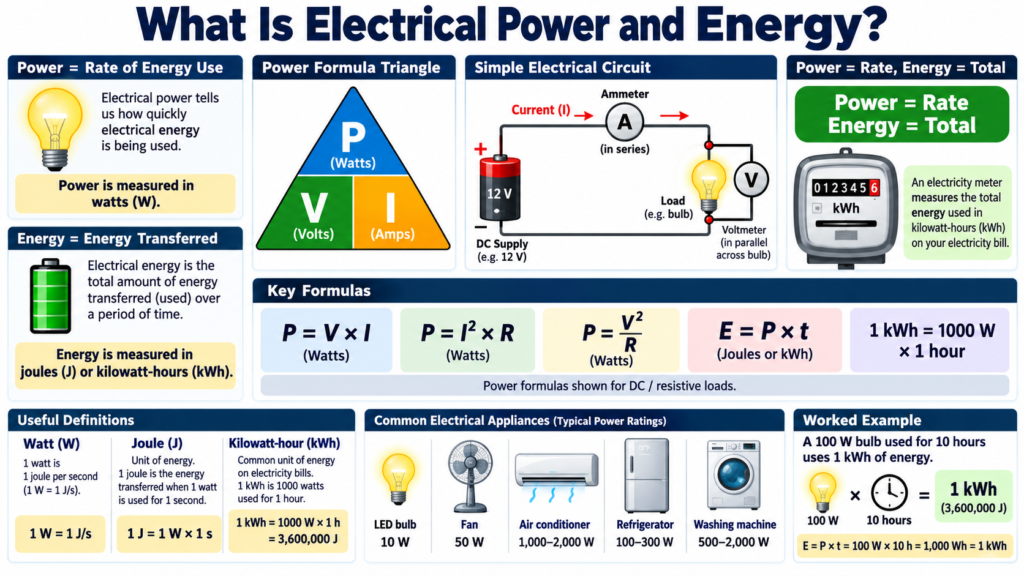
Electrical power and energy describe two related but different things. Power is the rate at which electrical energy is transferred or converted, measured in watts. Energy is the accumulated amount transferred over time, measured in joules or commonly in kilowatt-hours for electricity use.
A 100 W lamp and a 1000 W heater illustrate the difference. The heater uses energy ten times faster while operating at its rated power, but a lamp left on long enough can consume the same total energy. Understanding this distinction helps with circuit calculations, component selection, efficiency comparisons, and reading an electricity bill.
Electrical power and energy definitions
One watt equals one joule per second. If a device continuously converts 50 J of electrical energy each second, its input power is 50 W. Power tells you how quickly energy is being transferred at that operating condition.
Energy depends on both power and time. For constant power, E = Pt. If power varies, energy is found by integrating power over the relevant interval. A thermostat-controlled appliance, for example, may alternate between active heating and a lower-power state.
Electrical power and energy should never be assigned the same unit. A statement such as a device uses 2 kilowatts per hour is usually a confused description of either its power or its accumulated energy. Use kilowatts for power and kilowatt-hours for energy unless you truly mean a rate of change of power.
| Quantity | Common unit | Meaning |
|---|---|---|
| Power | W or kW | Energy transferred per second |
| Energy | J or kWh | Total energy transferred |
| Charge | C or Ah | Amount of charge transferred |
| Efficiency | Percent | Useful output divided by input |
DC electrical power formula
For a DC element at constant voltage and current, P = VI. A device operating at 12 V and drawing 2 A receives 24 W of electrical input power. Whether that becomes light, motion, heat, stored chemical energy, or a mixture depends on the device.
With the passive sign convention, current entering an element’s positive-labelled terminal gives positive absorbed power. A source delivering energy can have negative absorbed power. This convention makes power balance consistent across sources and loads.
For a resistor, combine P = VI with V = IR to obtain P = I squared R and P = V squared/R. These forms are useful when current and resistance, or voltage and resistance, are known. They describe resistor dissipation, not universal replacements for every device model.
For instance, 0.5 A through a 20 ohm resistor produces 5 W. Applying 10 V across the same resistor gives the same result, 100/20 = 5 W. The component’s power rating must be suitable for its thermal environment, not merely equal to a number calculated under ideal conditions.
Calculating electrical energy
Suppose a 60 W lamp operates for 5 hours at constant input power. Its energy use is 60 times 5 = 300 Wh, or 0.3 kWh. In joules, 60 W times 18,000 s gives 1,080,000 J.
One kilowatt-hour equals 3.6 million joules because 1000 W multiplied by 3600 s gives 3,600,000 J. The word hour in kilowatt-hour is part of the unit multiplication. It does not mean that a kilowatt-hour is a type of power.
Two appliances can use the same energy in different ways. A 100 W load operating for 10 hours and a 1000 W load operating for 1 hour each use 1 kWh. Their supply-current requirements and heating rates can still be very different while running.
Worked example: daily energy use and cost
Consider a small study setup with a 40 W light used for 5 hours and a 60 W fan used for 8 hours. Treat these as actual constant input powers for this example. The light uses 0.2 kWh and the fan uses 0.48 kWh each day.
Total daily energy is 0.68 kWh. Over 30 identical days, the total is 20.4 kWh. If a hypothetical flat tariff is 8 currency units per kWh, the energy charge is 163.2 currency units. This is an illustration, not a statement of any current local tariff.
- Convert each power from watts to kilowatts.
- Multiply by operating hours to obtain kilowatt-hours.
- Add all device energy values.
- Multiply by the applicable energy rate.
- Account separately for actual tariff slabs, fixed charges, and taxes.
Nameplate ratings may not equal average operating input. A refrigerator cycles, a computer changes consumption with workload, and a fan may have speed settings. A suitable energy meter or manufacturer performance data gives a better estimate than multiplying the maximum rating by every hour of the day.
AC power: why voltage times current is not always watts
For sinusoidal AC, real power is P = V_rms I_rms cos phi, where phi is the phase difference between voltage and current. The quantity cos phi is the displacement power factor for sinusoidal waveforms. Real power is the average rate of net energy transfer.
Apparent power is S = V_rms I_rms, measured in volt-amperes. Reactive power is Q = V_rms I_rms sin phi, measured in vars, with sign depending on inductive or capacitive behavior. The familiar right-triangle relationship applies under sinusoidal steady-state conditions.
If a sinusoidal load draws 5 A RMS at 100 V RMS with power factor 0.8, apparent power is 500 VA and real power is 400 W. Treating the full 500 VA as 500 W would overstate the real energy-transfer rate.
For distorted waveforms, true power factor is P divided by V_rms I_rms, and it is not generally equal to cos phi alone. Nonlinear electronic loads can distort current even when the fundamental components appear nearly in phase. Electrical power and energy calculations must use the appropriate waveform model.
Real power, reactive power, and power factor
A pure resistor converts electrical input into heat, so ideal sinusoidal voltage and current are in phase. An ideal inductor or capacitor temporarily stores energy and returns it to the source. Its average real power is zero in ideal periodic steady state, despite nonzero RMS current.
Real equipment contains losses, so a motor or transformer is not an ideal inductor. It absorbs real power as well as participating in reactive energy exchange. The magnetic function and the losses need to be distinguished rather than lumped into a statement that all current produces useful work.
Lower power factor requires more RMS current for a given real power at a fixed RMS voltage. That increases conductor losses and equipment loading. Power-factor correction can reduce reactive demand in appropriate systems, but it does not magically remove the real energy required by the useful load.
Efficiency and losses
Efficiency equals useful output power divided by input power. If a motor receives 500 W electrically and delivers 400 W mechanically at a particular operating point, its efficiency is 80 percent. The remaining 100 W becomes losses such as heating, friction, and other effects.
Input power and output power must refer to the same operating condition and time basis. A motor’s rated mechanical output does not directly specify its electrical input. Similarly, an LED lamp’s light output cannot be compared with an incandescent lamp merely by assuming both convert the same fraction of electrical input into visible light.
For a system with multiple conversion stages, overall efficiency is the product of stage efficiencies expressed as fractions. A 90 percent efficient supply feeding an 80 percent efficient device gives 72 percent overall efficiency for the defined useful output. Each stage contributes to the total loss budget.
Battery capacity: ampere-hours versus watt-hours
An ampere-hour is a unit of charge, not energy. One ampere-hour equals 3600 C. To estimate battery energy in watt-hours, multiply nominal voltage by ampere-hours, while recognizing that actual delivered energy depends on discharge conditions and changing terminal voltage.
A nominal 12 V, 7 Ah battery has a simple nominal energy estimate of 84 Wh. A constant 12 W load would suggest 7 hours ideally, but real runtime can be lower because of usable capacity limits, discharge rate, temperature, aging, and conversion losses.
This is another place where electrical power and energy must remain separate. A high energy capacity does not guarantee a high allowable output power. Battery discharge-current limits and protection ratings are separate specifications that must be respected.
Common student mistakes
- Multiplying watts by seconds and labelling the result watt-hours.
- Using peak AC voltage with RMS current in the same formula.
- Assuming every AC load has unity power factor.
- Treating ampere-hours as if they were watt-hours.
- Comparing useful output power with electrical input without considering efficiency.
A dimensional check catches many of these errors. Watts multiplied by seconds gives joules. Kilowatts multiplied by hours gives kilowatt-hours. For average power, divide energy by the duration expressed in compatible units.
Frequently asked questions
What is one unit of electricity?
In many billing contexts, one unit means one kilowatt-hour. Confirm the terminology on the actual bill. It represents an amount of energy, not a fixed current or voltage.
Can a low-power appliance use more energy than a high-power one?
Yes. Operating time matters. A small load running continuously can accumulate more energy use than a large load used briefly. Compare watt-hours or kilowatt-hours over the same period.
Does a 100 W rating mean exactly 100 W all the time?
Not necessarily. The label may describe a rated or maximum condition. Actual input can vary with control settings, supply conditions, operating cycle, and the equipment design.
Conclusion
Electrical power and energy answer different questions: how fast energy moves, and how much moves over time. Use watts for power, joules or kilowatt-hours for energy, and the correct DC or AC formula for the load. Careful units and realistic operating assumptions make these calculations useful beyond the classroom.
Comments
Comments are currently closed.