
MOSFET vs BJT: Key Differences, Working and Applications
Two transistors can switch the same load yet need very different drive circuits. Choose by the package alone, and your switch may run hot—or never turn on properly.
This MOSFET vs BJT guide compares how the devices are controlled, where their losses come from, and what you need to check before using them. Both can switch and amplify signals, but neither wins every application.
MOSFET vs BJT: how control differs
A BJT needs suitable base drive
A bipolar junction transistor has base, collector, and emitter terminals. In a common NPN switching circuit, base current helps establish collector current.
In forward-active operation, a useful approximation is IC ≈ βIB. Current gain varies with device, current, temperature, and operating region. Don’t use a typical gain value as a guarantee that a switch will saturate.
A MOSFET responds to gate-to-source voltage
A MOSFET has gate, drain, and source terminals. Its insulated gate draws little steady current under normal conditions, but the driver must charge and discharge it during switching.
That distinction matters in MOSFET vs BJT selection. Fast switching with a large gate charge can demand substantial short current pulses from a MOSFET driver.
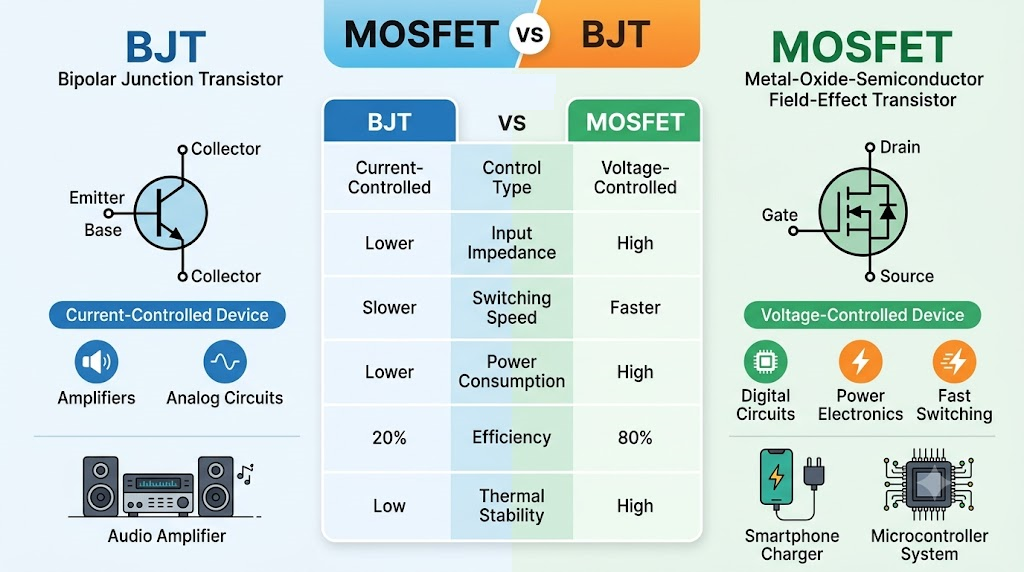
MOSFET vs BJT comparison table
| Feature | BJT | MOSFET |
|---|---|---|
| Control | Base-emitter junction and base drive | Gate-to-source voltage and gate charge |
| Switching conduction loss | Approximately VCE(sat)IC | Approximately I²RDS(on) |
| Driver demand | Base current while on | Charging current during transitions |
| Common roles | Amplifiers, small switches, current sources | Power switching, digital circuits, amplifiers |
| Important checks | Gain conditions, saturation, safe operating area | Gate drive, on-resistance, charge, safe operating area |
The MOSFET vs BJT loss formulas describe approximate on-state behavior. Switching transitions, driver power, leakage, and temperature add further losses.
Why gate threshold isn’t “fully on”
A MOSFET’s threshold voltage is specified at a small test current. It doesn’t tell you that the device can carry your load efficiently at that gate voltage.
Check RDS(on) at the gate-to-source voltage your circuit actually supplies. A part characterized only at 10 V gate drive may be a poor choice for a 3.3 V control signal.
Terminology can also mislead you. A BJT used as an on/off switch is often driven into saturation. A MOSFET used as a low-loss switch normally operates in its ohmic region; MOSFET saturation is a different operating region.
A simple loss comparison
Suppose a MOSFET carries 1 A and has 0.1 Ω on-resistance at the available gate drive. Its approximate conduction loss is 1² × 0.1 = 0.1 W.
A BJT carrying the same current with an assumed 0.2 V saturation voltage dissipates about 0.2 × 1 = 0.2 W in its collector-emitter path. Base-drive power is additional.
This MOSFET vs BJT example doesn’t establish a universal winner. The assumed specifications must match real devices, temperature, drive conditions, and load current.
How to choose a transistor
- Define load voltage, continuous current, startup current, and switching speed.
- Check whether your controller can supply the required drive.
- Estimate conduction and switching losses.
- Check voltage margin, thermal conditions, and safe operating area.
- Confirm the exact pinout and package.
- Plan protection for inductive loads and supply transients.
- Use a suitable flyback path for a DC relay or similar inductive load.
- Keep gate and base voltages within their ratings.
- Consider MOSFET body-diode behavior where reverse current matters.
- Use a driver when the controller pin can’t meet the switching demand.
Which is better for amplification?
Both families can form useful amplifiers. Biasing, noise, transconductance, bandwidth, source impedance, and required output swing influence the result.
A MOSFET vs BJT decision for an audio stage is different from choosing a motor switch. Compare the relevant measured or specified performance rather than carrying one rule between unrelated circuits.
Compare the complete circuit
MOSFET vs BJT selection becomes clearer when you include the driver, heat, load, and switching speed. The transistor is only one part of that system.
Choose two candidate datasheets and calculate their losses at your actual load. Then check whether your control signal can produce the drive conditions those calculations assume.


Comments
Comments are currently closed.