
What Is an Embedded System? Types, Working and Examples
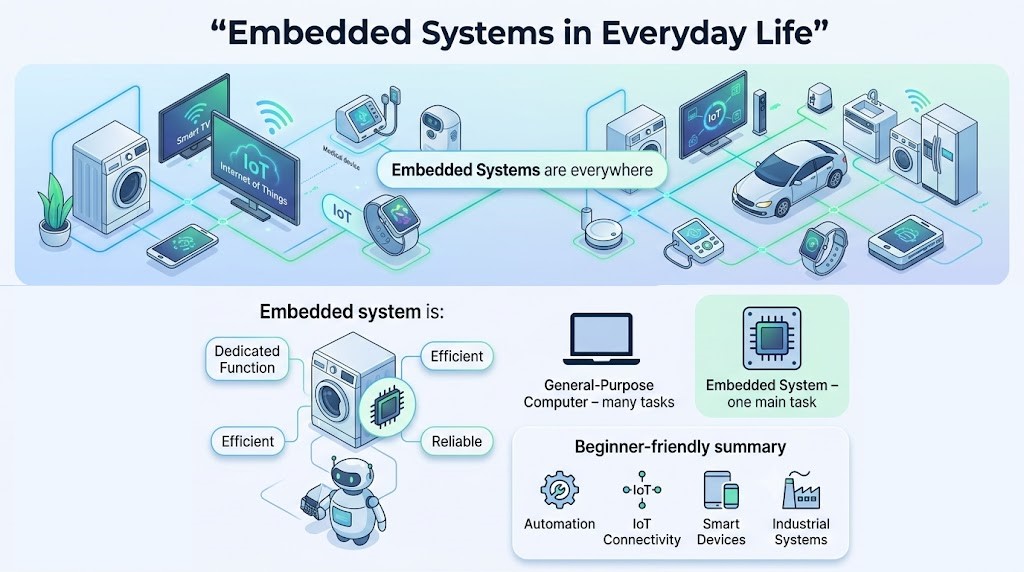
Your washing machine doesn’t need to browse the web to control water, heat, and drum speed. It needs a computer built around a specific job.
An embedded system is a computing system designed for a defined function within a product or larger installation. Hardware and software work together to sense conditions, process information, and control outputs. You’ll find this approach in appliances, vehicles, instruments, and industrial equipment.
What hardware does it need?
The controller may be a microcontroller, an application processor, or a combination of processors and dedicated logic. The right choice depends on timing, memory, interfaces, and software needs.
- Inputs: buttons, sensors, communication messages, or stored data.
- Processing: a CPU or dedicated hardware that makes decisions.
- Memory: program storage and working data.
- Outputs: displays, communication signals, or actuator commands.
- Power and support circuits: regulation, clocks, reset, and protection.
What is firmware?
Firmware is software closely tied to the product’s hardware. It initializes the device, reads inputs, manages communication, and controls behavior.
Firmware isn’t necessarily permanent. Many products support updates, but a reliable update process needs integrity checks and a way to recover if power fails during installation.
How does an embedded system work?
Consider a low-voltage temperature-controlled fan. Its control sequence might look like this:
- Read the temperature sensor at a defined interval.
- Check whether the reading is plausible.
- Compare it with the target temperature and switching limits.
- Send a command to a suitable fan driver.
- Update the display and record faults.
- Repeat while monitoring timing and system health.
Two switching thresholds can prevent rapid on/off cycling. For example, the fan might start above 30°C and stop below 28°C. This gap is hysteresis; the values are illustrative, not universal settings.
Why deadlines matter
A real-time embedded system must produce relevant results within required deadlines. A slow but predictable response may be acceptable for room temperature; braking control has very different requirements.
“Real-time” doesn’t mean “as fast as possible.” It means that timing is part of correctness. Missing a hard deadline can be unacceptable even if the calculated result is otherwise correct.
Common embedded system types
| Type | Typical example | Main concern |
|---|---|---|
| Standalone | A digital weighing instrument | Local sensing, processing, and display |
| Connected | A networked energy monitor | Communication and security |
| Real-time | A motor-control subsystem | Meeting specified deadlines |
| Portable | A battery-powered data logger | Energy use and physical size |
These categories overlap. A portable connected logger is still one embedded system, and it may also have real-time sampling requirements.
Main loop, RTOS, or rich operating system?
A small controller can use a repeating main loop with interrupts. This keeps the software straightforward when the workload is modest.
An RTOS adds task scheduling and coordination tools. A larger embedded system may run Linux or another rich OS for graphics, files, and networking. None of these choices removes the need to design fault handling.
- Keep interrupt routines short and predictable.
- Protect data shared between tasks.
- Use timeouts when waiting for external devices.
- Define what outputs should do after a sensor or communication failure.
What makes a design reliable?
A successful prototype is only a start. The product must handle supply dips, noise, component tolerances, environmental conditions, and unexpected inputs.
A watchdog can help recover from some software stalls, but restarting doesn’t prove the underlying fault has been fixed. Safe output states, error records, and reset behavior must be planned together.
Security matters too. A connected embedded system needs appropriate authentication, protected updates, and careful treatment of keys and untrusted data. Requirements depend on the product’s actual threats.
Build one small control loop
An embedded system connects computation to a defined physical or information-processing task. The challenge is making hardware, software, timing, and fault behavior work together.
Start with a sensor, development board, and indicator LED. Write down the sampling interval, output rule, and response to a disconnected sensor before you write the code.
Comments
Comments are currently closed.