
What Is Electric Charge? The Basis of Current and Voltage
Rub a balloon on your hair, then hold it against a wall. It can stay there without glue.
That small trick introduces electric charge, the property behind static shocks, electric current, and the forces that hold atoms together. You don’t need advanced maths to follow the idea. You need to know what carries charge, how charges interact, and what changes when they move.
By the end, you’ll be able to explain why a neutral object can be attracted to a charged one, what a coulomb measures, and why a battery doesn’t manufacture electrons.
What is electric charge?
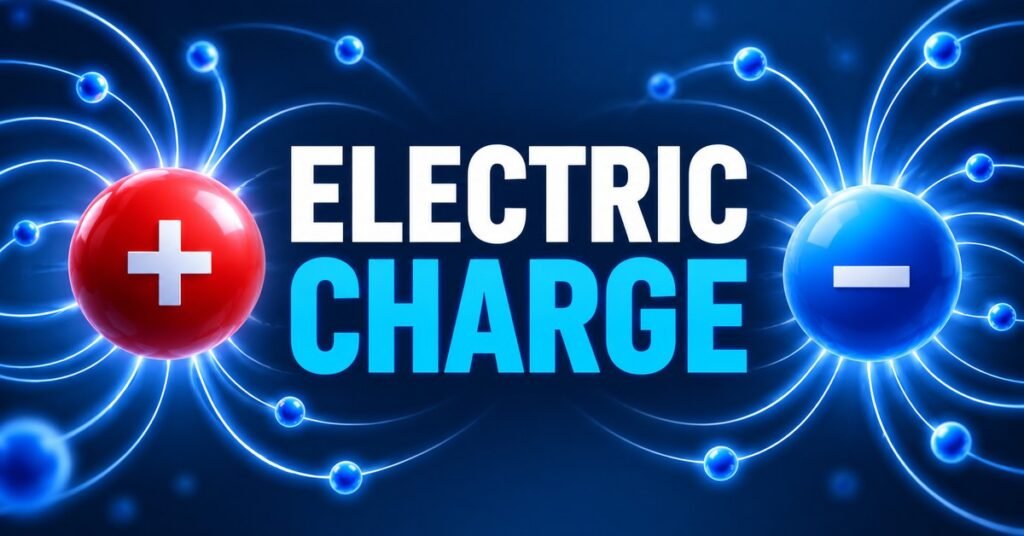
Electric charge is a physical property that determines how matter interacts through electric and magnetic fields. Charge comes in two signs, positive and negative. Like signs repel each other, while opposite signs attract.
An electron carries negative charge. A proton carries an equal amount of positive charge. A neutron has no net electric charge. These particles explain most everyday examples, although other particles can also carry charge.
An ordinary atom contains equal numbers of protons and electrons, so its total charge is zero. That doesn’t mean charge is missing. It means the positive and negative contributions balance.
If an object gains extra electrons, it becomes negatively charged. If it loses electrons, it becomes positively charged. In everyday charging of solids, electrons usually move between objects; protons remain bound inside atomic nuclei.
Think of charge as a quantity you can account for. A positive object isn’t automatically hot, powerful, or dangerous. The sign describes its charge balance, not its stored energy or the size of a possible shock.
Positive, negative, and neutral: a useful comparison
The word neutral describes net charge. A neutral metal spoon contains enormous amounts of positive and negative charge, but their totals balance.
A charged balloon can attract a neutral wall because charges within the wall shift slightly. Opposite charge becomes effectively closer to the balloon than like charge. This separation, called polarization, produces a net attraction.
Polarization doesn’t require the wall to gain a lasting net charge. That distinction helps explain why an object can respond to an electric field even if you haven’t charged it yourself.
In a conductor, mobile electrons can redistribute over relatively large distances. In an insulator, bound charges shift over much smaller distances. Both materials can respond to a nearby charged object, but they do so differently.
What is a coulomb?
The SI unit of electric charge is the coulomb, written C. An individual electron has charge −1.602176634 × 10⁻¹⁹ C. The corresponding positive amount is called the elementary charge, e.
That number is tiny. A charge magnitude of one coulomb corresponds to roughly 6.24 × 10¹⁸ elementary charges. Everyday static effects often involve much smaller charge amounts.
For a collection of N extra electrons, the net charge is Q = −Ne. If an object has lost N electrons, its charge is Q = +Ne. Keep the sign when it matters to the question.
For example, gaining one million electrons produces about −1.60 × 10⁻¹³ C. That is a very small amount, even though one million sounds like a large count.
Charge in ordinary isolated objects changes in whole multiples of elementary charge. Circuit calculations often treat it as continuous because the number of moving charge carriers is so large.
How electric charge becomes current
Current measures the rate at which charge passes a point. For a constant current, I = Q/t, or Q = It. Current is measured in amperes, and one ampere means one coulomb per second.
If 6 C passes a point in 3 seconds, the average current is 2 A. If a small circuit carries 20 mA for 10 seconds, the transferred charge is 0.020 × 10 = 0.20 C.
This is a flow measurement. It doesn’t mean that 0.20 C remains piled up inside the lamp. In a steady circuit, charge enters and leaves each component at matching rates.
Conventional current points in the direction that positive charge would move. In a metal wire, electrons drift in the opposite direction. Both descriptions can be consistent if you keep the sign convention clear.
A switch can make a lamp respond quickly even though individual electrons drift slowly. The electrical disturbance travels through the circuit far faster than the carriers’ average drift motion. It isn’t necessary for an electron to travel from the switch to the lamp first.
How charge relates to voltage
Voltage describes energy transferred per unit charge. One volt means one joule per coulomb. The relationship is V = W/Q, where W is energy transferred between two points.
Suppose 3 C passes through a component with a constant 5 V across it. The energy transferred is W = VQ = 15 J. This connects the amount of charge with the energy available per coulomb.
Two systems can transfer the same charge but deliver different energy because their voltages differ. Likewise, equal voltage doesn’t guarantee equal current; the connected circuit matters.
A battery uses chemical processes to maintain a potential difference between its terminals. The wires and components already contain charge carriers. When a closed path is available, the battery supports their motion around the circuit.
You can picture voltage as an energy difference, but avoid treating charge as fuel that disappears. In a resistor, electrical energy becomes heat while charge continues through the path.
Why static electricity builds up
Static electricity refers to charge imbalance that remains relatively localized instead of producing a sustained circuit current. Rubbing certain materials can transfer electrons because their surfaces interact differently.
A plastic comb drawn through dry hair can gain charge and attract small scraps of paper. Walking across a suitable carpet can also leave your body with a net charge.
Dry conditions often make static effects easier to notice because charge leaks away less readily. Humidity can increase surface conduction, although the details depend on the materials and environment.
A sudden discharge equalizes potential when a conducting path becomes available. That brief current pulse is what you notice as a spark or snap. Static doesn’t mean charge can never move; it means the buildup was not a continuous current beforehand.
Some static discharges have high voltage but limited stored energy. That doesn’t make all static events harmless. They can damage sensitive electronics or ignite flammable mixtures under suitable conditions.
Three ways to charge an object
Friction is one familiar method. Bringing materials into contact and separating them can transfer electrons. Rubbing increases repeated contact, but friction doesn’t create charge from nothing.
Conduction transfers charge through direct electrical contact. Touching a charged conductor to another conductor can allow electrons to redistribute until the combined system reaches an appropriate balance.
Induction charges a conductor without touching it with the original charged object. A nearby charge redistributes the conductor’s electrons. With a correctly timed earth connection and separation sequence, a net charge can remain.
Grounding provides a path for charge exchange with Earth or another reference reservoir. It doesn’t mean all electrical energy vanishes instantly, and a circuit’s ground symbol doesn’t always identify a physical earth connection.
For a beginner demonstration, stick to balloons, combs, and paper. Don’t experiment with wall sockets, charged capacitors, or improvised high-voltage equipment to make bigger sparks.
Charge is conserved
In an isolated system, total electric charge stays constant. If one object gains electrons and another loses them, their individual charges change while the overall total remains the same.
Imagine two initially neutral objects. After contact, one carries −4 nC and the other +4 nC. Their combined net charge is still zero. The charging process separated charge rather than creating it.
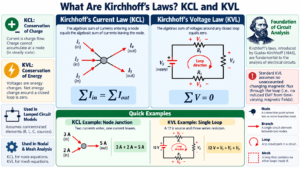
This conservation principle also appears in circuit analysis. At a junction, charge can’t accumulate indefinitely in ordinary steady operation. The total current entering therefore equals the total current leaving.
A useful bookkeeping exercise is to write the signs before adding quantities. Combining +7 nC and −2 nC gives +5 nC, not +9 nC. Charge is an algebraic quantity.
At the same time, conserved charge doesn’t imply conserved electrical potential energy within a chosen component. Energy can move into heat, light, motion, or chemical storage while total charge remains balanced.
A simple electric-charge calculation you can check
Suppose a sensor circuit draws a steady 5 mA for one minute. First convert 5 mA to 0.005 A and one minute to 60 seconds.
The transferred charge is Q = It = 0.005 × 60 = 0.30 C. If the supply is a constant 3 V, the electrical energy delivered is E = VQ = 0.90 J.
Now double the operating time. Charge and energy both double if current and voltage remain unchanged. Double only the voltage while holding the same current, and charge stays the same while energy doubles.
Real circuits may change current when supply voltage changes. The calculation describes the stated conditions; it doesn’t promise that an actual sensor will tolerate any voltage you choose.
This example gives you a practical checklist: identify the quantity, convert the units, choose the relationship, and check whether your assumptions match the device.
Common misunderstandings to avoid
Don’t confuse positive charge with conventional current. An object can remain positively charged while no current flows, and a metal wire can carry conventional current while its net charge remains almost neutral.
Don’t say an insulator has no electrons. Its electrons are present but are not free to move through the material as readily as conduction electrons in a metal.
Don’t assume attraction proves opposite net charges. A charged object can attract a neutral object through polarization.
Finally, don’t confuse charge capacity with energy capacity. An ampere-hour is 3600 C, a unit of charge. A watt-hour measures energy, and comparing batteries properly also requires voltage and discharge conditions.
Frequently asked questions
What is electric charge in simple words?
It’s a property of matter that makes particles and objects exert electrical forces. Positive and negative are the two signs, and equal amounts can cancel to give zero net charge.
What is the difference between charge and current?
Charge is an amount measured in coulombs. Current is the rate at which that amount crosses a point, measured in amperes. One ampere equals one coulomb per second.
Can a neutral object contain electric charge?
Yes. A neutral object usually contains both positive and negative charge in equal totals. Neutral means the net amount is zero, not that charged particles are absent.
Why do you get a shock after walking on carpet?
Contact and separation can leave your body with excess charge. Touching a conductor can then allow a brief discharge. The effect depends on footwear, flooring, humidity, and other conditions.
Does a battery create electric charge?
No. Chemical reactions maintain a potential difference and drive charge through a complete circuit. The charge carriers already exist in the materials, and total charge is conserved.
Quick reference and practice checklist
| Quantity | Unit | Meaning |
|---|---|---|
| Charge | C | Amount of electric charge |
| Current | A | Charge transferred per second |
| Voltage | V | Energy transferred per coulomb |
Use this three-step routine when you review the examples:
- Identify the charge sign before calculating.
- Convert milli-, micro-, and nano-units explicitly.
- Keep charge, energy, current, and voltage separate.
Before moving on, check these details:
- Write units beside every number.
- State the assumptions behind your calculation.
- Check the result against the physical behavior described above.
Put the idea to work
Electric charge connects atomic structure with the circuits you build. Coulombs measure the amount, amperes measure its flow rate, and volts describe energy transferred per coulomb.
Try the sensor calculation again with 10 mA and two minutes. Then explain the result in your own words. If you can keep charge, current, and energy separate, you’ve built a strong foundation for learning electronics.

Comments
Comments are currently closed.