
Conductors, Insulators, and Semiconductors Explained
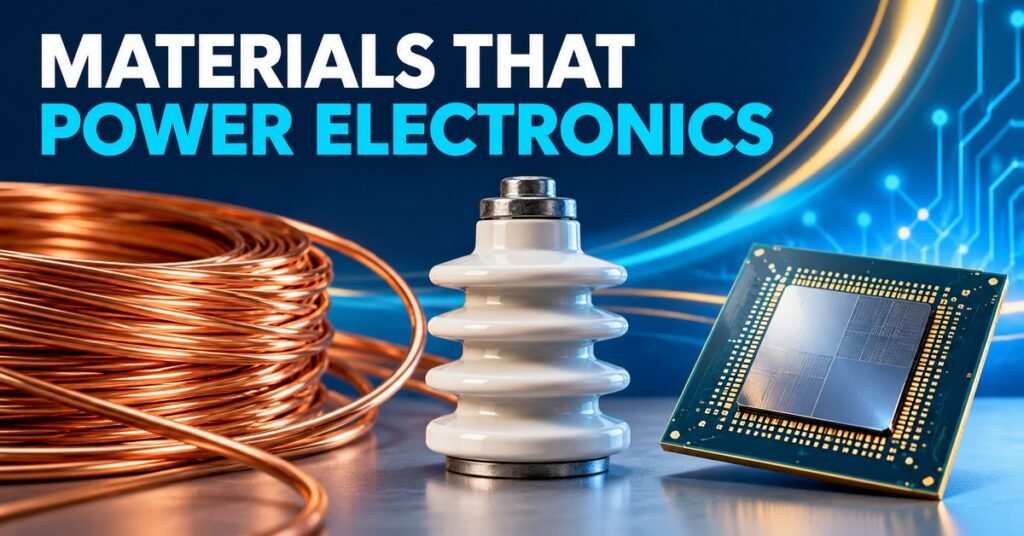
A charging cable carries current safely because its materials do different jobs. The metal inside conducts, the outer covering insulates, and tiny semiconductor devices control the charger.
Understanding conductors insulators and semiconductors helps you see why electronics uses more than just metal wires. The difference comes from how readily electric charge can move through each material.
You’ll meet these materials in plugs, sensors, solar cells, circuit boards, and nearly every powered device you own. Let’s connect their microscopic behavior with choices you can recognize on a workbench.
What makes a material conduct electricity?
Electric current requires mobile charge carriers and a driving electric field. In metals, some electrons can move through the structure rather than remaining tied to a single atom.
The material still resists their motion. Electrons interact with the lattice and imperfections, so ordinary conductors have finite resistance. Good conduction doesn’t mean current encounters no opposition.
Conductivity describes how readily a material supports current. Resistivity describes the opposite tendency. For a uniform wire, resistance is R = ρL/A, where ρ is resistivity, L is length, and A is cross-sectional area.
A longer wire has more resistance if everything else stays the same. A thicker wire has less. This is why material alone doesn’t determine whether a particular wire can carry an intended current safely.
Temperature, purity, physical structure, and frequency can all affect electrical behavior. The categories conductor, insulator, and semiconductor are useful guides, rather than a promise that every sample behaves identically in every situation.
Conductors: easy paths for charge
Copper and aluminium are familiar conductors. Copper is common in wiring because it combines useful conductivity with workable mechanical properties. Aluminium’s low mass makes it valuable in many power applications.
Silver conducts very well, but cost and practical requirements limit where it is used. Gold is useful on selected contacts partly because it resists corrosion; it isn’t chosen because it is the most conductive metal.
Graphite is a useful reminder that conductors don’t have to be metals. Its structure allows charge movement in particular directions. Material structure matters as much as a broad chemical label.
In liquids, current can be carried by ions instead of free electrons moving through metal. Salt water conducts because dissolved ions move. Very pure water has much lower conductivity than ordinary tap water.
Your body also contains conducting fluids. Never use your skin as a test instrument. Whether a material can conduct in theory says little about whether touching an energized object is safe.
Insulators: materials that restrict charge movement
An insulator has very few mobile charge carriers under normal operating conditions. Rubber, glass, ceramics, and many plastics are common examples of insulators.
The plastic around a wire helps keep charge in the intended conducting path. It also separates live conductors from each other and from surfaces you may touch.
Insulation isn’t perfect. A small leakage current may flow, especially when surfaces are dirty or wet. Excessive voltage can cause breakdown, allowing a large current through or across the material.
Dielectric strength describes resistance to electrical breakdown under specified test conditions. Actual insulation performance also depends on thickness, temperature, aging, physical damage, contamination, and geometry.
A cracked cable covering can therefore be unsafe even when the original plastic was an excellent insulator. The material name alone doesn’t tell you whether the whole assembly still provides reliable protection.
What is a semiconductor?
A semiconductor is a material whose charge-carrier population and conductivity can be controlled over a useful range. Silicon is the most familiar example in mainstream electronics.
Pure silicon has relatively few free carriers at ordinary temperatures compared with a metal. Thermal energy can promote electrons into states where they can move through the crystal.
When an electron leaves a filled bonding state, the missing electron behaves as a mobile positive carrier called a hole. Electrons and holes both contribute to current.
Manufacturers control conductivity by adding tiny, deliberate amounts of selected impurities. This process is called doping. It is a precise manufacturing step, not random contamination.
Semiconductors matter because their behavior can be shaped by doping, junctions, electric fields, light, and temperature. That flexibility lets devices rectify current, switch signals, sense conditions, and convert light into electricity.
Energy band: a simple explanation
Inside a solid, electrons occupy ranges of allowed energy called bands. The valence band contains bonding-related electron states, while the conduction band provides states associated with mobile electrons.
Between them may be a forbidden energy gap, called the band gap. An electron needs sufficient energy to cross that gap in a simple semiconductor picture.
A metal has available nearby states that support conduction without needing the same kind of excitation across a full semiconductor band gap. This helps explain its abundant mobile carriers.
A semiconductor has a gap small enough that temperature, light, and device design can produce useful carrier populations. A typical insulator has a wider gap and far fewer thermally available carriers under comparable conditions.
This model is simplified, but it explains more than saying a semiconductor is merely halfway between copper and rubber. Controllability is the useful feature. The exact conductivity depends strongly on the material and its operating conditions.
N-type and P-type materials
N-type silicon is doped with donor atoms that contribute electrons readily. Electrons are the majority carriers, while holes are minority carriers.
P-type silicon uses acceptor dopants that create holes. Holes become the majority carriers, while electrons remain minority carriers.
Neither name means the whole bulk material must carry a large net electrical charge. Ionized dopant atoms and mobile carriers generally balance in a neutral region.
Put suitable P-type and N-type regions together and a junction forms. Its internal field and carrier behavior are the basis of an ordinary semiconductor diode.
A transistor uses carefully arranged semiconductor regions or field-controlled channels to control current. That is why a tiny control signal can influence a larger circuit without requiring moving mechanical contacts.
Comparison table: what actually changes?
A simple comparison helps organize the differences. Remember that these descriptions refer to typical materials under ordinary conditions, not every special case.
Conductors provide an easy current path. Insulators restrict unwanted current. Semiconductors let engineers create a path whose behavior changes in controlled ways.
You can find all three within a single integrated circuit package. Metal connections carry signals, insulating layers separate structures, and semiconductor regions perform the switching.
When you troubleshoot a device, ask what role each material serves. A contact should conduct. A protective coating should insulate. A sensor may intentionally change its conductivity when conditions change.
Mixing up those roles leads to poor diagnoses. For example, a high resistance between two insulated conductors may be expected, while the same resistance in a power connector can indicate a damaged joint.
How temperature affects these materials
For many ordinary metals near room temperature, resistance increases as temperature rises. Increased lattice vibration makes charge transport more difficult.
In an intrinsic semiconductor, rising temperature generates more electron-hole pairs and can greatly increase conductivity. Doped semiconductor behavior is more complicated because carrier concentration and mobility both change.
Don’t turn this into a universal rule that every semiconductor device’s resistance always falls with temperature. Device structure, doping, operating region, and self-heating matter.
Insulation can also deteriorate with heat. A material that works at room temperature may soften, crack, or lose electrical performance outside its rated range.
This is why component and cable temperature ratings are part of electrical design. Current creates heating, heating changes material properties, and those changes can affect further heating. Good design considers the whole cycle.
Everyday examples you can recognize
Look at a low-voltage USB cable. Metal conductors carry supply and data signals. Polymer insulation keeps those conductors separated. Semiconductor chips in connected equipment manage communication and power.
A solar cell uses semiconductor material to absorb suitable light and separate charge carriers. Metal contacts collect current, while insulating layers help control unwanted paths.
A wall switch uses conductive contacts and an insulating enclosure. Some electronic switches replace the mechanical contact function with semiconductor devices while still needing insulation and suitable connections.
A thermistor uses a material whose resistance changes strongly with temperature. Many common sensing thermistors have a negative temperature coefficient, but positive-temperature-coefficient types also exist.
These examples show why selecting materials isn’t a contest to find the lowest resistance everywhere. A working product needs the right electrical behavior in the right location.
Practical selection tips and common mistakes
Start by identifying the job: carrying current, blocking current, or controlling current. Then consider voltage, current, temperature, mechanical stress, environment, and the manufacturer’s specifications.
For wiring, don’t choose only by metal type. Cross-sectional area, installation method, insulation rating, connector quality, and applicable electrical requirements all matter.
For a circuit board, don’t assume a clean-looking surface is perfectly insulating. Moisture and contamination can create leakage paths that disturb sensitive measurements.
For semiconductor parts, don’t select by package appearance. Two parts in similar black packages may have completely different pinouts, voltage limits, and functions.
A low-voltage continuity test is helpful for many checks, but it doesn’t establish insulation safety at operating voltage. Professional insulation testing uses appropriate equipment and procedures. Keep beginner experiments to safe, current-limited low-voltage circuits.
Frequently asked questions
What is the main difference between conductors insulators and semiconductors?
They differ in how readily charge moves and how controllable that movement is. Conductors carry current easily, insulators strongly restrict it, and semiconductors support engineered control of carrier populations and current paths.
Is silicon a conductor or an insulator?
Silicon is a semiconductor. Its conductivity depends on temperature, purity, doping, and device structure. A silicon chip also includes metal and insulating materials, so the complete chip isn’t a single uniform electrical material.
What are five examples of insulators?
Glass, porcelain, dry rubber, polyethylene, and PTFE are common examples. Their suitability depends on the exact grade, thickness, operating conditions, and the condition of the finished insulating structure.
Why is copper used in electrical wires?
Copper offers good conductivity, useful strength, and practical manufacturing properties. A copper wire still needs adequate cross-sectional area, appropriate insulation, and suitable connections for its intended load and environment.
Does adding impurities always make a material worse?
No. Controlled doping deliberately changes semiconductor behavior. Random contamination can be harmful, but selected dopants in precise amounts are essential to many diodes, transistors, and integrated circuits.
Quick reference and practice checklist
| Material group | Typical carriers | Typical role |
|---|---|---|
| Conductor | Mobile electrons in metals | Carry current |
| Insulator | Few mobile carriers | Separate conducting paths |
| Semiconductor | Electrons and holes | Control, sense, and switch |
Use this three-step routine when you review the examples:
- Identify whether the material should carry, restrict, or control current.
- Check temperature and environmental conditions.
- Use the finished part’s ratings rather than a material name alone.
Before moving on, check these details:
- Write units beside every number.
- State the assumptions behind your calculation.
- Check the result against the physical behavior described above.
Look for the material’s job
Conductors insulators and semiconductors form a team inside electronic equipment. One carries current, another keeps paths separate, and another makes controlled electronic behavior possible.
Next time you inspect an unplugged cable or a spare circuit board, identify one example of each role. Then check a component datasheet to see how its ratings turn material properties into a usable device.
Comments
Comments are currently closed.