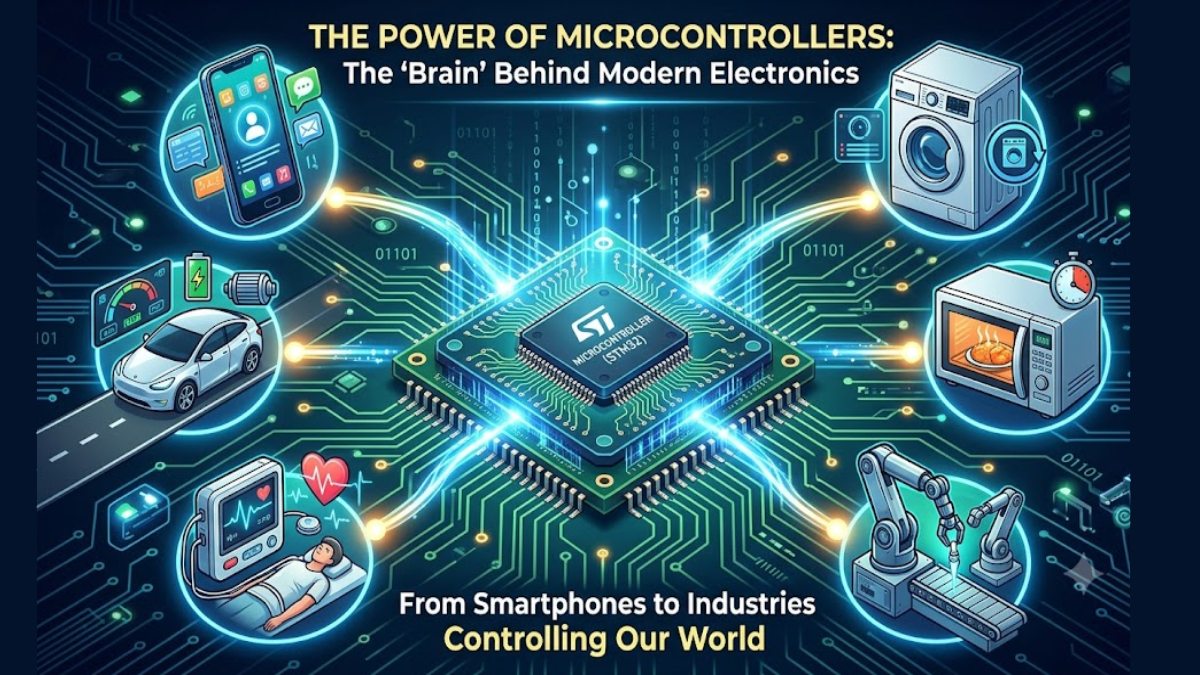
Microcontrollers are one of the most important components used in modern electronic devices. They are found in everyday products such as smartphones, washing machines, microwave ovens, automobiles, medical devices, and industrial control systems. A microcontroller acts as the “brain” of an embedded system by controlling and managing the functions of electronic equipment.
With the rapid growth of automation and smart technologies, microcontrollers have become essential in designing compact, efficient, and intelligent devices. Understanding their architecture, working principles, and applications helps learners gain insight into how modern electronic systems operate.
What is a Microcontroller?
A microcontroller is a small integrated circuit (IC) that contains a processor, memory, and input/output peripherals on a single chip. It is designed to perform specific tasks within an embedded system.
Unlike a general-purpose computer, which can execute many different programs, a microcontroller is programmed to perform dedicated functions such as controlling a motor, reading sensor data, or operating a display.
A typical microcontroller includes:
- Central Processing Unit (CPU)
- Memory (RAM, ROM, Flash)
- Input/Output (I/O) Ports
- Timers and Counters
- Communication Interfaces
- Clock Circuit
These components work together to process data and control electronic devices efficiently.
Characteristics of a Microcontroller
- Compact and small in size
- Low power consumption
- Cost-effective
- Reliable operation
- Real-time processing capability
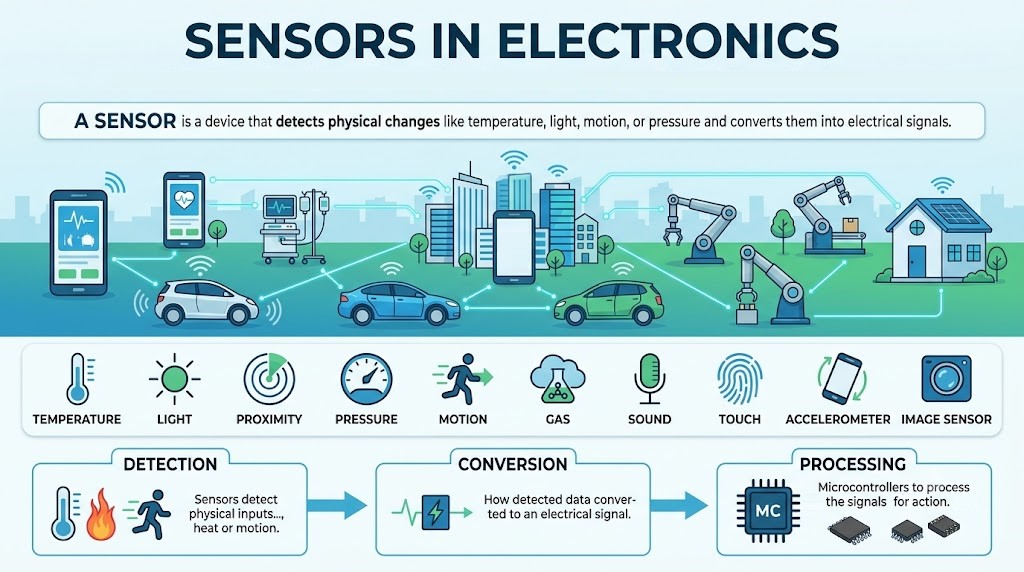
- Easy integration with sensors and actuators
Examples of Popular Microcontrollers
- 8051 Microcontroller
- PIC Microcontroller
- AVR Microcontroller
- Arduino-based ATmega328
- STM32 Microcontroller
- ESP32 Microcontroller
These microcontrollers are widely used in educational, industrial, and commercial applications.
Architecture of a Microcontroller
The architecture of a microcontroller refers to the arrangement and interaction of its internal components. Understanding the architecture helps learners know how a microcontroller processes information.
1. Central Processing Unit (CPU)
The CPU is the core component of the microcontroller. It executes instructions stored in memory and performs arithmetic and logical operations.
Functions of the CPU include:
- Fetching instructions
- Decoding instructions
- Executing operations
- Controlling system activities
The CPU acts as the decision-making unit of the microcontroller.
2. Memory Unit
Memory stores programs and data required for operation.
a) ROM (Read-Only Memory)
ROM stores the program permanently. The instructions remain even when power is turned off.
Functions:
- Stores firmware
- Contains application programs
- Preserves data permanently
b) RAM (Random Access Memory)
RAM temporarily stores data while the program is running.
Functions:
- Stores variables
- Holds intermediate results
- Supports program execution
c) Flash Memory
Flash memory is a non-volatile memory used to store program code and can be reprogrammed multiple times.
3. Input/Output (I/O) Ports
I/O ports allow the microcontroller to communicate with external devices.
Input devices:
- Sensors
- Switches
- Keypads
Output devices:
- LEDs
- Displays
- Motors
- Relays
These ports enable interaction between the microcontroller and the external environment.
4. Timers and Counters
Timers and counters are specialized hardware units used for:
- Measuring time intervals
- Generating delays
- Counting events
- Producing pulse-width modulation (PWM) signals
They are essential for precise timing operations.
5. Communication Interfaces
Modern microcontrollers include communication modules for data exchange.
Common communication protocols include:
- UART (Universal Asynchronous Receiver Transmitter)
- SPI (Serial Peripheral Interface)
- I2C (Inter-Integrated Circuit)
- CAN (Controller Area Network)
- USB Communication
These interfaces allow communication with sensors, computers, displays, and other microcontrollers.
6. Clock System
The clock provides timing signals for the microcontroller.
Functions:
- Synchronizes operations
- Controls instruction execution speed
- Maintains accurate timing
The clock source may be:
- Crystal oscillator
- Internal oscillator
- External clock source
Block Diagram Explanation
The CPU communicates with memory, I/O ports, timers, communication interfaces, and clock circuits through internal buses. All these components are integrated into a single chip, making the microcontroller compact and efficient.
Working of a Microcontroller
The operation of a microcontroller follows a sequence of steps known as the instruction cycle.
Step 1: Program Storage
A program is written using a programming language such as C or Embedded C and stored in the microcontroller’s memory.
Example:
A program may instruct the microcontroller to turn on a light when a sensor detects movement.
Step 2: Fetching Instructions
The CPU retrieves instructions from memory one at a time.
This process is called the fetch cycle.
Step 3: Decoding Instructions
The control unit interprets the fetched instruction and determines the operation to be performed.
This process is called instruction decoding.
Step 4: Executing Instructions
The CPU executes the instruction.
Examples:
- Reading sensor values
- Performing calculations
- Turning devices ON or OFF
- Sending data through communication channels
Step 5: Output Generation
After processing the input data, the microcontroller generates appropriate outputs.
For example:
Input:
A temperature sensor detects high temperature.
Processing:
The microcontroller compares the temperature with a preset threshold.
Output:
A cooling fan is activated automatically.
Example of Microcontroller Operation
Consider an automatic street-light system:
- A light sensor measures ambient light.
- The sensor sends data to the microcontroller.
- The microcontroller analyzes the data.
- If darkness is detected, it switches ON the street light.
- During daylight, it switches OFF the street light.
This process happens continuously and automatically.
Advantages of Microcontroller-Based Systems
- Fast response
- High accuracy
- Reduced human intervention
- Low power consumption
- Compact design
- Reliable operation
Applications of Microcontrollers
Microcontrollers are widely used in various fields due to their flexibility and efficiency.
1. Consumer Electronics
Microcontrollers control the operation of household appliances such as:
- Washing machines
- Microwave ovens
- Air conditioners
- Television sets
- Digital cameras
They improve functionality and automation.
2. Automotive Systems
Modern vehicles use numerous microcontrollers for:
- Engine control
- Airbag systems
- Anti-lock braking systems (ABS)
- Cruise control
- Power steering
- Climate control
These applications enhance safety and performance.
3. Industrial Automation
Industries use microcontrollers for:
- Process monitoring
- Robotics
- Motor control
- Production line automation
- Temperature and pressure control
Microcontrollers help increase productivity and efficiency.
4. Medical Equipment
Medical devices rely on microcontrollers for accurate operation.
Examples include:
- Patient monitoring systems
- Blood pressure monitors
- Glucose meters
- ECG machines
- Infusion pumps
These devices provide reliable healthcare solutions.
5. Communication Systems
Microcontrollers are used in:
- Mobile phones
- Wireless communication devices
- Routers
- Network equipment
They manage communication and data processing tasks.
6. Smart Home Systems
Home automation systems use microcontrollers to control:
- Smart lighting
- Security systems
- Smart locks
- Energy management systems
These applications improve convenience and security.
7. Internet of Things (IoT)
IoT devices depend heavily on microcontrollers.
Examples:
- Smart sensors
- Wearable devices
- Smart agriculture systems
- Smart energy meters
Microcontrollers enable connectivity and intelligent decision-making.
8. Educational and Research Projects
Students and researchers use microcontrollers for:
- Robotics projects
- Embedded system development
- Automation experiments
- Sensor-based applications
Platforms such as Arduino have made learning microcontroller programming easier.
Conclusion
A microcontroller is a compact integrated circuit that combines a CPU, memory, input/output ports, timers, and communication interfaces on a single chip. It serves as the control unit of embedded systems and is capable of performing specific tasks efficiently and reliably.
The architecture of a microcontroller consists of several interconnected components that work together to process data and control devices. Its operation involves fetching, decoding, and executing instructions to produce desired outputs. Due to their low cost, low power consumption, and versatility, microcontrollers are widely used in consumer electronics, automobiles, industrial automation, healthcare equipment, communication systems, smart homes, and IoT applications.
As technology continues to advance, microcontrollers will remain a fundamental part of modern electronic systems, enabling smarter, faster, and more efficient devices.