
11 Types of Sensors in Electronics: Working and Uses
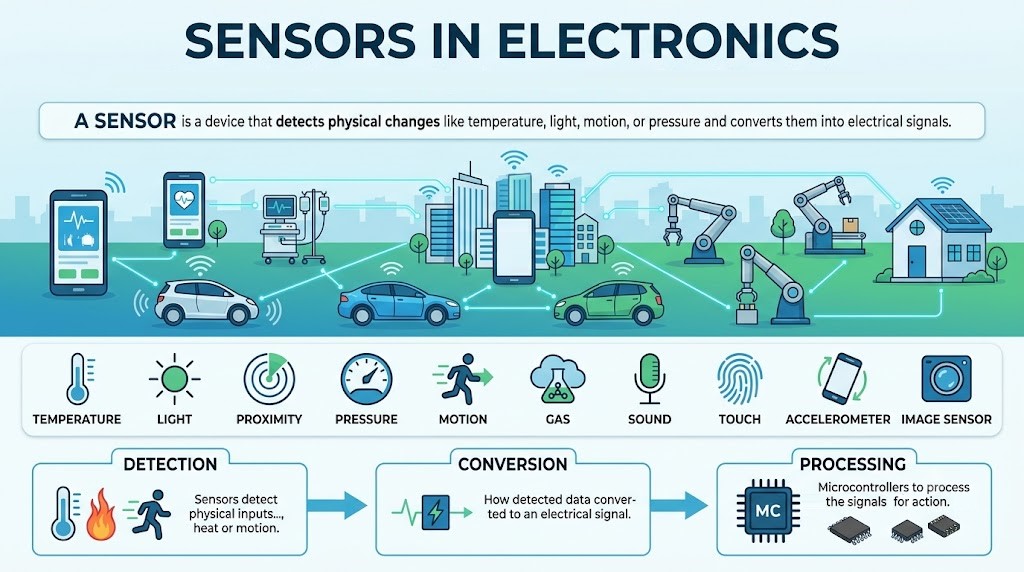
Your phone can sense a tilt, a lamp can react to darkness, and a scale can measure force. Each starts by turning a physical condition into an electrical signal.
Sensors in electronics help circuits measure the world. Some provide a small analog change; others include processing and a digital interface. For sensors in electronics, the useful question isn’t just “What does it detect?” It’s “Can you trust its reading under the conditions you expect?”
How sensors in electronics produce readings
A sensing element responds to temperature, light, movement, or another quantity. The resulting voltage, resistance, charge, or current may need conditioning before a controller can use it.
A complete measurement chain can include excitation, amplification, filtering, conversion, calibration, and software. A ready-made module may hide several of these stages inside one package.
11 common sensors in electronics
1. Temperature sensors
Thermistors change resistance with temperature. Other devices provide an analog voltage or digital reading. You’ll find them in thermal monitoring, environmental loggers, and battery systems.
2. Light sensors
Photodiodes, phototransistors, and light-dependent resistors respond to illumination. Spectral response matters: a sensor may respond differently from the human eye or another detector.
3. Proximity and distance sensors
Optical, ultrasonic, inductive, and capacitive devices detect nearby objects in different ways. Target material, angle, surface finish, and the surrounding environment can affect the reading.
4. Pressure sensors
Pressure devices often use a diaphragm whose movement changes an electrical property. Check whether the specification describes absolute, gauge, or differential pressure.
5. Humidity sensors
Many measure a capacitance change associated with moisture. Relative humidity depends on temperature, so temperature compensation and condensation limits matter.
6. PIR motion sensors
A passive infrared sensor responds to changes in infrared radiation across its sensing zones. It can detect movement under suitable conditions, but it isn’t a dependable count of people or proof of a stationary person’s absence.
7. Accelerometers
Accelerometers measure specific force along one or more axes. They support vibration measurement, orientation estimation, and motion sensing. Position estimation requires further processing and can drift.
8. Gyroscopes
A gyroscope measures angular rate. Combining it with other sensors can improve orientation estimates, but bias and integration errors still need attention.
9. Magnetic sensors
Hall-effect and magnetoresistive devices sense magnetic fields. Applications include position detection, rotation sensing, and current measurement with a suitable magnetic arrangement.
10. Force and load sensors
Strain-gauge load cells produce small changes that are often measured with a bridge and amplifier. Mechanical mounting, overload protection, and calibration are part of the measurement.
11. Gas sensors
Gas sensors use technologies such as electrochemical cells, metal-oxide sensing, and infrared absorption. Selectivity, humidity, aging, and calibration affect performance. A hobby module isn’t a substitute for a certified safety alarm.
Compare common sensor outputs
| Output | Example | What your circuit needs |
|---|---|---|
| Resistance change | Thermistor | Excitation and a measurement circuit |
| Small analog voltage | Bridge load cell | Suitable amplification and ADC |
| Logic state or pulse | Threshold detector | Compatible voltage and timing |
| Digital data | Digital temperature device | Supported interface and correct software |
When comparing sensors in electronics, don’t confuse resolution with accuracy. A display can show many digits while the underlying measurement remains biased or noisy.
How to choose sensors in electronics
- Define the quantity, range, and required accuracy.
- Check environmental limits and response time.
- Confirm the supply and output voltage compatibility.
- Plan mounting, calibration, filtering, and sampling.
- Compare readings with a suitable reference at several points.
- Test failure cases, including disconnection and out-of-range inputs.
Sampling too slowly can miss changes or introduce aliasing. Sampling quickly doesn’t automatically help if the sensor itself responds slowly or the analog signal needs filtering.
Start with the measurement you need
The best sensors in electronics are the ones that meet the complete measurement requirement. Range, accuracy, mounting, and calibration matter as much as the interface.
Pick one low-voltage sensor and record readings beside a suitable reference. Change one condition at a time, then explain where the differences come from before adding control logic.

Comments
Comments are currently closed.