
What Are Logic Gates? Types and Truth Tables
A machine can require a guard to be closed and a start button to be pressed before it runs. That simple decision has a direct digital-logic equivalent.
Logic gates perform Boolean operations on inputs represented as 0 or 1. They form the building blocks of digital circuits, from small control functions to processors. Learn their truth tables first, then check how real voltages and timing implement those rules.
What do 0 and 1 mean physically?
Digital inputs interpret voltage ranges as logic low or logic high. The permitted ranges depend on the device family, supply voltage, and operating conditions.
A logic 1 isn’t always 5 V. A 3.3 V output also isn’t automatically safe or compatible with every 5 V input. Compare output levels, input thresholds, and absolute maximum ratings.
Combinational logic gates determine outputs from the present inputs, after propagation delays. Circuits such as latches and flip-flops add stored state.
Common types of logic gates
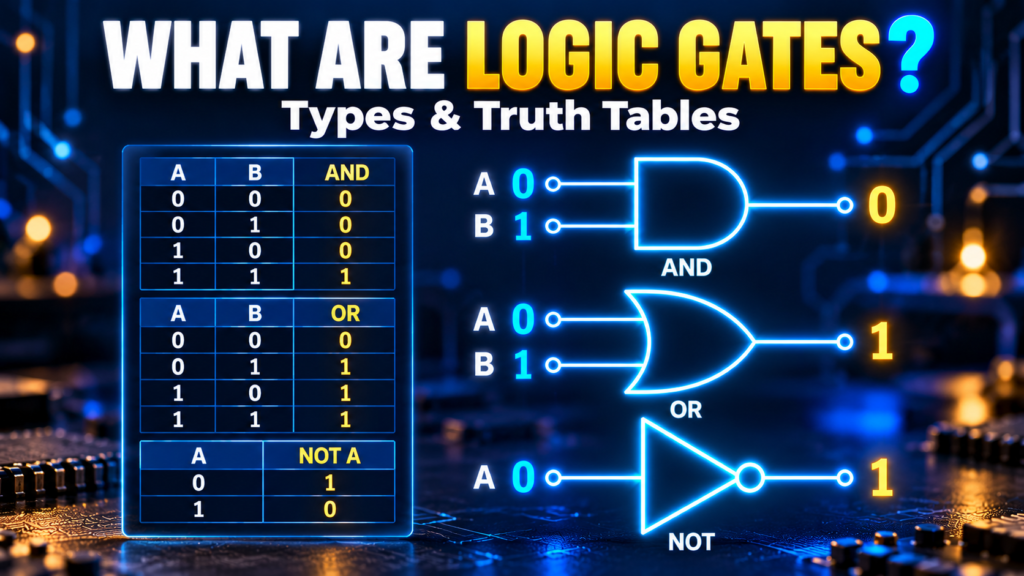
- AND: outputs 1 when all relevant inputs are 1.
- OR: outputs 1 when at least one input is 1.
- NOT: inverts one input.
- NAND: the inverse of AND.
- NOR: the inverse of OR.
- XOR: for two inputs, outputs 1 when they differ.
- XNOR: for two inputs, outputs 1 when they match.
Two-input truth tables
| A | B | AND | OR | NAND | NOR | XOR | XNOR |
|---|---|---|---|---|---|---|---|
| 0 | 0 | 0 | 0 | 1 | 1 | 0 | 1 |
| 0 | 1 | 0 | 1 | 1 | 0 | 1 | 0 |
| 1 | 0 | 0 | 1 | 0 | 0 | 1 | 0 |
| 1 | 1 | 1 | 1 | 0 | 0 | 0 | 1 |
For NOT, input 0 gives output 1, and input 1 gives output 0. For multi-input XOR functions, the common extension is odd parity; don’t carry the two-input wording over without checking the defined function.
Writing Boolean expressions for logic gates
Using common notation, AND is written A·B, OR is A + B, and NOT can be written ¬A. These are logical operations, not ordinary arithmetic on arbitrary numbers.
For two inputs, XOR can be expressed as (A AND NOT B) OR (NOT A AND B). The output is true for either input alone, but false when both match.
NAND and NOR are called universal logic gates because combinations of either type can implement any Boolean function.
Build a small decision step by step
Suppose an indicator should light when a button is pressed and a cover sensor reports closed. Define A = button pressed and B = cover closed.
- State the desired behavior in words.
- Assign a clear meaning to each logic state.
- Write the expression Y = A AND B.
- List all four input combinations in a truth table.
- Check that only A = 1 and B = 1 produces Y = 1.
- Choose compatible hardware and test the implementation.
This is a learning example, not a safety-rated interlock design. Machinery protection requires appropriate safety architecture and validation beyond a simple gate.
Real logic gates have limits
Propagation delay and glitches
Outputs don’t change instantly. When signals travel through different paths, temporary output glitches can occur before the circuit settles.
That matters when a signal clocks a register or controls an asynchronous input. A steady-state truth table alone doesn’t describe every timing event.
Inputs, outputs, and power
- Connect supply and ground correctly and provide recommended decoupling.
- Don’t leave inputs floating unless the manufacturer explicitly permits it.
- Check output current and loading rather than directly driving arbitrary loads.
- Handle mechanical-switch bounce where it affects behavior.
- Keep signals within the specified input range.
Some outputs are open-drain and require pull-ups. Package appearance doesn’t tell you the logic family, pinout, or output structure.
Start with a truth table
Logic gates turn clear rules into electrical decisions. Correct hardware needs both the right Boolean function and compatible voltage, loading, and timing.
Write a truth table for an indicator that turns on when either of two buttons is pressed. Then compare the OR and XOR outputs when both buttons are pressed together.



Comments
Comments are currently closed.