
What Is Capacitance? Formula, Units and Applications
A camera flash can release energy in a brief burst. A tiny capacitor near a chip can help keep its supply steady. Both rely on the same property.
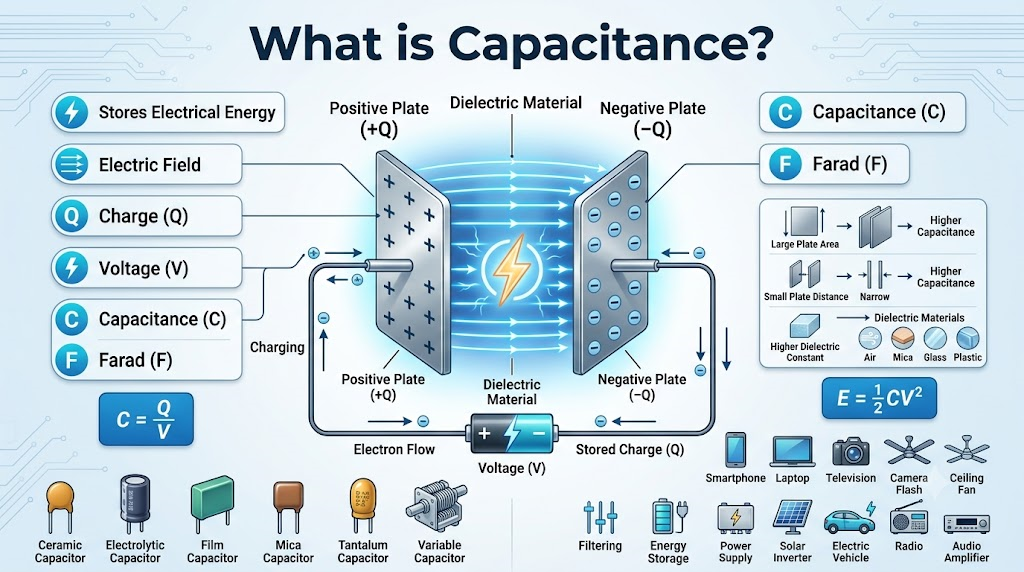
Capacitance describes how much separated charge a system stores for a given voltage. A capacitor uses conductors separated by an insulating dielectric to store energy in an electric field. Its value tells you part of the story; voltage rating, losses, and temperature matter too.
Formula and units
For an ideal linear capacitor, C = Q/V, where C is capacitance in farads, Q is the magnitude of charge on either plate, and V is the voltage between them.
The plates carry equal and opposite charges in the ideal two-terminal model. The capacitor doesn’t need a net charge overall to store energy.
- 1 microfarad, or µF, = 10−6 F.
- 1 nanofarad, or nF, = 10−9 F.
- 1 picofarad, or pF, = 10−12 F.
A charge calculation
A 100 µF ideal capacitor charged to 5 V has Q = CV = 100 × 10−6 × 5 = 500 µC on each plate in magnitude.
For nonlinear devices, capacitance can depend on voltage. A nominal marking doesn’t guarantee the same effective value at every operating point.
What determines the value?
For an ideal parallel-plate arrangement with negligible fringing, C = εA/d. Larger plate area increases capacitance, while greater separation reduces it.
The dielectric’s permittivity also affects the value. Practical capacitors use layered, wound, or other structures to pack useful area into a small package.
Real dielectric behavior introduces trade-offs. Some ceramic capacitors lose substantial effective capacitance with DC bias; others prioritize stability rather than high value per unit volume.
How a capacitor responds to changing voltage
For constant capacitance, i = C × dv/dt. Faster voltage change requires more current. An ideal capacitor at a fixed DC voltage carries no steady current.
That doesn’t mean a capacitor always blocks every DC-related event. It conducts charging current during a change, and real parts also have leakage.
In AC circuits, ideal capacitive reactance is XC = 1/(2πfC). Higher frequency reduces its magnitude, but real resistance and inductance eventually affect behavior.
Common capacitor types compared
| Type | Common use | Check carefully |
|---|---|---|
| Ceramic | Decoupling and small signal networks | Dielectric class, DC bias, temperature |
| Aluminum electrolytic | Bulk storage and supply smoothing | Polarity, ripple current, lifetime |
| Film | Filtering and suitable pulse applications | Voltage, pulse rating, physical size |
| Supercapacitor | Energy buffering and backup | Cell voltage, leakage, balancing needs |
Choose capacitance and technology together. A high nominal value is not useful if the part can’t handle the ripple current, voltage, or environment.
RC charging step by step
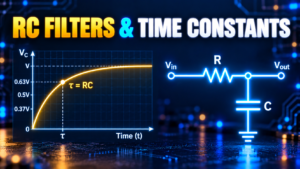
Connect an initially discharged ideal capacitor to a DC source through a resistor. The time constant is τ = RC.
- Convert the values into ohms and farads.
- Multiply R and C to obtain seconds.
- After one time constant, voltage reaches about 63.2% of its final change.
- After five time constants, it reaches about 99.3%.
- Compare with real behavior, allowing for leakage and component tolerances.
With 10 kΩ and 100 µF, τ = 10,000 × 0.0001 = 1 second. From a 5 V ideal source, capacitor voltage is about 3.16 V after one second.
Stored energy and handling
An ideal linear capacitor stores E = ½CV². The 100 µF capacitor at 5 V stores 0.00125 J, or 1.25 mJ.
Energy increases with voltage squared. Larger capacitors and higher voltages can remain hazardous after power is removed. Follow equipment-specific discharge and verification procedures; don’t short terminals with a tool.
Calculate, then check the real part
Capacitance links charge, voltage, current change, and stored energy. Real performance also depends on construction and operating conditions.
Try the RC example with 47 µF instead of 100 µF. Calculate the new time constant, then inspect a capacitor datasheet for tolerance, voltage rating, and effective capacitance under bias.
Comments
Comments are currently closed.