
Electrical Grounding: Purpose, Types and How It Works
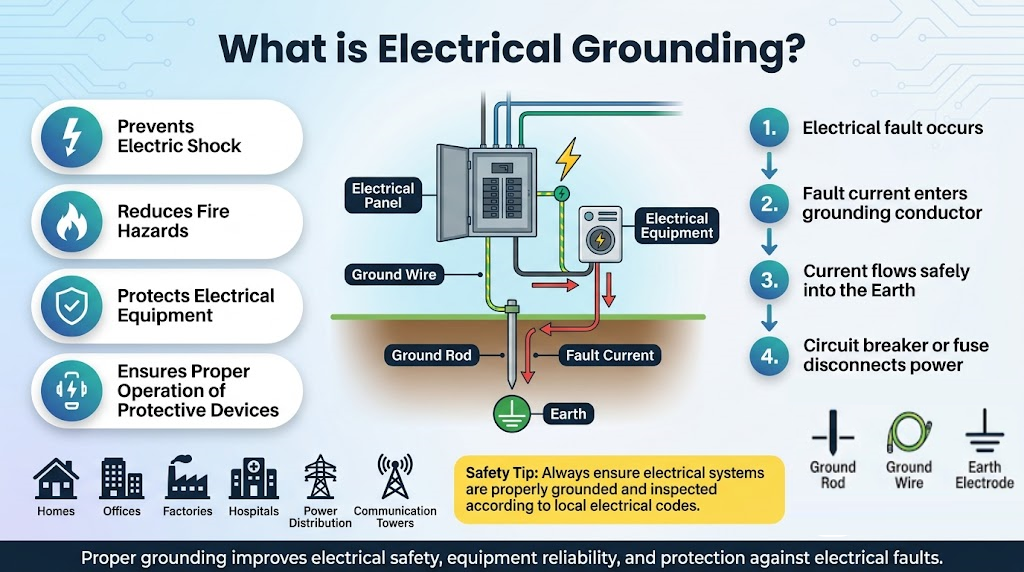
A metal appliance casing should never become a dangerous live surface. Protective conductors and correctly selected protection help keep a fault from turning into a lasting shock hazard.
Electrical grounding, also called earthing, connects specified parts of a system to Earth. Protective bonding connects conductive parts to control dangerous potential differences and support fault protection. They work as part of a coordinated system—not as a stand-alone guarantee of safety.
Electrical grounding, bonding, and neutral
The earth connection establishes a reference and forms part of the protection arrangement. Bonding provides intentional conductive connections between specified parts.
A protective conductor, commonly called PE, serves a protective function. A neutral conductor can carry normal load current. Their connections depend on the system arrangement and applicable requirements.
- Earthing electrode: a conductive part in contact with the ground.
- Main earthing terminal: a central connection point for specified protective and earthing conductors.
- Protective bonding: connections intended to reduce dangerous differences in potential.
- Fault loop: the complete path through which fault current returns to its source.
Never improvise a neutral-to-earth link at an appliance or socket. A connection that appears to solve one symptom can create a serious hazard.
How electrical grounding supports fault protection
Consider insulation damage that lets a line conductor contact a metal enclosure. In an appropriately designed installation, protection must limit how long a dangerous condition can persist.
- The fault connects the supply to an exposed conductive part.
- The protective arrangement provides a return path toward the source.
- Fault current or residual-current imbalance is detected by suitable protection.
- The relevant protective device disconnects the affected circuit within the required conditions.
- The fault is investigated and repaired before normal service resumes.
This is a conceptual sequence, not a procedure for testing or modifying a live installation. Protection depends on the entire path and the device characteristics.
Current doesn’t simply disappear into the ground
In many TN arrangements, a metallic protective path is central to returning fault current to the source. Soil isn’t the only path, and it often isn’t the principal one.
In a TT arrangement, the electrode and soil path can limit fault current enough that ordinary overcurrent protection alone may not disconnect quickly. Suitable residual-current protection is therefore an essential part of the design.
Common earthing systems compared
| Arrangement | Basic characteristic | Protection concern |
|---|---|---|
| TN | Exposed conductive parts connect to the source’s earthed point through protective conductors | Fault-loop impedance and disconnection coordination |
| TT | The installation uses an earth electrode separate from the source electrode | Electrode path and suitable residual-current protection |
| IT | The source is isolated from Earth or connected through impedance | Insulation monitoring and fault management |
These are broad descriptions. Subtypes, permitted connections, and detailed measures must be established for the actual installation.
Electrical grounding and protective devices
In electrical grounding systems, a fuse or circuit breaker responds to specified overcurrent conditions. An RCD responds to an imbalance between monitored current paths, within its design characteristics.
An RCD doesn’t replace every other protective measure, and an ordinary RCCB doesn’t provide overload protection by itself. Combined devices can provide both functions.
Electrical grounding also doesn’t make touching a faulty appliance safe while protection is operating. Touch voltage and disconnection time still matter.
Common misconceptions
- “Any earth rod is enough.” Electrode performance is only part of the system assessment.
- “One resistance number proves safety.” The required checks depend on the arrangement and protective devices.
- “Neutral and PE are interchangeable.” They have different functions and permitted connections.
- “Every appliance needs an earth wire.” Class II equipment uses a different protective construction and must follow its manufacturer’s design.
Signal ground in electronics isn’t automatically protective earth either. Its role may be a circuit reference, and isolation arrangements can keep it separate.
Understand the arrangement before the hardware
Electrical grounding is useful only as part of a properly designed, installed, and verified protective system. Bonding, return paths, and disconnection must work together.
For study, draw the conceptual fault loop for TN and TT systems and compare the return paths. For an actual installation, have a qualified electrician identify the arrangement and perform the required inspection and tests.


Comments
Comments are currently closed.