
Active vs Passive Components: Differences and Examples
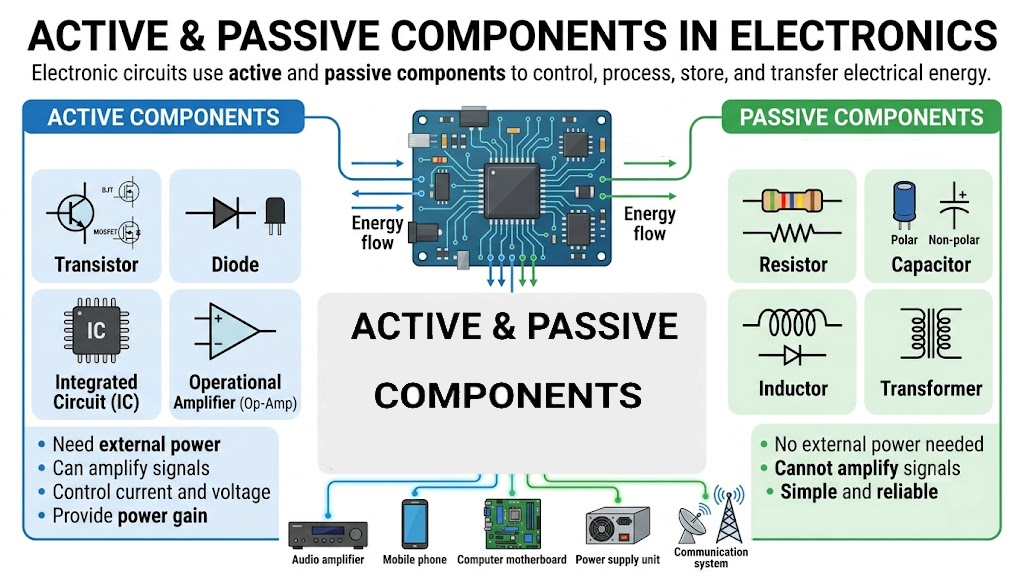
A transformer can raise voltage without becoming an amplifier. A transistor can control a much larger signal, but it needs energy from somewhere.
The active vs passive components distinction makes sense when you ask how a device handles energy. Using the circuit-analysis convention here, active circuits can supply power gain using a source; passive components dissipate, store, or transfer energy without generating net energy.
Active vs passive components: the main idea
A passive resistor converts electrical energy mainly into heat. A capacitor stores energy in an electric field, and an inductor stores it in a magnetic field.
An active amplifier uses a power supply so a small input can control a larger output signal. The additional output energy comes from that supply, not from the transistor or op-amp creating energy.
Terminology varies across textbooks. Some classify devices by controllability, others by gain or energy behavior. State the convention before treating a label as a universal rule.
Active vs passive components compared
| Feature | Active examples | Passive examples |
|---|---|---|
| Common devices | Transistors and powered amplifiers | Resistors, capacitors, inductors, transformers |
| Power gain | Possible in a suitable powered circuit | No net power gain in the passive network |
| Typical function | Amplification, control, switching | Limiting, filtering, storage, coupling |
| Energy relationship | Controls energy supplied by a source | Transfers, stores, or dissipates supplied energy |
This active vs passive components table describes circuit roles. A transistor isn’t automatically amplifying whenever you connect it; bias, configuration, and operating region determine its behavior.
Passive parts can do more than reduce signals
Voltage gain isn’t power gain
An ideal transformer can step 12 V AC up to 24 V AC. Under ideal power transfer, the available secondary current is correspondingly lower.
For example, 12 V at 2 A is 24 W. An ideal 24 V output could deliver 1 A at that same power. Real losses reduce the available output.
Stored energy can return later
A charged capacitor can briefly power a load. That doesn’t make it a generator of new energy; it returns energy stored earlier.
Resonant passive networks can also produce large internal voltages. Component voltage and current ratings still matter, even without an active amplifier.
How an active circuit provides gain
Consider a sensor amplifier powered from a supply. A small sensor voltage influences transistor currents inside the amplifier, producing a larger output change.
The output is limited by supply voltage, load current, bandwidth, noise, and device ratings. An amplifier can distort or saturate if you ask for more than the circuit can deliver.
In active vs passive components discussions, “needs power” alone is a weak test. A resistor also requires applied energy to dissipate heat; the useful issue is the component’s electrical role.
What about diodes and batteries?
A diode is nonlinear and can rectify a signal, but a basic diode doesn’t provide power gain. Some teaching conventions nevertheless group all semiconductors as active devices.
A battery can supply energy from chemical storage and is treated as an active source in circuit theory. That doesn’t make it an amplifier. Keep “source,” “semiconductor,” and “gain device” distinct.
How to choose active vs passive components
- Define the required function: attenuation, filtering, amplification, switching, or energy conversion.
- Check whether the task needs power gain or only voltage transformation.
- Choose a circuit arrangement and identify its energy source.
- Check voltage, current, power, frequency, and temperature limits.
- Calculate expected behavior, including losses and component tolerances.
- Test the circuit under the intended load.
- A passive divider can reduce voltage but is affected by loading.
- An active buffer can reduce loading, within its operating limits.
- A passive RC filter is simple; an active filter adds powered stages and different trade-offs.
Follow the energy
Active vs passive components is a useful comparison when you focus on energy and circuit function. Labels become less confusing once you separate voltage gain from power gain.
Draw a voltage divider and a powered voltage follower. Explain what each does, where its output energy comes from, and how connecting a load changes the result.


Comments
Comments are currently closed.