
What Is an Inverter? Working Principle, Types and Uses
The power goes out, but your fan keeps turning. What’s keeping it running?
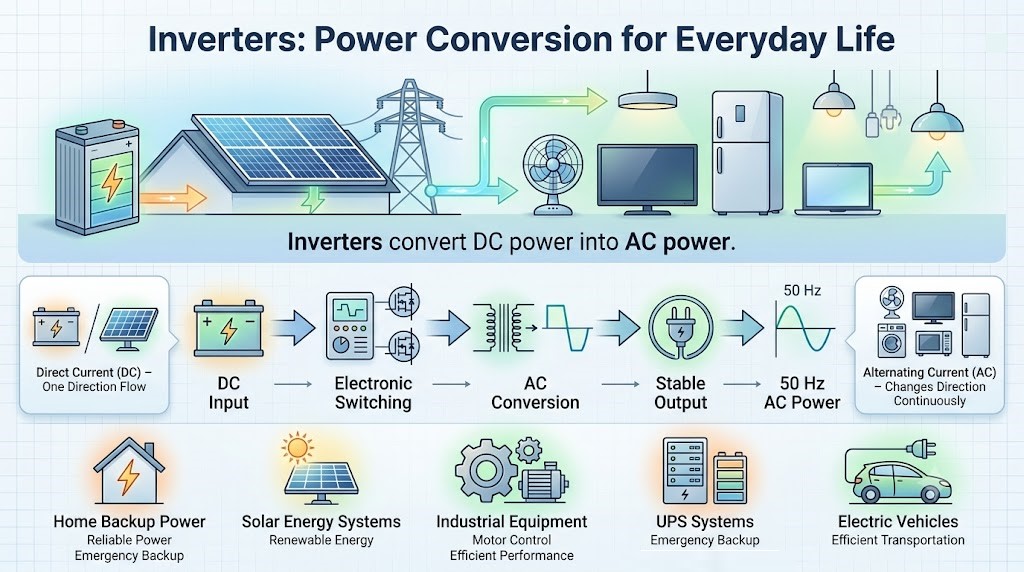
An inverter converts direct current (DC) from a source such as a battery into alternating current (AC) that compatible appliances can use. It doesn’t create electricity; it changes how electrical energy is delivered.
Once you understand that conversion, the different waveforms, ratings and backup options become much easier to follow.
How does an inverter work?
A battery supplies DC, which has a fixed voltage polarity. Household AC reverses polarity repeatedly. Electronic switches make that change possible.
Here’s a simplified view of the process:
- Receive DC power. Energy comes from a battery, solar panels or a DC link supplied by another converter.
- Switch it electronically. Power transistors, often MOSFETs or IGBTs, turn on and off in a controlled sequence.
- Build the AC waveform. A bridge circuit can apply positive and negative voltage across the output. Many designs use pulse-width modulation, or PWM, to control the pulses.
- Condition and regulate the output. Filters reduce unwanted switching components. Feedback helps control voltage or current as operating conditions change.
Why switching frequency isn’t output frequency
A household unit intended for Indian mains-compatible appliances typically produces 50 Hz AC. Its transistors may switch thousands of times per second to shape that output.
Those are two different frequencies. In motor drives, the controller deliberately changes the output frequency to help control motor speed.
Main components inside an inverter
The exact circuit depends on its purpose, but you’ll commonly find:
- Power switches: handle the energy being converted.
- Gate drivers: provide the signals needed to operate those switches.
- Controller and sensors: measure conditions and adjust operation.
- Capacitors and inductors: store energy briefly and manage ripple or filtering.
- Protection and cooling: help manage faults, overloads and heat.
Some designs include a transformer for voltage conversion or electrical isolation. Others are transformerless. A battery may sit alongside the unit in a backup system, but it isn’t a required internal component in every design.
Inverter output types: waveform comparison
The output shape affects how connected equipment behaves. These are the three common descriptions you’ll see:
| Waveform | What it looks like | What you should know |
|---|---|---|
| Square wave | Abrupt changes between positive and negative voltage | Contains strong harmonics; unsuitable for many appliances. |
| Modified sine wave | A stepped approximation, usually with zero-voltage intervals | Some loads may buzz, run hotter or fail to operate correctly. |
| Pure sine wave | A close approximation to a smooth sine wave | Generally offers broader appliance compatibility when all other ratings match. |
“Pure sine wave” doesn’t mean every appliance will work. You still need the correct voltage, frequency, continuous power and starting capacity.
Also, waveform quality and conversion efficiency are separate specifications. Don’t assume one waveform automatically makes every product more efficient.
Inverter types by application and their uses
Home backup systems
These supply selected loads when mains power fails. Many home backup products combine DC-to-AC conversion, a battery charger and automatic changeover in one enclosure.
You might run lights, fans and a router, provided the complete system can support their combined demand.
Solar power systems
A solar inverter converts electricity from photovoltaic panels into usable AC. Standard grid-tied models operate with the utility supply and normally stop supplying power during an outage.
Off-grid and suitably configured hybrid systems can supply local loads independently. Backup requires compatible equipment and proper isolation; the word “hybrid” alone doesn’t guarantee it.
Motor drives and electric vehicles
Industrial drives use controlled AC voltage and frequency to operate motors. Electric vehicles also convert battery DC into the controlled AC needed by their traction motors.
These are specialised systems. A household backup unit isn’t interchangeable with a motor drive.
Understanding inverter power ratings and battery runtime
Watts, VA and starting power
Watts (W) describe real power. Volt-amperes (VA) describe apparent power. Where both limits are specified, your load must stay within both.
For a single-phase AC load, W = VA × power factor. A 1,000 VA label therefore doesn’t automatically mean 1,000 W of usable output; check the stated watt rating.
Motors and compressors may need a brief starting surge above their running demand. Check how much surge power the unit can supply and for how long.
A simple DC input example
Suppose your appliances draw 200 W and conversion efficiency is an assumed 90%:
- DC input power ≈ 200 ÷ 0.90 = 222 W.
- At an actual 12 V input, current ≈ 222 ÷ 12 = 18.5 A.
This is an illustration, not a product specification. Input current rises if battery voltage falls while output power stays the same. Idle consumption also matters, especially with small loads.
What determines backup time?
A bigger inverter doesn’t automatically give you longer backup. Runtime depends mainly on usable battery energy, load demand and conversion losses.
Approximate runtime in hours = usable battery energy in Wh × conversion efficiency ÷ AC load in W.
If 600 Wh is usable and efficiency is 90%, a steady 200 W load gives an estimate of 2.7 hours. Battery condition, temperature, discharge rate, cutoff settings and idle losses can change the result.
What to check before choosing an inverter
- List your loads. Add the running watts of equipment you’ll use together.
- Check startup demand. Look up motor and compressor requirements rather than guessing.
- Match the electrical ratings. Confirm output voltage, frequency, waveform, W and VA limits.
- Check the DC source. Battery voltage, discharge capability, chemistry and charging settings must suit the system.
- Check backup behaviour. Transfer time matters if your computer or other equipment can’t tolerate a short interruption.
- Plan installation. Follow the manufacturer’s requirements for cooling, cables, protection and earthing.
Have mains and grid connections installed by a qualified professional. Never feed power into a wall socket or connect a standalone unit directly to the utility supply.
Common inverter questions
Is an inverter the same as a UPS?
No. A UPS is a complete system designed to maintain power to its loads. It commonly includes energy storage and a DC-to-AC stage, but transfer behaviour depends on the UPS design.
Can it work without a battery?
Yes, in designs that use another suitable DC source. A standard grid-connected solar system can operate without battery storage, although that doesn’t make it an outage backup system.
Does a larger rating reduce my electricity bill?
No. A higher rating means greater supported load capacity under specified conditions. Conversion and battery charging have losses; savings depend on the wider energy system and how you use it.
Your next step: start with the load
An inverter makes DC energy usable by AC equipment. The right choice depends on what you need to run, how it starts and whether you need backup during a power cut.
Write down your essential appliances and their power ratings. Then compare that list with the product’s continuous output, surge limits and battery requirements.
Comments
Comments are currently closed.