What Is a Closed Circuit? Meaning, Examples, and Diagrams
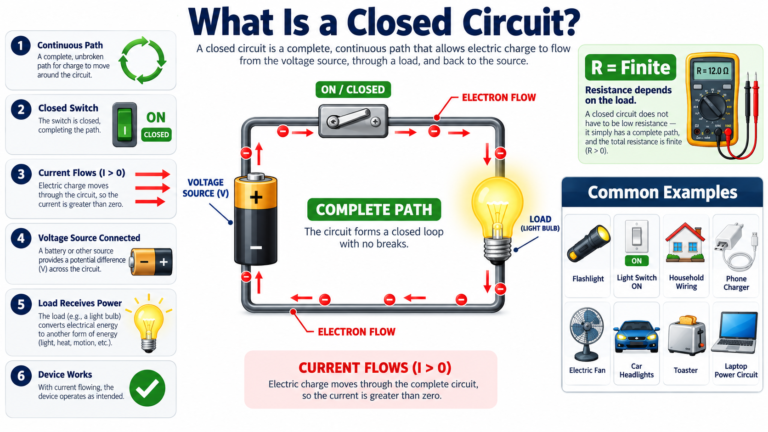
A closed circuit has a complete electrical path around which current can flow under suitable source and component conditions. In a simple battery, switch, and lamp…
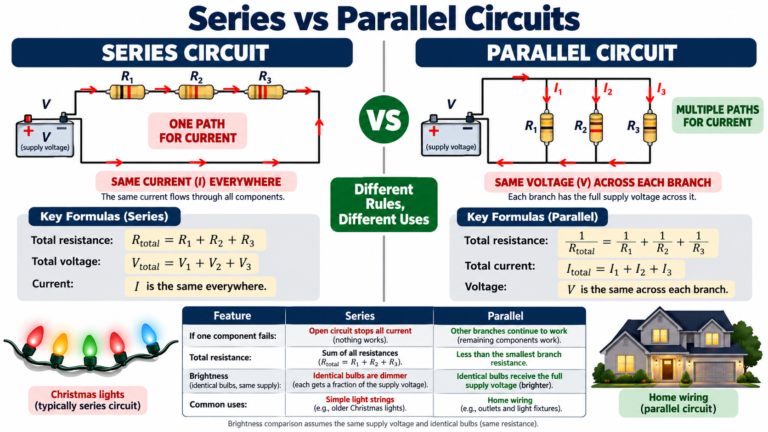
Series vs parallel circuits is a comparison of connection patterns. Components in a simple series path carry the same current because there is no branching between…
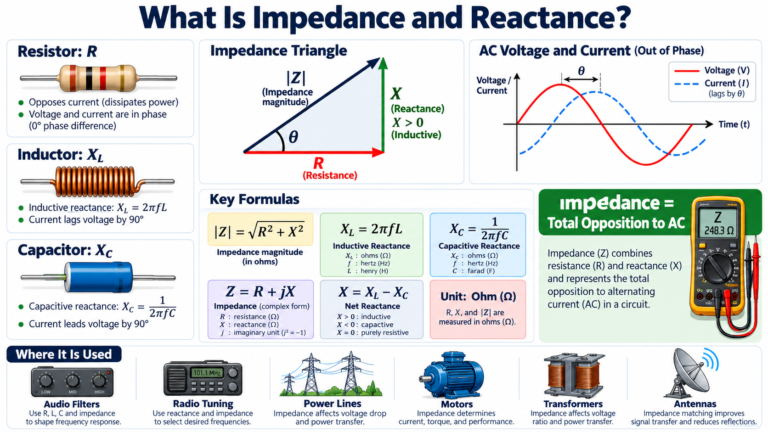
Impedance and reactance describe how circuit elements respond to alternating electrical signals. Impedance is the total opposition represented by the complex ratio of voltage phasor to…
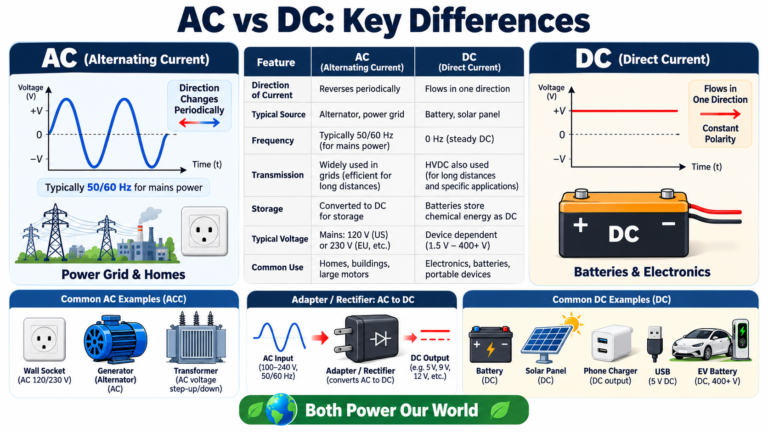
AC vs DC describes a difference in how electrical current behaves over time. Alternating current reverses direction, while direct current remains unidirectional. When discussing voltage, AC…
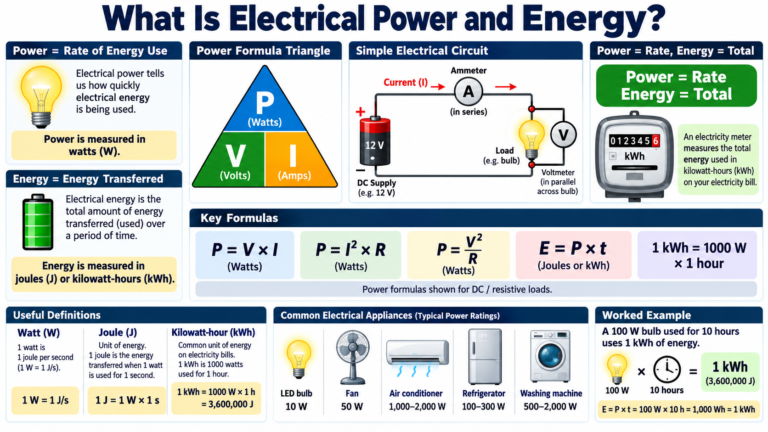
Understand electric power, watts, kilowatt-hours, and your electricity bill with clear formulas, appliance examples, power factor basics, and practical tips.
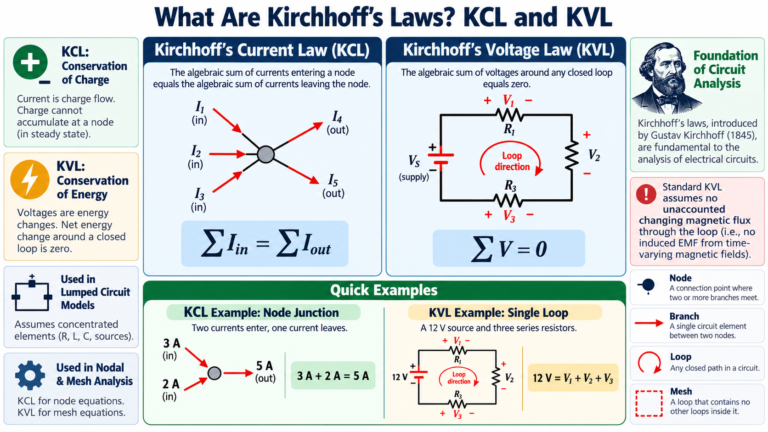
Kirchhoff’s laws are two circuit-analysis rules that express charge balance at a node and voltage balance around a loop. Kirchhoff’s current law, or KCL, relates currents…
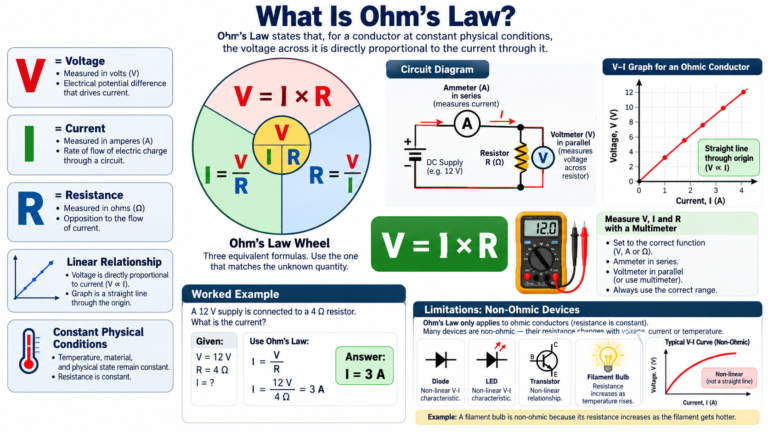
Ohm’s law states that the current through an ohmic conductor is proportional to the voltage across it when physical conditions, particularly temperature, remain constant. The familiar…
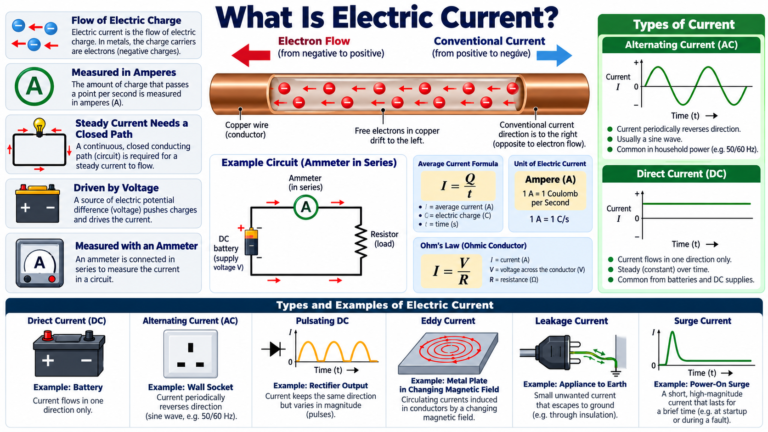
Electric current is the rate at which electric charge passes through a chosen surface, such as the cross-section of a wire. Its SI unit is the…