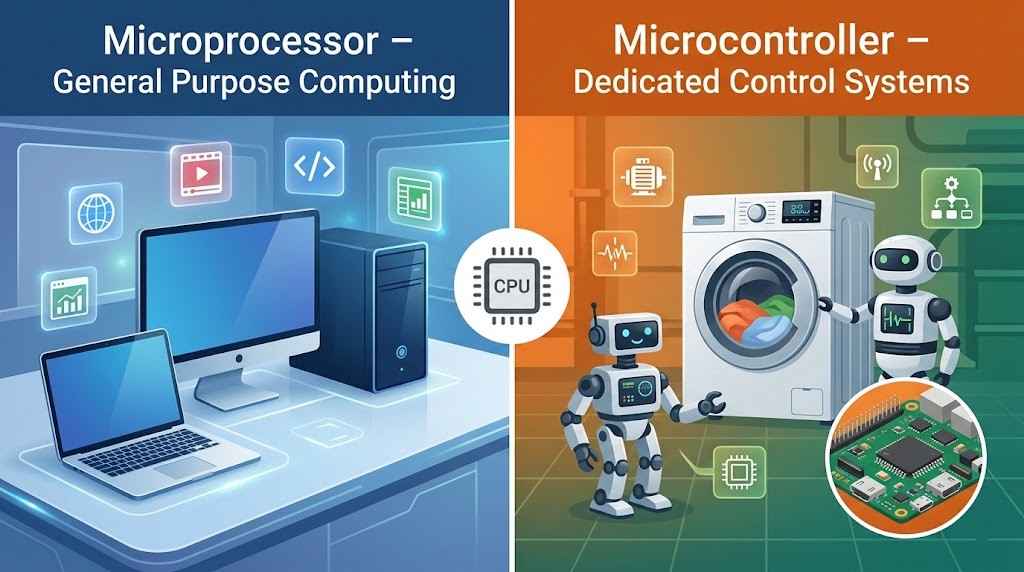
In modern electronics, both microprocessors and microcontrollers play a crucial role in computing and control systems. Although they may appear similar because both contain a processing unit, they are designed for very different purposes.
A microprocessor is mainly used for general-purpose computing tasks like in computers and laptops, while a microcontroller is designed for dedicated control applications such as washing machines, robots, and embedded systems.
Understanding the differences between these two helps learners choose the right device for a specific application and understand how modern electronic systems are built.
What is a Microprocessor?
A microprocessor is a central processing unit (CPU) integrated on a single chip. It does not include memory or input/output peripherals internally. Instead, it depends on external components for memory and I/O operations.
Microprocessors are designed for high-performance computing tasks and are commonly used in systems that require complex processing.
Examples of Microprocessors:
- Intel Core i3, i5, i7
- AMD Ryzen series
- Intel Pentium processors
Key Characteristics:
- High processing speed
- Requires external memory and I/O devices
- Suitable for complex applications
- Used in personal computers and servers
What is a Microcontroller?
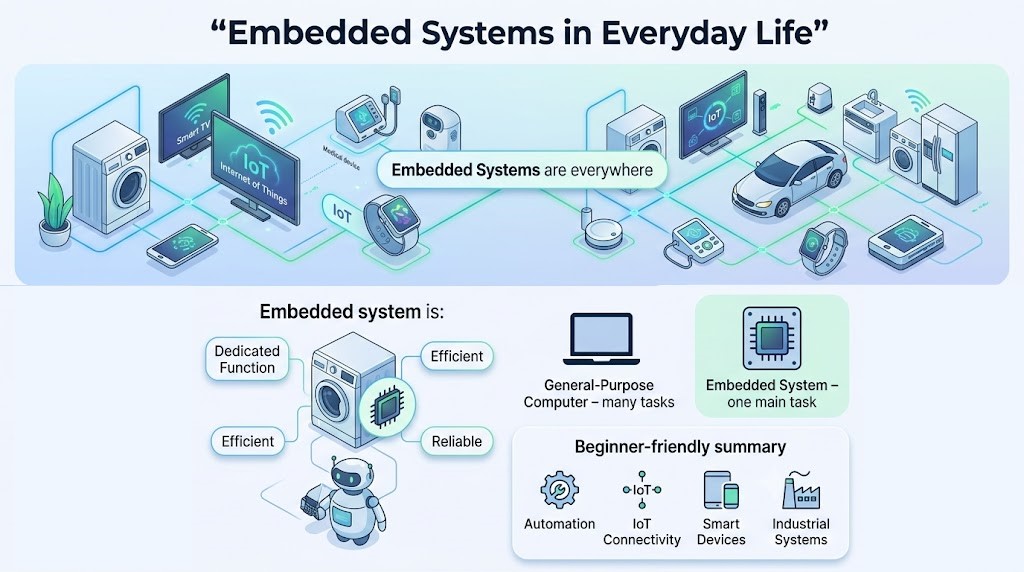
A microcontroller is a compact integrated circuit that contains a CPU, memory, and input/output peripherals on a single chip. It is designed for specific control-based applications in embedded systems.
Microcontrollers are optimized for low power consumption and real-time control tasks.
Examples of Microcontrollers:
- 8051 Microcontroller
- PIC16F877A Microcontroller
- ATmega328 Microcontroller
- STM32 Microcontroller
- ESP32 Microcontroller
Key Characteristics:
- Compact and low-cost
- Includes CPU, memory, and I/O on one chip
- Designed for dedicated tasks
- Used in embedded systems
Architecture Comparison
Microprocessor Architecture
A microprocessor consists mainly of:
- CPU (Arithmetic Logic Unit + Control Unit)
- External RAM
- External ROM
- External Input/Output devices
- System bus (address, data, and control bus)
This means a microprocessor system is built using multiple chips connected together, making it more flexible but complex.
Microcontroller Architecture
A microcontroller consists of:
- CPU
- Internal RAM
- Internal ROM/Flash memory
- I/O ports
- Timers and counters
- Communication modules (UART, SPI, I2C)
All components are integrated into a single chip, making it compact and efficient.
Working Principle Comparison
Microprocessor Working
- Fetches data from external memory
- Processes instructions using the CPU
- Sends results to external devices
- Relies heavily on external components
Microprocessors are designed for multitasking and complex computing operations.
Microcontroller Working
- Executes program stored in internal memory
- Reads inputs from built-in I/O ports
- Processes data using internal CPU
- Produces output to control devices directly
Microcontrollers are designed for real-time control applications.
Key Differences Between Microprocessor and Microcontroller
1. Definition
- Microprocessor: A CPU on a chip used for general-purpose computing.
- Microcontroller: A complete system with CPU, memory, and I/O on a single chip.
2. Components
- Microprocessor: Only CPU; requires external memory and I/O.
- Microcontroller: CPU + RAM + ROM + I/O integrated internally.
3. Application Type
- Microprocessor: Used in computers, laptops, servers.
- Microcontroller: Used in embedded systems like appliances and automation.
4. Complexity
- Microprocessor: Complex system design with external components.
- Microcontroller: Simple and compact design.
5. Cost
- Microprocessor: Expensive due to external components.
- Microcontroller: Low cost due to integration.
6. Power Consumption
- Microprocessor: High power consumption.
- Microcontroller: Low power consumption.
7. Speed
- Microprocessor: Very high speed for complex tasks.
- Microcontroller: Moderate speed sufficient for control tasks.
8. Memory
- Microprocessor: External memory required.
- Microcontroller: Internal memory available.
9. I/O Ports
- Microprocessor: External I/O interfaces needed.
- Microcontroller: Built-in I/O ports.
10. Real-Time Usage
- Microprocessor: Not ideal for real-time control.
- Microcontroller: Excellent for real-time applications.
11. Examples
- Microprocessor: Intel Core i7, AMD Ryzen
- Microcontroller: ATmega328 Microcontroller, 8051 Microcontroller, ESP32 Microcontroller
Comparison Table
| Feature | Microprocessor | Microcontroller |
|---|---|---|
| Definition | CPU on a chip | Complete system on a chip |
| Components | CPU only | CPU + Memory + I/O |
| Memory | External | Internal |
| I/O Ports | External | Built-in |
| Applications | PCs, laptops | Embedded systems |
| Power Consumption | High | Low |
| Cost | High | Low |
| Speed | Very high | Moderate |
| Complexity | High | Low |
| Real-time use | Not ideal | Ideal |
Applications Comparison
Microprocessor Applications
- Personal computers
- Laptops
- Servers
- High-performance computing systems
- Gaming systems
Microcontroller Applications
- Washing machines
- Microwave ovens
- Robotics
- Automotive systems
- Smart home devices
- IoT systems
Advantages and Limitations
Microprocessor Advantages
- Very powerful processing capability
- Suitable for multitasking
- High-speed computing
Microprocessor Limitations
- High cost
- High power consumption
- Requires complex system design
Microcontroller Advantages
- Low cost and compact
- Low power consumption
- Easy to program and integrate
Microcontroller Limitations
- Limited processing power
- Not suitable for heavy computing tasks
Conclusion
Microprocessors and microcontrollers are both essential components in modern electronics, but they serve different purposes. A microprocessor is designed for high-performance general-purpose computing, while a microcontroller is designed for dedicated control applications in embedded systems.
Microprocessors are commonly used in computers and servers, whereas microcontrollers are used in everyday electronic devices such as appliances, vehicles, and IoT systems. The integration of memory and I/O in microcontrollers makes them compact, efficient, and cost-effective.
Choosing between the two depends on the application requirements—processing power for microprocessors and control efficiency for microcontrollers.