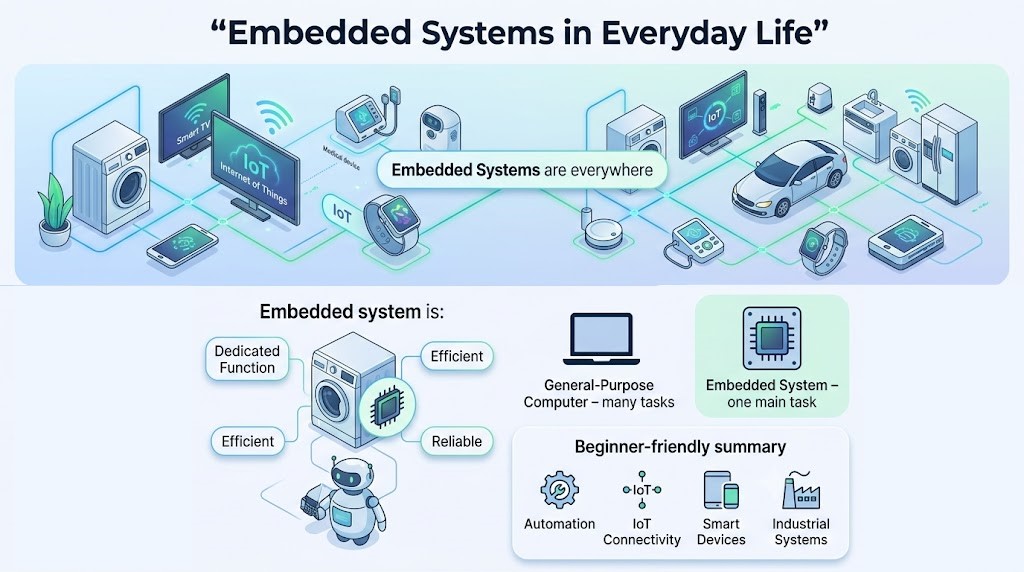
In today’s world, almost every electronic device we use contains some form of computing intelligence inside it. From washing machines and smart TVs to cars and medical devices, these systems rely on a special type of computer called an embedded system.
An embedded system is designed to perform a specific task or a set of dedicated functions within a larger system. Unlike general-purpose computers, which can run many different applications, embedded systems are built for one main purpose and operate with high efficiency and reliability.
As technology advances, embedded systems have become the backbone of modern electronics, automation, and the Internet of Things (IoT). This guide explains what embedded systems are, their structure, types, working, and real-world applications in a simple way for beginners.
What is an Embedded System?
An embedded system is a combination of hardware and software designed to perform a specific function within a larger mechanical or electrical system.
It is “embedded” because it is built into a device and is not a standalone computer like a laptop or desktop.
Definition (Simple):
An embedded system is a special-purpose computer designed to perform dedicated tasks efficiently and reliably.
Key Characteristics of Embedded Systems
Embedded systems have unique features that make them different from general computers:
- Dedicated Function: Performs one specific task
- Real-Time Operation: Responds quickly to inputs
- Small Size: Compact and integrated
- Low Power Consumption: Energy efficient
- High Reliability: Works continuously without failure
- Cost-Effective: Designed for mass production
- Minimal User Interface: Limited interaction with users
Examples of Embedded Systems
Embedded systems are present in almost every modern device:
- Washing machines
- Microwave ovens
- Air conditioners
- Digital watches
- Smart TVs
- Cars (engine control units)
- Traffic signal systems
- Medical devices like heart monitors
Structure of an Embedded System
An embedded system is mainly composed of hardware and software components working together.
1. Hardware Components
a) Microcontroller / Microprocessor
The core of an embedded system is a processing unit such as a microcontroller or microprocessor. It executes instructions and controls system operations.
Common examples include:
- 8051 Microcontroller
- ATmega328 Microcontroller
- PIC Microcontroller
- STM32 Microcontroller
b) Memory
Memory stores program instructions and data.
- ROM/Flash: Stores program permanently
- RAM: Temporary data storage during execution
c) Input Devices
These devices collect data from the environment:
- Sensors (temperature, light, motion)
- Switches
- Keypads
d) Output Devices
These devices act based on processed data:
- LEDs
- Displays
- Motors
- Buzzers
e) Communication Interfaces
Used for data exchange:
- UART
- SPI
- I2C
- CAN
2. Software Components
Software in embedded systems is usually called firmware.
It includes:
- Program code written in C, C++, or Assembly
- Operating instructions stored in memory
- Control algorithms for decision-making
The firmware is stored permanently in the system and runs automatically when powered ON.
Types of Embedded Systems
Embedded systems can be classified based on performance, functionality, and real-time requirements.
1. Standalone Embedded Systems
These systems operate independently without a host computer.
Examples:
- Digital cameras
- Microwave ovens
- Washing machines
They take input, process it, and produce output on their own.
2. Real-Time Embedded Systems
These systems must respond within a specific time limit.
Types:
a) Hard Real-Time Systems
- Missing a deadline can cause system failure
- Example: Airbags in cars
b) Soft Real-Time Systems
- Delays are acceptable but not ideal
- Example: Video streaming systems
3. Networked Embedded Systems
These systems are connected to a network for communication.
Examples:
- Smart home devices
- IoT systems
- Industrial monitoring systems
4. Mobile Embedded Systems
These are portable embedded systems used in mobile devices.
Examples:
- Smartphones
- Smartwatches
- GPS devices
Working of an Embedded System
The working of an embedded system is based on a continuous cycle of input, processing, and output.
Step 1: Input Collection
Sensors or input devices collect data from the environment.
Example:
A temperature sensor detects room temperature.
Step 2: Data Processing
The microcontroller processes the input using programmed instructions.
It compares data with predefined conditions.
Example:
If temperature > 30°C, turn ON fan.
Step 3: Decision Making
The system decides what action to take based on logic.
Step 4: Output Generation
The system activates output devices such as motors, lights, or alarms.
Step 5: Continuous Operation
This process repeats continuously in real-time.
Example: Automatic Street Light System
- Light sensor detects sunlight or darkness
- Embedded system reads sensor value
- If it is dark, system turns ON the light
- If it is bright, system turns OFF the light
This happens automatically without human intervention.
Applications of Embedded Systems
Embedded systems are used in almost every industry today.
1. Consumer Electronics
- Washing machines
- Refrigerators
- Smart TVs
- Air conditioners
They automate daily household tasks.
2. Automotive Industry
Modern vehicles use embedded systems for:
- Engine control units (ECU)
- ABS braking systems
- Airbag control systems
- Navigation systems
These improve safety and performance.
3. Industrial Automation
Factories use embedded systems for:
- Robotics
- Conveyor belt control
- Machine monitoring
- Process automation
This increases efficiency and reduces human error.
4. Healthcare Systems
Medical devices rely on embedded systems:
- Heart rate monitors
- MRI machines
- Blood pressure monitors
- Insulin pumps
They ensure accurate diagnosis and treatment.
5. Smart Home and IoT
Embedded systems are the backbone of IoT:
- Smart lighting systems
- Home security systems
- Smart thermostats
- Voice-controlled assistants
6. Communication Systems
Used in:
- Mobile phones
- Routers
- Network switches
- Satellite systems
They manage data transmission efficiently.
7. Aerospace and Defense
Embedded systems are used in:
- Aircraft control systems
- Navigation systems
- Radar systems
- Missile guidance systems
Advantages of Embedded Systems
- High efficiency
- Low power consumption
- Compact design
- Reliable performance
- Cost-effective production
- Real-time operation capability
Limitations of Embedded Systems
- Limited processing power
- Designed for specific tasks only
- Difficult to upgrade hardware
- Requires specialized programming knowledge
Future of Embedded Systems
Embedded systems are rapidly evolving with advancements in AI, IoT, and automation. Future systems will be:
- More intelligent with AI integration
- Highly connected through IoT networks
- Smaller and more energy-efficient
- Used in autonomous vehicles and smart cities
Conclusion
Embedded systems are specialized computing systems designed to perform dedicated tasks efficiently within larger devices. They combine hardware and software to provide real-time control, automation, and intelligent decision-making.
From household appliances to advanced aerospace systems, embedded systems play a vital role in modern technology. Understanding embedded systems is essential for anyone interested in electronics, robotics, or computer engineering.
As technology continues to grow, embedded systems will become even more powerful and widely used in shaping the future of smart devices and automation.