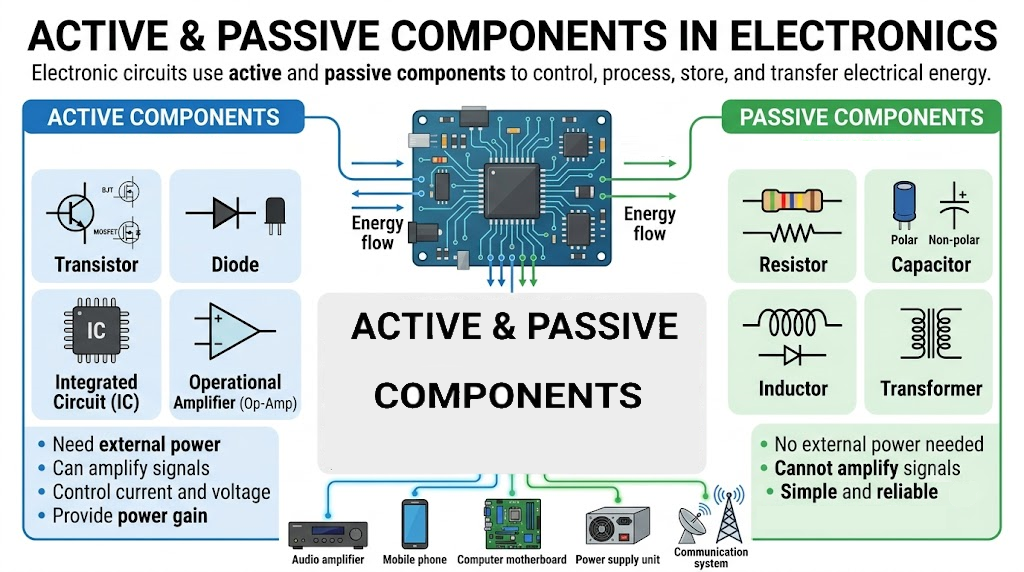
In electronics, transistors are fundamental components used for switching and amplification. Two of the most widely used types of transistors are BJT (Bipolar Junction Transistor) and MOSFET (Metal Oxide Semiconductor Field Effect Transistor).
Both devices are essential in analog and digital circuits, but they operate on different principles and are suited for different applications. Understanding the differences between MOSFET and BJT is important for students of electronics, electrical engineering, and embedded systems.
This guide explains their structure, working principles, characteristics, advantages, limitations, and applications in a simple and detailed manner.
What is a BJT (Bipolar Junction Transistor)?
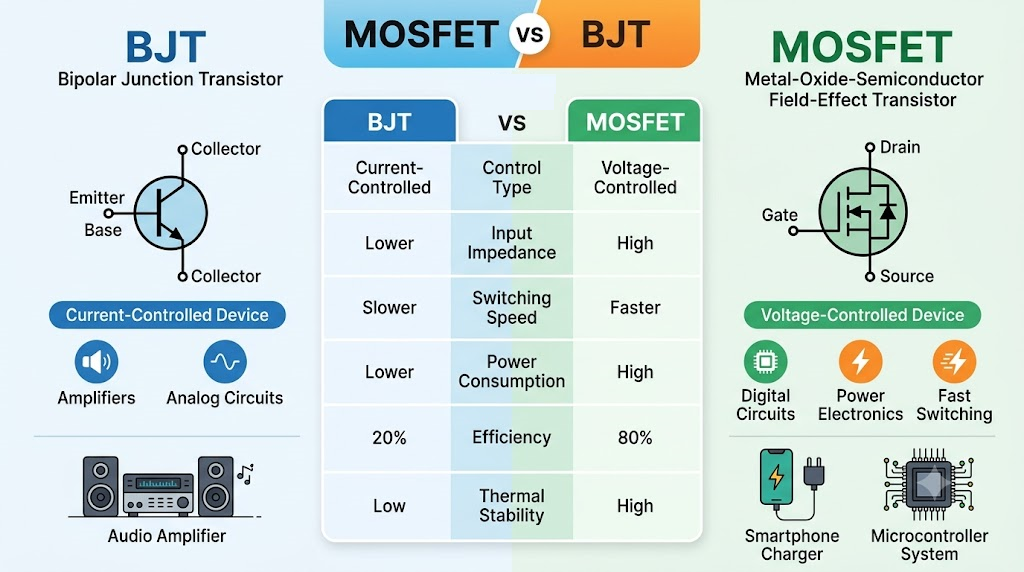
A BJT (Bipolar Junction Transistor) is a current-controlled device used for amplification and switching. It consists of three terminals:
- Emitter (E)
- Base (B)
- Collector (C)
BJTs are made using semiconductor materials and come in two types:
- NPN transistor
- PNP transistor
Working Principle of BJT
A BJT works by controlling a large current (collector-emitter current) using a small base current.
- A small input current at the base controls a larger output current.
- This makes BJTs suitable for amplification.
Key Features of BJT
- Current-controlled device
- Low input impedance
- High gain
- Faster response in analog circuits
- Used for amplification
What is a MOSFET?
A MOSFET (Metal Oxide Semiconductor Field Effect Transistor) is a voltage-controlled device widely used for switching and amplification in modern electronics.
It has three main terminals:
- Gate (G)
- Drain (D)
- Source (S)
MOSFETs are divided into:
- N-channel MOSFET
- P-channel MOSFET
Working Principle of MOSFET
A MOSFET works by using voltage applied at the gate terminal to control current flow between drain and source.
- No direct current flows into the gate.
- Voltage creates an electric field that controls conduction.
Key Features of MOSFET
- Voltage-controlled device
- Very high input impedance
- Low power consumption
- High switching speed
- Widely used in digital circuits and power electronics
Structure Comparison
BJT Structure
A BJT consists of three layers of semiconductor material:
- NPN or PNP arrangement
- Two PN junctions
The structure is designed for current flow control.
MOSFET Structure
A MOSFET consists of:
- Gate (insulated by oxide layer)
- Source
- Drain
- Substrate
The insulating oxide layer makes the gate electrically isolated.
Working Principle Comparison
How BJT Works
- A small base current is applied
- This allows a larger current between collector and emitter
- Output current is proportional to input current
👉 BJT = Current-controlled device
How MOSFET Works
- Voltage is applied to the gate
- Electric field forms a conductive channel
- Current flows between drain and source
👉 MOSFET = Voltage-controlled device
Key Differences Between MOSFET and BJT
1. Type of Control
- BJT: Current-controlled device
- MOSFET: Voltage-controlled device
2. Input Impedance
- BJT: Low input impedance
- MOSFET: Very high input impedance
3. Power Consumption
- BJT: Higher power consumption due to base current
- MOSFET: Lower power consumption
4. Switching Speed
- BJT: Slower switching
- MOSFET: Very fast switching
5. Thermal Stability
- BJT: Less stable at high temperature
- MOSFET: Better thermal stability
6. Efficiency
- BJT: Less efficient in high-speed switching
- MOSFET: Highly efficient in switching applications
7. Size and Integration
- BJT: Larger in modern IC design
- MOSFET: Compact and widely used in integrated circuits
8. Noise Performance
- BJT: Produces more noise
- MOSFET: Lower noise operation
9. Gain
- BJT: High current gain
- MOSFET: High voltage gain, but depends on design
10. Driving Requirement
- BJT: Needs continuous base current
- MOSFET: Needs only voltage at gate
Comparison Table
| Feature | BJT | MOSFET |
|---|---|---|
| Control Type | Current-controlled | Voltage-controlled |
| Terminals | Emitter, Base, Collector | Gate, Drain, Source |
| Input Impedance | Low | Very high |
| Power Consumption | Higher | Lower |
| Switching Speed | Slower | Faster |
| Efficiency | Moderate | High |
| Thermal Stability | Poor | Good |
| Noise | Higher | Lower |
| Driving Signal | Continuous current | Voltage only |
Applications of BJT
BJTs are widely used in:
- Audio amplifiers
- Signal amplification circuits
- Analog circuits
- Switching circuits
- Low-frequency applications
They are preferred where linear amplification is required.
Applications of MOSFET
MOSFETs are used in modern electronics such as:
- Power supplies
- DC-DC converters
- Motor control systems
- Digital circuits
- Microprocessors and microcontrollers
- High-speed switching circuits
They are widely used in power electronics and digital systems.
Advantages and Limitations
Advantages of BJT
- High gain in amplification
- Good linear response
- Simple design
Limitations of BJT
- High power consumption
- Slower switching speed
- Thermal instability
Advantages of MOSFET
- Very fast switching
- Low power consumption
- High efficiency
- Easy integration in ICs
Limitations of MOSFET
- Sensitive to static electricity
- More complex manufacturing
- Can be expensive in some cases
Real-World Example Comparison
BJT Example
In an audio amplifier:
- Small input signal at base
- Large amplified output at collector
- Used in speakers and radios
MOSFET Example
In a smartphone charger:
- Gate voltage controls power flow
- Efficient switching reduces heat loss
- Used in fast charging circuits
Conclusion
Both MOSFET and BJT are essential semiconductor devices used in modern electronics. However, they differ in their working principles and applications.
BJTs are current-controlled devices best suited for analog amplification, while MOSFETs are voltage-controlled devices widely used in digital circuits and power electronics due to their high efficiency and fast switching speed.
In modern electronic design, MOSFETs are more commonly used, especially in integrated circuits and high-speed applications, while BJTs are still valuable in analog and low-power amplification systems.
Choosing between MOSFET and BJT depends on the application requirements such as speed, power efficiency, cost, and signal type.