Electronic circuits are made up of different types of components that work together to perform specific functions. These components are broadly classified into two categories: active components and passive components. Understanding these components is essential in the field of basic electronics because they form the building blocks of all electronic devices such as radios, televisions, computers, mobile phones, and industrial control systems.
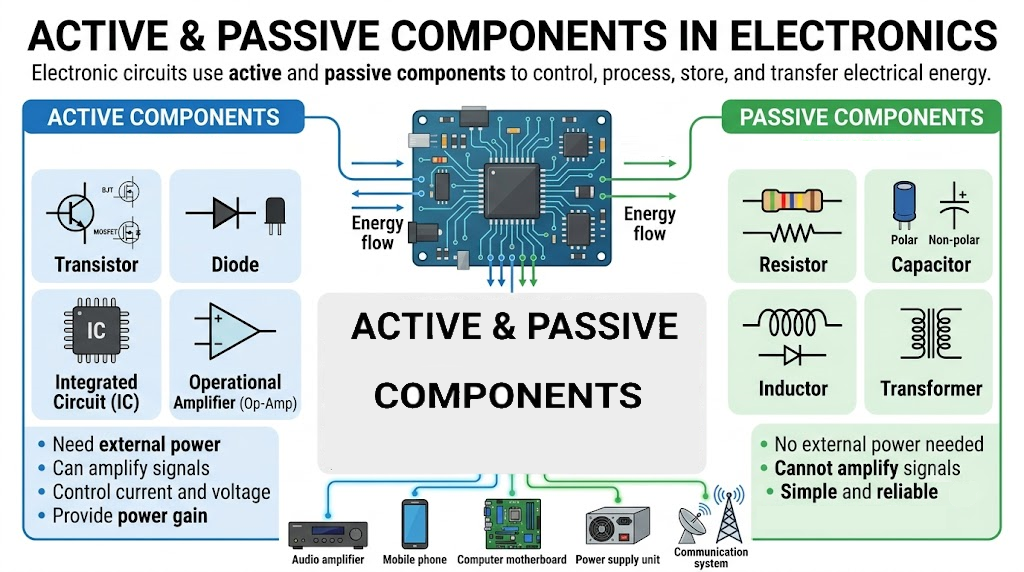
Active components require an external source of energy to operate and are capable of controlling the flow of electrical current. Passive components, on the other hand, do not require an external power source for their basic operation and cannot amplify electrical signals. Both types of components are necessary for designing and operating electronic circuits effectively.
Active Components
Definition
Active components are electronic devices that require an external power source to function properly. They have the ability to amplify signals, generate power gain, or control the flow of current in a circuit. These components play a crucial role in signal processing, switching, amplification, and computation.
Characteristics of Active Components
- Require an external power supply.
- Can amplify electrical signals.
- Provide power gain in a circuit.
- Control the flow of current and voltage.
- Usually made from semiconductor materials such as silicon and germanium.
Examples of Active Components
1. Transistor
A transistor is one of the most important active components in electronics. It is used for amplification and switching applications. Transistors are found in computers, mobile phones, televisions, and many other electronic devices.
Types of Transistors:
- Bipolar Junction Transistor (BJT)
- Field Effect Transistor (FET)
- MOSFET (Metal Oxide Semiconductor Field Effect Transistor)
Applications:
- Signal amplification
- Switching circuits
- Oscillators
- Digital logic circuits
2. Diode
A diode allows current to flow in only one direction. Although it is a semiconductor device, it is considered active because it controls current flow and requires semiconductor action.
Applications:
- Rectifiers
- Voltage regulation
- Signal clipping
- Protection circuits
3. Integrated Circuit (IC)
An Integrated Circuit is a collection of electronic components fabricated onto a single semiconductor chip. ICs can perform complex functions such as computation, memory storage, and signal processing.
Applications:
- Microprocessors
- Memory devices
- Amplifiers
- Communication systems
4. Operational Amplifier (Op-Amp)
An operational amplifier is a high-gain electronic amplifier widely used in analog circuits.
Applications:
- Signal amplification
- Filtering
- Mathematical operations
- Instrumentation systems
Advantages of Active Components
- Can amplify weak signals.
- Enable complex electronic functions.
- Essential for modern communication systems.
- Allow automation and control operations.
Disadvantages of Active Components
- Require external power.
- More complex than passive components.
- Can generate heat during operation.
- Generally more expensive.
Passive Components
Definition
Passive components are electronic devices that do not require an external source of power to perform their basic functions. They cannot amplify signals or provide power gain. Instead, they store, dissipate, or transfer electrical energy within a circuit.
Passive components are widely used for filtering, energy storage, voltage division, and current limiting.
Characteristics of Passive Components
- Do not provide signal amplification.
- Do not generate electrical energy.
- Store or dissipate energy.
- Simple construction and operation.
- Highly reliable and cost-effective.
Examples of Passive Components
1. Resistor
A resistor opposes the flow of electric current and is used to control voltage and current levels in a circuit.
Unit: Ohm (Ω)
Applications:
- Current limiting
- Voltage division
- Biasing circuits
- Heat generation
2. Capacitor
A capacitor stores electrical energy in the form of an electric field between two conductive plates separated by an insulating material.
Unit: Farad (F)
Applications:
- Energy storage
- Filtering
- Coupling and decoupling
- Timing circuits
3. Inductor
An inductor stores energy in the form of a magnetic field when current passes through it.
Unit: Henry (H)
Applications:
- Filters
- Transformers
- Power supplies
- Radio frequency circuits
4. Transformer
A transformer transfers electrical energy from one circuit to another through electromagnetic induction.
Applications:
- Voltage step-up and step-down
- Power transmission
- Isolation circuits
Advantages of Passive Components
- Simple design and construction.
- No external power source required.
- Highly reliable and durable.
- Less expensive than active components.
- Generate less heat.
Disadvantages of Passive Components
- Cannot amplify signals.
- Limited functionality.
- Larger components may be required for high-power applications.
Difference Between Active and Passive Components
| Active Components | Passive Components |
|---|---|
| Require external power supply | Do not require external power supply |
| Can amplify signals | Cannot amplify signals |
| Provide power gain | No power gain |
| Control current flow actively | Only store or dissipate energy |
| Usually semiconductor devices | Usually non-semiconductor devices |
| Examples: Transistor, Diode, IC, Op-Amp | Examples: Resistor, Capacitor, Inductor, Transformer |
Importance of Active and Passive Components
Both active and passive components are essential in electronic circuit design. Active components perform tasks such as amplification, switching, and signal processing, while passive components provide support functions like filtering, energy storage, and current control. A practical electronic circuit usually contains a combination of both types of components.
For example, in an audio amplifier, transistors or operational amplifiers increase the signal strength, while resistors and capacitors control voltage levels and filter unwanted noise. Similarly, in communication systems, active devices process signals and passive devices help in tuning and filtering.
Conclusion
Active and passive components are fundamental elements of all electronic systems. Active components, such as transistors, diodes, and integrated circuits, require external power and can amplify or control electrical signals. Passive components, including resistors, capacitors, inductors, and transformers, do not amplify signals but are responsible for storing, transferring, and dissipating energy. Understanding the characteristics, functions, advantages, and applications of these components is essential for studying and designing electronic circuits. Together, active and passive components form the foundation of modern electronics and enable the operation of countless electronic devices used in everyday life.