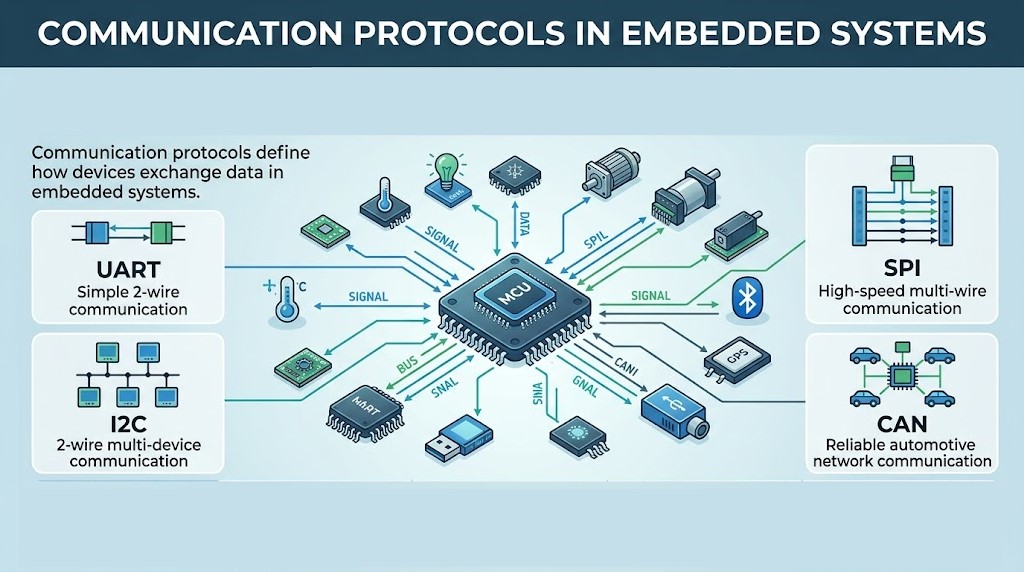
In embedded systems, communication between devices is essential for exchanging data and controlling operations. Microcontrollers, sensors, actuators, and other electronic modules must communicate efficiently to build smart and automated systems. This communication is made possible through communication protocols.
A communication protocol is a set of rules that defines how data is transmitted, received, and interpreted between devices. Without proper protocols, devices would not understand each other, leading to errors and system failure.
Embedded systems commonly use serial communication protocols such as UART, SPI, I2C, and CAN because they are simple, reliable, and efficient for short and long-distance communication.
This guide explains these four important communication protocols in a structured and beginner-friendly way.
What is a Communication Protocol?
A communication protocol is a standardized method that allows two or more electronic devices to exchange data in a structured and error-free manner.
Simple Definition:
A communication protocol is a set of rules that ensures proper data transfer between devices in an embedded system.
Why Communication Protocols are Important
Communication protocols are essential because they:
- Enable data exchange between devices
- Ensure accurate and reliable communication
- Reduce wiring complexity
- Improve system efficiency
- Support real-time applications
- Allow integration of multiple devices
Without communication protocols, embedded systems cannot function as interconnected smart systems.
Types of Communication in Embedded Systems
Communication in embedded systems is mainly classified into:
1. Serial Communication
Data is transmitted one bit at a time.
Examples:
- UART
- SPI
- I2C
2. Parallel Communication
Multiple bits are transmitted simultaneously.
- Faster but requires more wires
- Less commonly used in modern embedded systems
1. UART (Universal Asynchronous Receiver Transmitter)
What is UART?
UART is a simple serial communication protocol used for asynchronous data transmission between two devices.
Key Feature:
It does not use a clock signal for synchronization.
Working of UART
UART communication involves two devices:
- Transmitter (TX)
- Receiver (RX)
Steps:
- Data is sent bit by bit from TX
- Start and stop bits are added
- Receiver reads data using agreed baud rate
- Data is reconstructed at the receiver side
UART Frame Structure
A typical UART frame includes:
- Start bit
- Data bits (usually 8 bits)
- Parity bit (optional)
- Stop bit
Advantages of UART
- Simple design
- Requires only two wires
- Easy to implement
- Low cost
Limitations of UART
- Slower compared to other protocols
- Only two devices can communicate
- No shared bus system
Applications of UART
- GPS modules
- Bluetooth modules
- Serial communication between microcontrollers
- Debugging in embedded systems
2. SPI (Serial Peripheral Interface)
What is SPI?
SPI is a high-speed synchronous communication protocol used for short-distance communication between a master and multiple slave devices.
SPI Working
SPI uses four main lines:
- MOSI (Master Out Slave In)
- MISO (Master In Slave Out)
- SCLK (Serial Clock)
- SS/CS (Slave Select/Chip Select)
Steps:
- Master generates clock signal
- Data is sent simultaneously in both directions
- Slave devices are selected using CS line
- Communication happens at high speed
Features of SPI
- Full-duplex communication
- High-speed data transfer
- Synchronous protocol (uses clock)
- Multiple slaves supported
Advantages of SPI
- Very fast communication
- Simple data transfer mechanism
- Efficient for real-time systems
Limitations of SPI
- Requires more wires
- No built-in error checking
- No addressing system for slaves
Applications of SPI
- SD cards
- Displays (LCD, OLED)
- ADC and DAC modules
- Sensors
3. I2C (Inter-Integrated Circuit)
What is I2C?
I2C is a synchronous, multi-master, multi-slave communication protocol used for connecting low-speed devices using only two wires.
I2C Working
I2C uses two lines:
- SDA (Serial Data Line)
- SCL (Serial Clock Line)
Steps:
- Master initiates communication
- Sends address of slave device
- Slave acknowledges request
- Data is transferred between devices
- Communication ends with stop condition
Features of I2C
- Two-wire communication
- Supports multiple devices
- Address-based communication
- Synchronous protocol
Advantages of I2C
- Requires only two wires
- Supports multiple devices
- Easy expansion of system
- Built-in acknowledgment system
Limitations of I2C
- Slower than SPI
- More complex protocol
- Limited data speed for high-performance systems
Applications of I2C
- Temperature sensors
- EEPROM memory
- RTC (Real-Time Clock) modules
- Accelerometers and gyroscopes
4. CAN (Controller Area Network)
What is CAN?
CAN is a robust communication protocol designed for reliable communication in automotive and industrial systems.
It allows multiple microcontrollers and devices to communicate without a host computer.
CAN Working
CAN uses a message-based communication system.
Steps:
- Devices send messages on shared bus
- Each message has an identifier
- Priority is assigned based on ID
- Highest priority message is transmitted first
- Other devices receive and process messages
Features of CAN
- Multi-master communication
- Message-based protocol
- High reliability
- Error detection and correction
- Works in noisy environments
Advantages of CAN
- Very reliable communication
- Excellent noise immunity
- Real-time performance
- Efficient for automotive systems
Limitations of CAN
- More complex design
- Higher cost compared to UART/I2C
- Requires specialized controllers
Applications of CAN
- Automotive systems (cars, buses)
- Industrial automation
- Robotics
- Medical equipment
- Aerospace systems
Comparison of UART, SPI, I2C, and CAN
| Feature | UART | SPI | I2C | CAN |
|---|---|---|---|---|
| Type | Asynchronous | Synchronous | Synchronous | Message-based |
| Speed | Medium | Very High | Medium | High |
| Wires Required | 2 | 4+ | 2 | 2 |
| Devices Supported | 2 | Multiple slaves | Multiple devices | Many nodes |
| Complexity | Low | Medium | Medium | High |
| Error Handling | No | No | Yes (ACK) | Yes (strong) |
Applications of Communication Protocols in Embedded Systems
Communication protocols are used in almost every embedded system:
1. Consumer Electronics
- Smartphones
- Smart TVs
- Home appliances
2. Automotive Systems
- Engine control units
- ABS systems
- Dashboard communication (CAN bus)
3. Industrial Automation
- PLC communication
- Sensor networks
- Machine control systems
4. IoT Devices
- Smart sensors
- Home automation systems
- Wearable devices
5. Medical Systems
- Patient monitoring devices
- Diagnostic machines
- Medical sensors
Advantages of Communication Protocols
- Reliable data transfer
- Reduced wiring complexity
- Efficient system design
- Real-time communication
- Easy integration of multiple devices
Limitations
- Protocol complexity in advanced systems
- Speed limitations in some protocols
- Hardware dependency
- Compatibility issues between devices
Conclusion
Communication protocols such as UART, SPI, I2C, and CAN are essential building blocks of embedded systems. They enable efficient and reliable data exchange between microcontrollers, sensors, and external devices.
Each protocol has its own advantages and use cases—UART is simple and widely used, SPI is fast, I2C is efficient for multiple devices, and CAN is highly reliable for automotive and industrial applications.
Understanding these protocols is crucial for designing modern embedded systems used in IoT, robotics, automotive electronics, and industrial automation.