Electric motors are one of the most important inventions in modern engineering and electronics. They are used in almost every machine that involves movement—from household appliances like fans and washing machines to industrial machines, electric vehicles, robotics, and aerospace systems.
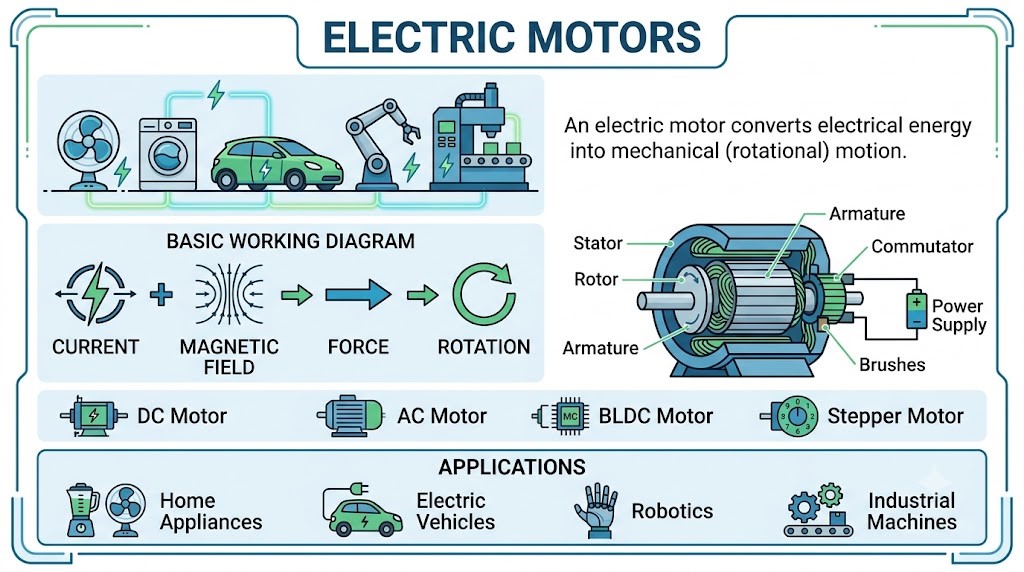
An electric motor is a device that converts electrical energy into mechanical energy. This mechanical energy is used to produce motion such as rotation or linear movement. The working principle of an electric motor is based on the interaction between electric current and magnetic fields.
Understanding how an electric motor works is essential for students of electronics, electrical engineering, and robotics because it forms the foundation of many modern technologies.
What is an Electric Motor?
An electric motor is an electromechanical device that converts electrical energy into mechanical energy using electromagnetic principles.
Simple Definition:
An electric motor is a machine that uses electricity to produce motion.
Basic Principle of Electric Motor
The working of an electric motor is based on Fleming’s Left-Hand Rule and the interaction between:
- Electric current
- Magnetic field
- Force on a conductor
When a current-carrying conductor is placed in a magnetic field, it experiences a force that causes motion.
This force is what makes the motor rotate.
Main Parts of an Electric Motor
An electric motor consists of several important components that work together:
1. Stator
- The stationary part of the motor
- Produces a magnetic field
- Can use permanent magnets or electromagnets
2. Rotor
- The rotating part of the motor
- Placed inside the stator
- Connected to the output shaft
3. Armature
- A coil of wire placed on the rotor
- Carries electric current
- Interacts with the magnetic field
4. Commutator
- A mechanical switch in DC motors
- Reverses current direction
- Ensures continuous rotation
5. Brushes
- Conduct electricity between stationary and rotating parts
- Made of carbon material
- Maintain electrical contact with the commutator
6. Power Supply
- Provides electrical energy to the motor
- Can be AC or DC depending on motor type
Working Principle of an Electric Motor
The working of an electric motor is based on a simple electromagnetic concept:
A current-carrying conductor placed in a magnetic field experiences a force.
This force causes the conductor to move, and continuous switching of current direction keeps the motion rotating.
Step-by-Step Working of an Electric Motor
Step 1: Current Supply
When electric current is supplied to the motor, it flows through the armature coil.
Step 2: Magnetic Field Interaction
The stator produces a magnetic field. When current flows in the armature, it creates its own magnetic field.
These two magnetic fields interact with each other.
Step 3: Force Generation
Due to electromagnetic interaction, a force acts on the armature conductor.
- One side of the coil moves upward
- The other side moves downward
This creates rotational motion.
Step 4: Rotation of Rotor
The rotor starts rotating due to the force applied.
However, after half rotation, the direction of current must change to continue motion.
Step 5: Role of Commutator
The commutator reverses the direction of current in the coil every half turn.
This ensures that the torque remains in the same direction.
Step 6: Continuous Rotation
Because of continuous current reversal, the rotor keeps spinning in one direction.
This motion is transferred to the output shaft, which drives machines.
Types of Electric Motors
Electric motors are classified based on the type of current used and construction.
1. DC Motor (Direct Current Motor)
A DC motor runs on direct current.
Features:
- Simple design
- Easy speed control
- High starting torque
Applications:
- Toys
- Electric vehicles
- Robotics
- Small appliances
2. AC Motor (Alternating Current Motor)
An AC motor runs on alternating current.
Types:
- Induction motor
- Synchronous motor
Features:
- Durable
- Low maintenance
- High efficiency
Applications:
- Fans
- Air conditioners
- Industrial machines
3. Brushless DC Motor (BLDC)
A modern motor without brushes.
Features:
- High efficiency
- Low noise
- Long life
Applications:
- Drones
- Electric vehicles
- Computer cooling fans
4. Stepper Motor
Moves in small steps instead of continuous rotation.
Features:
- Precise control
- Position accuracy
Applications:
- 3D printers
- CNC machines
- Robotics
Fleming’s Left-Hand Rule
This rule is used to determine the direction of force in a motor.
Rule:
If the thumb, index finger, and middle finger of the left hand are mutually perpendicular:
- Index finger → Magnetic field
- Middle finger → Current
- Thumb → Force (motion)
This helps explain motor rotation direction.
Factors Affecting Motor Performance
Several factors influence how an electric motor performs:
1. Magnetic Field Strength
Stronger magnetic fields produce more torque.
2. Current Flow
Higher current increases force and speed.
3. Number of Turns in Coil
More turns increase magnetic interaction.
4. Load on Motor
Heavier loads reduce speed and efficiency.
5. Friction
Mechanical friction reduces performance.
Applications of Electric Motors
Electric motors are used in almost every industry.
1. Household Appliances
- Fans
- Washing machines
- Mixers
- Vacuum cleaners
2. Industrial Applications
- Conveyor belts
- Pumps
- Compressors
- Manufacturing machines
3. Automotive Industry
- Electric vehicles
- Power windows
- Wipers
- Cooling fans
4. Robotics
- Robot arms
- Automated machines
- Drones
5. Medical Equipment
- Surgical tools
- Pumps
- Diagnostic machines
6. Aerospace Systems
- Flight control systems
- Satellite mechanisms
Advantages of Electric Motors
- High efficiency
- Easy control
- Low maintenance
- Reliable operation
- Environment-friendly (no fuel combustion)
Limitations of Electric Motors
- Requires continuous power supply
- Can overheat under heavy load
- Mechanical wear in some types
- Initial cost in advanced motors
Conclusion
An electric motor is a fundamental device that converts electrical energy into mechanical motion using electromagnetic principles. Its working is based on the interaction between current and magnetic fields, which produces rotational force.
From simple household appliances to advanced industrial systems and electric vehicles, electric motors play a vital role in modern life. Understanding their working principle, types, and applications helps build a strong foundation in electronics and electrical engineering.
As technology advances, electric motors are becoming more efficient, compact, and powerful, especially with innovations like brushless motors and smart motor control systems.