In modern electronics, sensors play a very important role in converting real-world physical quantities into electrical signals that can be measured, processed, and used by electronic systems. Almost every smart device we use today—such as smartphones, cars, medical equipment, and industrial machines—depends on sensors to interact with the environment.
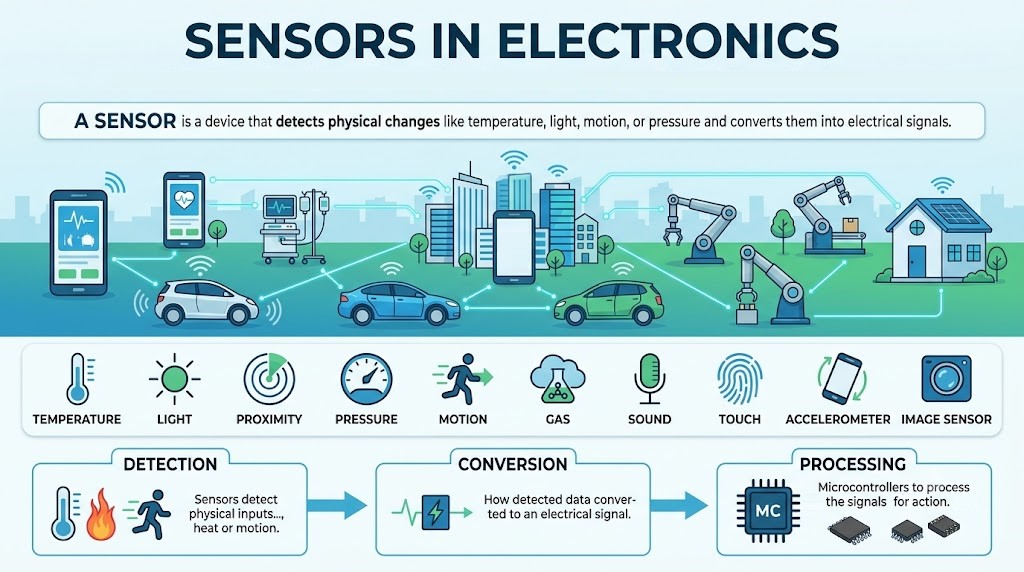
A sensor is a device that detects a change in a physical parameter and converts it into an electrical signal that can be interpreted by a microcontroller or electronic system. These parameters may include temperature, light, pressure, motion, sound, humidity, and many more.
With the growth of automation, robotics, and the Internet of Things (IoT), sensors have become the foundation of intelligent systems. This guide explains the types of sensors used in electronics, their working principles, and applications in a simple and structured way.
What is a Sensor?
A sensor is an electronic device that detects physical or environmental conditions and converts them into measurable electrical signals such as voltage, current, or digital data.
Simple Definition:
A sensor is a device that “feels” changes in the environment and sends that information to an electronic system.
Importance of Sensors in Electronics
Sensors are important because they:
- Enable automation
- Improve system accuracy
- Allow real-time monitoring
- Support decision-making in smart systems
- Reduce human intervention
- Power IoT and smart devices
Without sensors, modern electronic systems would not be able to interact with the real world.
Classification of Sensors
Sensors can be classified in different ways based on their working principle, output type, or physical quantity measured.
1. Based on Measured Quantity
- Temperature sensors
- Light sensors
- Pressure sensors
- Motion sensors
- Humidity sensors
- Gas sensors
2. Based on Output Type
- Analog sensors
- Digital sensors
3. Based on Power Requirement
- Active sensors (require external power)
- Passive sensors (generate their own signal)
Types of Sensors Used in Electronics
Below are the most commonly used sensors in electronics systems.
1. Temperature Sensors
Temperature sensors measure heat or temperature changes in an environment.
Working Principle:
They detect changes in resistance, voltage, or current based on temperature variations.
Common Types:
- Thermistor
- LM35 temperature sensor
- Thermocouple
Applications:
- Air conditioners
- Refrigerators
- Industrial temperature control
- Medical devices
Temperature sensors are widely used in both consumer and industrial electronics.
2. Light Sensors
Light sensors detect the intensity of light in an environment.
Working Principle:
They change resistance or generate voltage based on light intensity.
Common Types:
- LDR (Light Dependent Resistor)
- Photodiode
- Phototransistor
Applications:
- Automatic street lights
- Smart phones (auto brightness)
- Camera exposure control
- Solar tracking systems
Light sensors are essential for energy-saving systems.
3. Proximity Sensors
Proximity sensors detect the presence of nearby objects without physical contact.
Working Principle:
They use electromagnetic fields or infrared signals to detect objects.
Common Types:
- Infrared (IR) sensors
- Ultrasonic sensors
- Capacitive sensors
Applications:
- Mobile touchless detection
- Automatic doors
- Robotics obstacle detection
- Industrial automation
4. Pressure Sensors
Pressure sensors measure force applied per unit area.
Working Principle:
They convert mechanical pressure into an electrical signal.
Common Types:
- Piezoelectric sensors
- Strain gauge sensors
- Barometric pressure sensors
Applications:
- Weather forecasting
- Tire pressure monitoring systems
- Industrial machines
- Medical equipment
5. Motion Sensors
Motion sensors detect movement in a specific area.
Working Principle:
They detect changes in infrared radiation or movement of objects.
Common Types:
- PIR (Passive Infrared) sensor
- Microwave sensor
- Ultrasonic motion sensor
Applications:
- Security systems
- Automatic lighting
- Smart home systems
- Alarm systems
Motion sensors are widely used in security and automation.
6. Humidity Sensors
Humidity sensors measure the amount of moisture in the air.
Working Principle:
They measure changes in electrical resistance or capacitance due to humidity.
Common Types:
- Capacitive humidity sensor
- Resistive humidity sensor
Applications:
- Weather monitoring
- HVAC systems
- Agricultural systems
- Industrial storage control
7. Gas Sensors
Gas sensors detect the presence of gases in the environment.
Working Principle:
They measure changes in conductivity when gas molecules interact with the sensing material.
Common Types:
- MQ series gas sensors
- Carbon monoxide sensors
- LPG gas sensors
Applications:
- Air quality monitoring
- Industrial safety systems
- Fire detection systems
- Smart homes
Gas sensors are crucial for safety applications.
8. Sound Sensors
Sound sensors detect sound waves and convert them into electrical signals.
Working Principle:
They use microphones to convert sound vibrations into voltage signals.
Common Types:
- Microphone sensor
- Sound detection module
Applications:
- Voice recognition systems
- Clap switches
- Noise monitoring systems
- Smart devices
9. Accelerometer Sensors
Accelerometers measure acceleration or movement of an object.
Working Principle:
They detect changes in motion using MEMS (Micro-Electro-Mechanical Systems) technology.
Applications:
- Smartphones (screen rotation)
- Fitness trackers
- Drones
- Automotive crash detection
10. Touch Sensors
Touch sensors detect physical touch or contact.
Working Principle:
They detect changes in capacitance or resistance when touched.
Common Types:
- Capacitive touch sensor
- Resistive touch sensor
Applications:
- Smartphones
- Touchscreens
- Control panels
- Smart appliances
11. Image Sensors
Image sensors convert optical images into electronic signals.
Working Principle:
They capture light and convert it into digital image data.
Common Types:
- CCD (Charge Coupled Device)
- CMOS sensor
Applications:
- Digital cameras
- Smartphones
- Surveillance systems
- Medical imaging
Working of Sensors in Electronic Systems
The general working of sensors follows three steps:
Step 1: Detection
The sensor detects a physical change (light, temperature, motion, etc.).
Step 2: Conversion
The physical change is converted into an electrical signal.
Step 3: Processing
The signal is sent to a microcontroller or processor for analysis and decision-making.
Example:
A temperature sensor detects heat → converts it into voltage → microcontroller turns ON fan.
Applications of Sensors in Electronics
Sensors are used in almost every modern field:
1. Consumer Electronics
- Smartphones
- Smart TVs
- Home appliances
2. Automotive Systems
- Parking sensors
- Airbag systems
- Engine monitoring
3. Industrial Automation
- Machine monitoring
- Robotics
- Process control
4. Healthcare
- Patient monitoring
- Medical imaging
- Diagnostic equipment
5. Smart Homes and IoT
- Smart lighting
- Security systems
- Smart thermostats
6. Environmental Monitoring
- Air pollution detection
- Weather stations
- Water quality monitoring
Advantages of Sensors
- Enable automation
- Improve accuracy
- Real-time monitoring
- Reduce human effort
- Support smart technologies
Limitations of Sensors
- Can be affected by noise
- Require calibration
- Sensitive to environmental conditions
- Some sensors are expensive
Conclusion
Sensors are essential components of modern electronics that enable systems to interact with the physical world. They detect various physical parameters such as temperature, light, motion, pressure, and gas, and convert them into electrical signals for processing.
With the rapid growth of IoT, robotics, and smart devices, sensors have become even more important in creating intelligent and automated systems. Understanding different types of sensors is fundamental for anyone studying electronics, embedded systems, or modern engineering technologies.
As technology continues to evolve, sensors will play an even bigger role in building smarter, safer, and more efficient electronic systems.