Capacitance is one of the most important concepts in electricity and electronics. It is the ability of a component or system to store electrical energy in the form of an electric field. The device used to store this energy is called a capacitor. Capacitors are found in almost every electronic circuit, from small mobile phones and computers to large industrial machines and power systems.
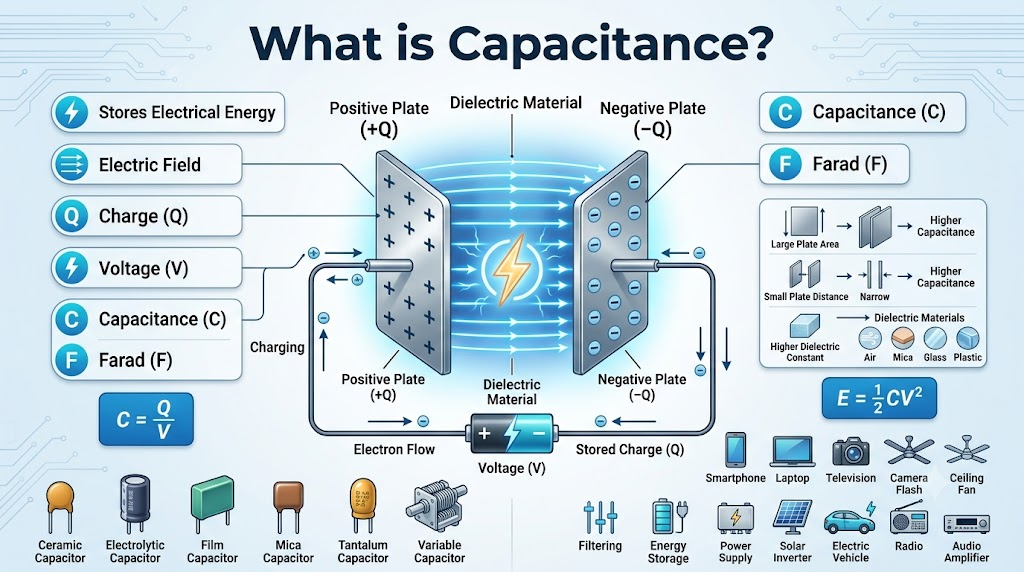
Whenever two conducting plates are separated by an insulating material called a dielectric, they can store electric charges. One plate stores positive charge while the other stores an equal amount of negative charge. This storage of electric charge is known as capacitance.
Capacitance is represented by the symbol C, and its SI unit is the Farad (F), named after the English scientist Michael Faraday. One farad is a very large unit, so in practical applications, smaller units such as microfarads (µF), nanofarads (nF), and picofarads (pF) are commonly used.
The basic formula for capacitance is:
C = Q / V
Where:
- C = Capacitance (Farads)
- Q = Electric Charge (Coulombs)
- V = Voltage (Volts)
This equation means that capacitance is the amount of charge stored per unit voltage. A capacitor with higher capacitance can store more charge at the same voltage.
Construction of a Capacitor
A simple capacitor consists of three main parts:
- Two Conducting Plates
- Usually made of aluminum or other conductive metals.
- One plate becomes positively charged and the other negatively charged.
- Dielectric Material
- An insulating material placed between the plates.
- Examples include air, paper, ceramic, mica, glass, plastic, and electrolytes.
- It prevents direct current from flowing while allowing energy storage.
- Connecting Leads
- Used to connect the capacitor to an electrical circuit.
When voltage is applied across the capacitor, electrons accumulate on one plate and leave the other plate. This creates an electric field in the dielectric, storing energy.
Working Principle of Capacitance
The operation of a capacitor is based on the storage of electrical charges.
When a battery is connected:
- Electrons move from one plate.
- One plate gains excess electrons (negative charge).
- The opposite plate loses electrons (positive charge).
- The dielectric prevents charges from crossing between the plates.
- An electric field develops between the plates.
- Electrical energy is stored in this electric field.
When the battery is disconnected, the capacitor continues to hold the stored charge for some time. If connected to a load, it releases the stored energy back into the circuit.
Thus, a capacitor behaves like a temporary energy storage device.
Factors Affecting Capacitance
The capacitance of a capacitor depends on three important factors.
1. Area of the Plates
Larger plate area allows more electric charge to be stored.
- Larger area → Higher capacitance
- Smaller area → Lower capacitance
2. Distance Between Plates
The closer the plates are, the stronger the electric field.
- Smaller distance → Higher capacitance
- Larger distance → Lower capacitance
3. Dielectric Material
Different dielectric materials have different dielectric constants.
A material with a higher dielectric constant increases capacitance.
Examples:
- Air
- Paper
- Ceramic
- Glass
- Plastic
- Mica
The mathematical expression is:
C = εA / d
Where:
- C = Capacitance
- ε = Permittivity of dielectric
- A = Area of plates
- d = Distance between plates
This formula shows that capacitance is directly proportional to plate area and dielectric constant, and inversely proportional to the distance between the plates.
Unit of Capacitance
The SI unit of capacitance is the Farad (F).
Practical units include:
- 1 Farad (F)
- 1 Millifarad (mF) = 10⁻³ F
- 1 Microfarad (µF) = 10⁻⁶ F
- 1 Nanofarad (nF) = 10⁻⁹ F
- 1 Picofarad (pF) = 10⁻¹² F
Most electronic circuits use capacitors in the µF, nF, or pF range.
Energy Stored in a Capacitor
A charged capacitor stores electrical energy.
The stored energy is given by:
E = ½CV²
Where:
- E = Energy (Joules)
- C = Capacitance
- V = Voltage
From this equation, it is clear that increasing either capacitance or voltage increases the stored energy.
Types of Capacitors
Different capacitors are designed for different applications.
Ceramic Capacitors
- Small size
- Low cost
- High reliability
- Used in electronic circuits
Electrolytic Capacitors
- High capacitance
- Polarized
- Used in power supplies and filters
Film Capacitors
- Stable performance
- Long life
- Used in audio and industrial applications
Mica Capacitors
- High precision
- Excellent stability
- Used in RF circuits
Tantalum Capacitors
- Compact size
- High efficiency
- Used in portable electronic devices
Variable Capacitors
- Capacitance can be adjusted.
- Used in radio tuning circuits.
Applications of Capacitance
Capacitance plays an important role in many electrical and electronic systems.
Energy Storage
Capacitors temporarily store electrical energy and release it when needed.
Filtering
They remove unwanted noise and ripple from power supplies.
Coupling
Capacitors transfer AC signals while blocking DC signals.
Timing Circuits
They determine charging and discharging time in oscillators and timers.
Power Factor Correction
Large capacitors improve the power factor in industrial electrical systems.
Motor Starting
Capacitors provide extra starting torque in single-phase motors.
Camera Flash
They store energy and release it instantly to produce a bright flash.
Memory Backup
Capacitors maintain data during brief power interruptions.
Radio Tuning
Variable capacitors help select different radio frequencies.
Advantages of Capacitors
- Simple construction
- High efficiency
- Fast charging and discharging
- Long service life
- Low maintenance
- Reliable operation
- Low power loss
- Available in many sizes and values
Limitations of Capacitors
- Cannot store energy for very long periods
- Limited energy storage compared to batteries
- Electrolytic capacitors have polarity restrictions
- High voltage may damage the dielectric
- Capacitance changes with temperature and aging
Everyday Examples of Capacitance
Capacitance is present in many devices we use daily.
Examples include:
- Mobile phone chargers
- Televisions
- Computers
- Air conditioners
- Ceiling fans
- Refrigerators
- UPS systems
- LED drivers
- Camera flash units
- Audio amplifiers
- Solar inverters
- Electric vehicles
Without capacitors, modern electronic equipment would not function efficiently.
Conclusion
Capacitance is the property of a capacitor to store electric charge and electrical energy in an electric field. It is measured in Farads (F) and depends on the plate area, the distance between the plates, and the dielectric material. Capacitors charge when connected to a voltage source and discharge when connected to a load, making them essential components in electrical and electronic circuits.
Capacitance is widely used for energy storage, filtering, timing, coupling, power factor correction, motor starting, communication systems, and many other applications. Understanding capacitance is fundamental for students and engineers because it forms the basis of numerous electronic devices and modern technologies.