
Fuse vs Circuit Breaker: What They Do and How They Differ
A damaged cable can let current rise far beyond what its wires can safely carry. A protective device must interrupt that current before the fault causes greater damage.
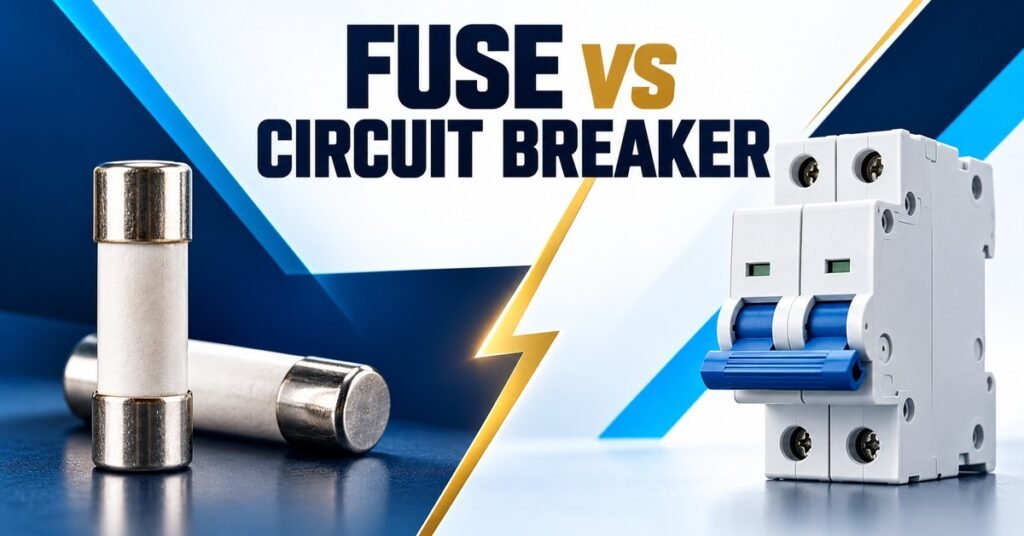
A fuse and circuit breaker both provide overcurrent protection, but they interrupt a circuit differently. A fuse melts a designed element. A breaker opens contacts through a trip mechanism.
The useful comparison goes beyond replaceable versus resettable. Current rating, fault-interruption capability, operating time, voltage, and the type of load all matter. Here’s how to understand those differences without turning a beginner lesson into a wiring project.
Why too much current is a problem
Current produces heating in resistive conductors. For a fixed resistance, heating power follows I²R, so doubling current produces four times the heating.
An overload occurs when a circuit carries more current than intended through its normal path. Too many loads or a stalled motor can cause overload conditions.
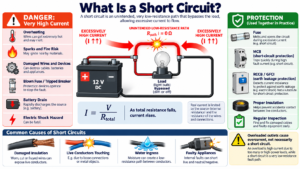
A short circuit introduces an unintended low-impedance path. Fault current can be much greater than ordinary operating current, depending on the source and circuit impedance.
The protective device isn’t there merely to protect itself. It must be selected as part of a system that protects wiring and equipment within the relevant requirements.
Don’t assume an appliance’s modest normal current means every fault will also be modest. A supply can deliver a large short-circuit current even when its normal load uses very little power.
How a fuse works
A fuse contains an element designed to heat and melt under specified overcurrent conditions. When it opens, it interrupts the conducting path.
The complete fuse construction also has to manage the arc that can occur when the element separates. Housing, filling material, element design, and spacing influence that process.
A fuse doesn’t necessarily operate the instant current reaches its printed rating. Its time-current characteristic describes how operating time changes with current.
After a normal fuse operates, it must be replaced with the correct specified type. Its melted element doesn’t reset.
That single-use behavior can be simple and reliable, but replacement must be done correctly. Substituting wire, foil, or a higher-rated part defeats the intended protection and can leave the circuit exposed to damaging current.
Common types of fuses
Cartridge fuses enclose their element inside a body, often glass or ceramic. Automotive blade fuses use a different package suited to compatible vehicle fuse holders.
Fast-acting and time-delay fuses respond differently to temporary current surges. A time-delay type may tolerate a specified startup surge while still protecting against sustained overcurrent.
High-rupturing-capacity or high-breaking-capacity fuse designs are intended to interrupt high prospective fault currents within their ratings.
Semiconductor protection fuses are designed for applications needing particular energy-limiting behavior. They are not automatically interchangeable with general-purpose protection.
Appearance isn’t a full specification. Two fuses that fit the same holder can differ in current, voltage, breaking capacity, speed, and application suitability. Match the required markings and manufacturer guidance.
How a circuit breaker works
A circuit breaker detects a specified fault condition and opens contacts. Many low-voltage breakers combine protection and a means of manual switching.
A common thermal-magnetic breaker uses a thermal element for sustained overloads and a magnetic mechanism for high-current faults.
The thermal part responds to heating over time. The magnetic part can operate rapidly when current reaches its specified operating region.
Other breakers use electronic sensing and trip units. Their functions, settings, and maintenance requirements depend on the equipment.
After a breaker trips, it may be reset once the fault has been identified and corrected and the equipment is suitable for service. Resettable doesn’t mean endlessly reusable regardless of fault severity, wear, or manufacturer inspection requirements.
What is an MCB?
MCB stands for miniature circuit breaker. It’s a common type of low-voltage protective device used in suitable distribution and equipment applications.
Its current rating and trip characteristic must suit the circuit. Different characteristics allow different tolerances for startup and inrush currents.
The letters used for trip curves describe particular operating ranges under the relevant product standard. They aren’t a universal ranking from weak protection to strong protection.
An MCB’s breaking capacity must also suit the available fault current. A suitable normal-current rating alone doesn’t establish that it can safely interrupt a severe short.
Selecting and changing distribution-board devices requires qualified assessment. This article explains the concepts; it isn’t a procedure for replacing a breaker in a live or household panel.
Fuse and circuit breaker comparison
A fuse and circuit breaker can both be excellent choices when correctly selected. Neither category is always faster or better in every possible application.
Some current-limiting fuses interrupt high faults very quickly. Some breakers provide sophisticated adjustable protection. You need the actual device curves and ratings to compare performance.
Fuses usually need replacement after operation, while breakers can often be reset after appropriate checks. That difference affects downtime, spare parts, and maintenance.
A breaker can offer convenient manual operation and clear trip indication. Fuse systems can offer compact, economical protection and strong fault-limiting performance in suitable designs.
The right choice depends on the system: expected load, fault level, coordination with other devices, maintenance arrangements, space, and applicable requirements.
Ratings that matter more than the package
Rated current describes the device’s intended current capability under specified conditions. Ambient temperature and installation arrangements can affect performance.
Rated voltage establishes where the device can interrupt safely within its specifications. It isn’t a voltage that the device automatically reduces to protect the load.
Breaking or interrupting capacity describes the fault current the device can safely interrupt under its rated conditions. It is different from its normal current rating.
AC and DC ratings also differ. DC doesn’t have the regular current zero crossings that assist interruption in AC systems, so arc-control requirements can be different.
Never assume an AC-only device is suitable for the same numerical DC voltage. Use a device explicitly rated and approved for the application.
Time-current curves and inrush
Many loads draw a brief startup current higher than their normal running current. Motors, transformers, and power supplies can all show this behavior.
A protective device should tolerate legitimate operation while interrupting damaging overcurrent. Time-current curves show this balance more clearly than a single ampere number.
The curve may describe a range rather than one exact trip time. Manufacturing tolerances, initial temperature, and previous loading can influence actual operation.
For fuses, pre-arcing and total clearing behavior may be relevant. For breakers, different mechanisms or settings can control different current regions.
Don’t solve unwanted trips by increasing the device rating without evaluating the circuit. That can remove protection from conductors or equipment that were never designed for the higher current.
Overcurrent protection isn’t complete shock protection
An ordinary fuse or MCB reacts to excessive current. A dangerous current through a person can be far below the level that trips the circuit’s overcurrent device.
Residual-current protection detects an imbalance between outgoing and returning current. Devices such as RCDs provide a different protective function.
An RCCB generally doesn’t provide overload protection by itself. An RCBO combines residual-current and overcurrent functions, within its product specifications.
These devices complement suitable earthing, insulation, enclosures, and circuit design. No single component substitutes for all the others.
The key lesson is to identify the fault being detected. Overload, short circuit, leakage, surge, and arc faults aren’t interchangeable terms, and they don’t all require the same protective response.
What repeated operation is telling you
A fuse that keeps opening or a breaker that keeps tripping is a symptom. Possible causes include an overload, a damaged appliance, a cable fault, or an unsuitable protection arrangement.
Repeatedly resetting a breaker without investigating can re-energize a persistent fault. Replacing fuses repeatedly can do the same.
If equipment trips protection unexpectedly, stop using it and follow the appropriate qualified inspection route. Burning smells, heat, damaged insulation, and visible arcing need prompt attention.
For a small low-voltage project, inspect wiring and load current with power removed before further testing. Even batteries can supply damaging fault current.
Keep the specified protective device in place. Bypassing it to see whether the equipment works removes the very function that is warning you something may be wrong.
A practical comparison example
Imagine a small low-voltage motor that normally draws 1 A but briefly draws more during startup. A protection device selected only by the running-current number may operate unnecessarily.
Now imagine a fault that directly shorts the supply wiring. The device must interrupt the available fault current, not merely tolerate the startup pulse.
Those are two separate checks: survive normal operation and interrupt abnormal operation safely. Wire capacity, source capability, device curves, and environmental conditions all enter the decision.
The example doesn’t produce one universal fuse or breaker size. It shows why a complete specification is needed before selecting one.
When reading a product datasheet, locate the current rating, voltage rating, interrupting rating, operating curve, and environmental conditions. If one is missing, the comparison is incomplete.
Frequently asked questions
What is the main difference between a fuse and circuit breaker?
A fuse interrupts current by melting its element and normally needs replacement. A breaker opens contacts through a trip mechanism and can often be reset after the fault and equipment condition are checked.
Is a circuit breaker always faster than a fuse?
No. Response depends on the exact device and fault current. Compare time-current and clearing data for the specified products rather than making a general rule.
Does an MCB protect against electric shock?
Its main role is overcurrent protection. Dangerous shock current may be too small to trip it. Residual-current protection provides a different function and forms part of a wider protection system.
Can I replace a fuse with a higher amp rating?
Don’t increase the rating to stop it opening. The original rating may protect wiring or equipment that cannot safely carry more current. Identify the cause and use the specified replacement.
Can an AC fuse be used on DC?
Only if it also has a suitable DC rating for the application. AC and DC interruption conditions differ, so the numerical voltage marking alone isn’t enough.
Quick reference and practice checklist
| Feature | Fuse | Circuit breaker |
|---|---|---|
| Interruption | Element melts | Contacts open |
| After operation | Specified replacement needed | Reset after fault and condition checks |
| Response | Depends on type and curve | Depends on type and curve |
| Selection | Current, voltage, breaking capacity, curve | Current, voltage, breaking capacity, curve |
Use this three-step routine when you review the examples:
- Identify the fault type and prospective fault current.
- Compare the exact device ratings and curves.
- Investigate faults before replacing or resetting protection.
Before moving on, check these details:
- Write units beside every number.
- State the assumptions behind your calculation.
- Check the result against the physical behavior described above.
Read the ratings before making the comparison
A fuse and circuit breaker serve the same broad purpose but achieve it with different designs and characteristics.
For your next study exercise, compare two manufacturer datasheets and identify their current, voltage, breaking capacity, and time-current information. For an actual installation or recurring fault, have the system assessed by a qualified electrician.

Comments
Comments are currently closed.