
What Is RMS Value? Simple Explanation with Examples
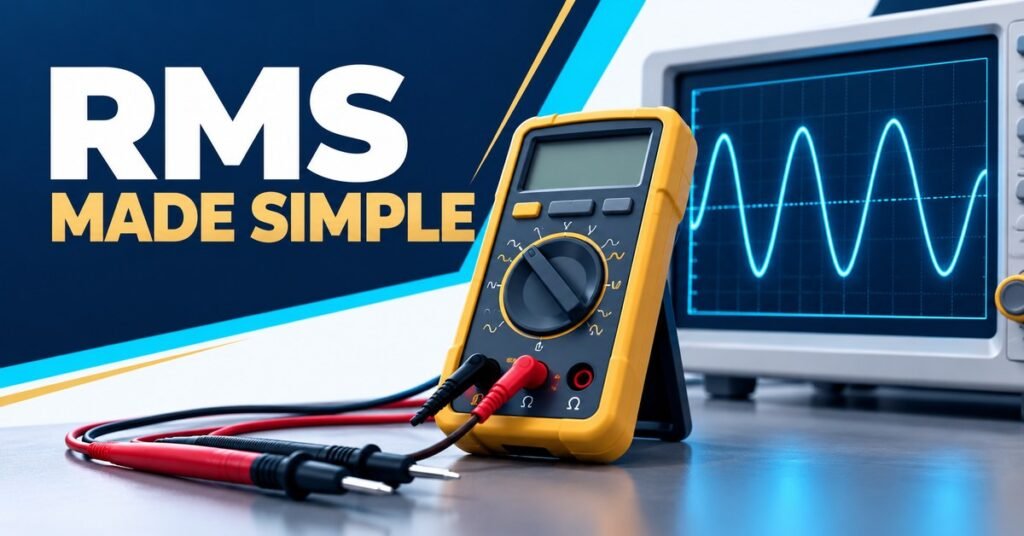
An alternating current can average to zero and still make a heater hot. Positive and negative current don’t cancel their heating effect.
RMS value gives you a way to compare that changing current with a steady DC current. It is one of the most useful ideas in AC measurements, electrical power, and waveform analysis.
The letters stand for root mean square. That sounds mathematical, but the process is simple: square the values, average them, then take the square root. Let’s connect those steps to something you can calculate and measure.
What RMS value means physically
For a fixed ideal resistor, RMS current is the DC current that would produce the same average heating power as the changing current over the stated interval.
Average resistor power is P = Irms²R. The voltage form is P = Vrms²/R when the same fixed resistance is used.
If a changing current has RMS value 2 A, it produces the same average resistor heating as steady 2 A DC, assuming resistance stays constant.
That doesn’t mean every device responds identically to AC and DC of the same RMS value. Motors, transformers, rectifiers, and electronic circuits have additional behavior that matters.
RMS is a mathematical measure with a useful heating interpretation. Apply that interpretation to the right load instead of assuming it describes every physical effect of every waveform.
The root mean square calculation
For N equally spaced samples, the RMS formula is √[(x1² + x2² + … + xN²)/N]. Each sample receives equal weight when the time spacing is equal.
Suppose current has four equal-duration sample values: +2 A, −2 A, +2 A, and −2 A. Squaring produces four values of 4 A².
Their mean is 4 A². Taking the square root gives 2 A RMS. The arithmetic average of the original signed values is zero, but the RMS value is not.
For a continuous waveform, the equivalent calculation averages the square over time using an integral, then takes its square root.
For a periodic signal, one complete period or an integer number of periods gives the usual steady RMS value. For a transient, the selected measurement interval must be stated because the answer can depend on it.
Why squaring matters
Resistor heating depends on current squared. Reversing current changes its direction but doesn’t make the resistor absorb negative heat.
Squaring also makes positive and negative sample contributions nonnegative. The average therefore captures their combined magnitude rather than letting opposite signs cancel.
Taking the square root restores the original unit. Current squared has units A²; after the square root, RMS current is measured in amperes.
Don’t confuse RMS with the average of absolute values. Rectifying a waveform and averaging its magnitude is a different calculation.
For some shapes these measures have fixed relationships, which allows certain meters to estimate RMS under specific assumptions. Change the waveform shape, and the assumed relationship may no longer hold.
RMS voltage for a sine wave
For a pure sine wave with zero DC offset, Vrms = Vpeak/√2, approximately 0.7071 times the peak voltage.
A sine wave with a 10 V peak therefore has RMS voltage about 7.07 V. Its peak-to-peak voltage is 20 V.
Going the other way, Vpeak = √2Vrms. A hypothetical 100 V RMS pure sine has peak magnitude about 141.4 V.
These relationships refer to a sine wave. They are not universal conversions for triangle waves, square waves, clipped signals, or pulses.
The conditions also matter when there is a DC offset. Dividing the overall maximum voltage by √2 doesn’t correctly account for a shifted sine wave.
Worked heating example
Connect an ideal 100 Ω resistor to a pure sine-wave source with 10 V peak. Its RMS voltage is 7.07 V.
Average power is Vrms²/R = 7.07²/100 ≈ 0.50 W. Using the exact expression gives 10²/(2 × 100) = 0.50 W.
If you incorrectly use peak voltage in V²/R, you obtain 1 W, twice the correct average power for this waveform.
A steady 7.07 V DC source would produce the same average heating in that fixed resistor. A steady 10 V DC source would dissipate 1 W.
For an actual component, check power rating, derating, temperature rise, and mounting conditions. A calculated average power is only one part of determining whether a resistor can operate reliably.
RMS value of square waves
An ideal symmetric square wave alternating between +5 V and −5 V has RMS voltage 5 V. Squaring either level gives 25 V² throughout the cycle.
Its average voltage is zero, and its peak-to-peak voltage is 10 V. All three descriptions are correct because they measure different properties.
An ideal 0-to-5 V square wave with 50% duty cycle has total RMS voltage 5√0.5 ≈ 3.54 V.
Its average voltage is 2.5 V. Its AC-only RMS component is 2.5 V, showing why you must know whether a meter reports AC only or combined AC and DC.
The phrase square wave isn’t enough by itself. State the high level, low level, duty cycle, and which RMS quantity you’re discussing.
RMS of pulses and PWM
For an ideal pulse train switching between zero and amplitude A, total RMS is A√D, where D is the high-state duty-cycle fraction.
At 12 V and 25% duty cycle, total RMS voltage is 12√0.25 = 6 V. Average voltage is 12 × 0.25 = 3 V.
Across an ideal resistor, heating follows the 6 V RMS result rather than the 3 V average result. Squaring before averaging makes that difference visible.
The same pulse waveform can have very different consequences after filtering or when applied to a motor, inductor, or electronic input.
PWM descriptions should therefore include the load and the circuit. The duty-cycle formula is useful, but it doesn’t replace analysis of switching transients, ripple current, or device limits.
AC plus DC: combine the components correctly
A waveform can contain a DC average plus an AC variation around that average. For a zero-mean AC component, total RMS squared equals DC² plus AC RMS².
Suppose a waveform has 3 V DC offset and a sinusoidal ripple of 4 V RMS. Total RMS is √(3² + 4²) = 5 V.
Don’t add 3 V and 4 V directly to obtain 7 V RMS. The components combine through their mean squares under the stated conditions.
A meter in AC mode may reject the DC component and report only the ripple. Another function may report combined AC+DC RMS.
Read the instrument manual before comparing the display with a theoretical number. A perfectly functioning meter can disagree with your calculation because you are measuring different quantities.
True RMS meters and average-responding meters
An average-responding AC meter often measures rectified average and scales the result to match the RMS of a sine wave.
That can work well for a clean sine within the instrument’s specifications. It can give a wrong reading for a waveform with a different shape.
A true RMS meter calculates or measures RMS more directly. Even so, it has limits, including bandwidth, crest factor, input range, and permitted DC content.
Crest factor is peak magnitude divided by RMS magnitude. Narrow pulses can have high peaks despite a modest RMS value, potentially exceeding the instrument’s capability.
True RMS on the label doesn’t mean correct measurement of every imaginable signal. Check the allowed frequency range and waveform conditions for the actual mode you are using.
RMS voltage times RMS current isn’t always real power
For a purely resistive load, average real power is VrmsIrms because voltage and current track each other.
For sinusoidal AC with a phase difference φ, real power is VrmsIrms cosφ. The product VrmsIrms alone is apparent power, measured in volt-amperes.
For distorted waveforms, true power factor is real power divided by apparent power. It isn’t generally described by one cosine factor alone.
The most general instantaneous relationship is p(t) = v(t)i(t). Average that product over the relevant interval to find average real power.
This distinction matters when measuring electronic power supplies and other nonlinear loads. Separate RMS measurements of voltage and current don’t automatically tell you how much energy the device actually consumes.
A practical RMS checklist
Before calculating, identify waveform shape, time interval, DC offset, and whether you need voltage or current RMS.
Write peak, peak to peak, average, and RMS as separate quantities. Never substitute one merely because the units are the same.
Choose the matching formula. Use the sine conversion only for a pure zero-offset sine, and the pulse formula only for the stated zero-to-A pulse train.
Before measuring, confirm the meter mode, frequency range, input limits, and whether it includes DC. For oscilloscope measurements, confirm the selected interval and channel scaling.
Practice with safe low-voltage signals. High-voltage measurements require suitable instruments, probes, ratings, and procedures; understanding RMS alone doesn’t establish safe measurement technique.
Frequently asked questions
What is RMS value in simple words?
It’s the square root of the average squared signal. For a fixed resistor, it gives the DC voltage or current that would produce the same average heating over the stated time interval.
Why is RMS not the same as average?
A signed average allows positive and negative values to cancel. RMS squares them first, so both polarities contribute. A zero-mean AC waveform can therefore have a nonzero RMS value.
Is RMS always 0.707 times peak?
No. That factor applies to a pure sine wave with zero DC offset. Other waveform shapes and offset signals need their own RMS calculation.
What is the RMS of a 5 V square wave?
You need its levels and duty cycle. An ideal +5/−5 V square wave has 5 V RMS. A 0-to-5 V waveform at 50% duty has about 3.54 V total RMS.
Do I need a true RMS meter?
It is useful for nonsinusoidal waveforms, provided the signal fits the meter’s bandwidth, crest-factor, and input specifications. For clean sine waves, a suitable average-responding meter may also be accurate.
Quick reference and practice checklist
| Waveform | Average voltage | Total RMS voltage |
|---|---|---|
| Zero-offset sine, peak A | 0 | A/√2 |
| Symmetric +A/−A square | 0 | A |
| Zero-to-A pulses, duty D | AD | A√D |
Use this three-step routine when you review the examples:
- Identify waveform shape and DC offset.
- Choose the correct RMS formula.
- Check whether your meter includes the DC component.
Before moving on, check these details:
- Write units beside every number.
- State the assumptions behind your calculation.
- Check the result against the physical behavior described above.
Check the waveform before the formula
RMS value becomes straightforward when you connect the calculation with squared magnitude and resistor heating.
Try calculating total RMS for a 0-to-10 V pulse train at 36% duty cycle. The answer is 6 V. Then compare its 3.6 V average and explain why those values differ.


Comments
Comments are currently closed.