
What Is Electric Current? Definition, Formula, and Types
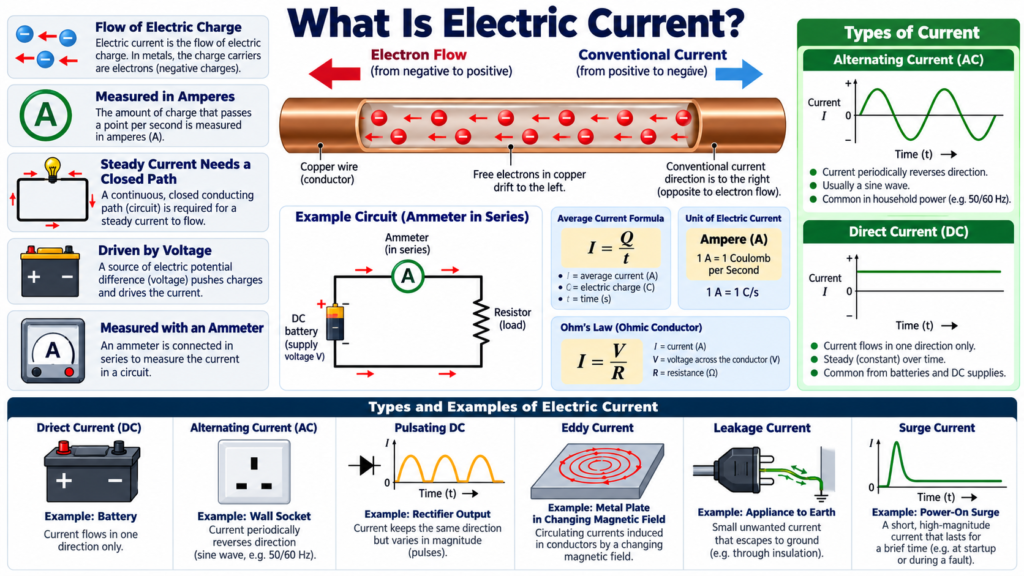
Electric current is the rate at which electric charge passes through a chosen surface, such as the cross-section of a wire. Its SI unit is the ampere. A current of one ampere means that one coulomb of charge passes through that cross-section each second.
This definition is more useful than imagining electricity as a material being used up. A lamp receives energy from the circuit, while charge continues around the conducting path. Learning how electric current is defined, directed, calculated, and measured gives you a foundation for analyzing resistors, electronic components, motors, and power systems.
Electric current formula and units
For a constant rate of charge flow, I = Q/t. Here I is current in amperes, Q is charge in coulombs, and t is time in seconds. More generally, instantaneous current is i = dq/dt, and the charge transferred over an interval is the integral of current over time.
If 6 C passes a cross-section in 3 s at a constant rate, the electric current is 2 A. If the rate varies, dividing total charge by total time gives the average current over that interval rather than the current at every instant.
| Quantity | Unit | Useful relationship |
|---|---|---|
| Current | Ampere, A | I = Q/t for steady flow |
| Charge | Coulomb, C | Q = It for constant current |
| Milliampere | mA | 1 mA = 0.001 A |
| Microampere | Microampere | 1 microampere = 0.000001 A |
Unit conversions deserve attention. A sensor drawing 20 mA uses 0.020 A, not 20 A. Over 100 s, that constant current transfers 2 C. Writing units beside every number makes this conversion visible and reduces errors when calculating power or battery runtime.
What actually moves in a conductor?
In metal wires, mobile electrons carry charge through a lattice of positive ions. Their motion includes rapid random movement and a much smaller average drift caused by the electric field. The drift direction is opposite to the direction of conventional current because electrons carry negative charge.
Other materials have different charge carriers. In an electrolyte, positive and negative ions can both contribute to current. In semiconductors, electrons and holes are useful descriptions of charge transport. Electric current therefore means charge flow, not exclusively electron flow in every situation.
For a simple uniform conductor, the magnitude relationship I = nqAv_d connects current to microscopic behavior. Here n is the number of mobile carriers per unit volume, q is carrier charge magnitude, A is cross-sectional area, and v_d is average drift speed. The formula assumes an appropriate simplified carrier model.
A larger wire can carry the same electric current with lower current density. Current density is current per cross-sectional area for uniform flow. This helps explain why wire dimensions matter, although allowable current also depends on material, insulation, cooling, and installation conditions.
Conventional current versus electron flow
Conventional current is defined in the direction that positive charge would move. In the external part of a simple battery-resistor circuit, it goes from the positive terminal through the resistor toward the negative terminal. Electron drift in the metallic conductor is in the opposite direction.
Neither description is a mistake. They are different conventions applied to charges of different sign. Circuit equations usually use conventional current, so transistor symbols, diode arrows where applicable, and standard circuit notation should be interpreted consistently with that convention.
When solving a circuit, you may choose an assumed current direction before knowing the answer. A negative result simply means the actual conventional current is opposite to that arrow. Redrawing every equation is unnecessary if the original sign convention remains consistent.
Why does electric current start when a switch closes?
A source establishes electrical conditions that produce an electric field throughout the connected circuit after a finite propagation process. Mobile charges already present in the wires respond to that field. The lamp does not wait for an individual electron to travel all the way from the battery.
This distinction separates signal propagation from drift speed. Electrical changes can propagate rapidly through a circuit, while average electron drift in a metal can be quite slow. The exact propagation speed depends on the geometry and electromagnetic properties of the surrounding materials.
A complete conducting path is needed for sustained current in a simple DC resistive loop. An open switch interrupts that path. Capacitive and inductive circuits add transient behavior, so current and voltage may not jump immediately to their final values when switching occurs.
Electric current, voltage, and resistance
For an ohmic resistor under fixed physical conditions, I = V/R. A 10 V supply across a 5 ohm resistor produces 2 A in the ideal model. Increasing the resistance to 10 ohms while keeping the same voltage reduces the current to 1 A.
Voltage does not specify current by itself. A 9 V battery connected to a large resistor supplies little current; connected to a much smaller resistance, it attempts to supply more. Internal resistance, source limits, and component behavior affect the practical result.
A supply labelled 12 V, 2 A normally means it is intended to provide about 12 V up to a specified maximum output current under its rated conditions. It does not force 2 A through every load. A compatible load determines the current it draws, within the supply’s capabilities.
Direct current and alternating current
Direct current has a single direction. Its magnitude can remain constant or vary with time without reversing. A battery feeding a resistor is a familiar approximately steady example. Rectified current may pulse while remaining unidirectional.
Alternating current reverses direction. A sinusoidal current passes smoothly through positive and negative values, where the sign refers to the chosen arrow direction. Frequency measures cycles per second, while period is the duration of one cycle.
For a pure sinusoid, RMS current equals peak current divided by the square root of two. A sine wave with 2 A peak has about 1.414 A RMS. Its average over a complete cycle is zero, but it still produces heating because resistor power depends on the square of current.
Electric current in series and parallel circuits
In a simple series path, the same electric current passes through each component. Charge does not disappear after the first resistor. If one coulomb per second enters a resistor in steady operation, the same rate leaves it, apart from negligible charge accumulation in the ideal model.
At a junction, current divides among branches. Kirchhoff’s current law states that total current entering a node equals total current leaving it in ordinary lumped circuit analysis. The branch values depend on the connected impedances and the voltage across those branches.
For example, place 6 ohm and 3 ohm resistors in parallel across 12 V. Their currents are 2 A and 4 A, respectively, giving a source current of 6 A. The lower-resistance branch carries more current, but the higher-resistance branch still conducts.
A worked charge and power example
A small DC device draws a constant 0.25 A from a 12 V source for 8 minutes. First convert the operating time to 480 s. The transferred charge is Q = It = 0.25 times 480 = 120 C.
The electrical input power is P = VI = 12 times 0.25 = 3 W. Over 480 s, the energy supplied is 1440 J, or 0.4 Wh. Charge, power, and energy describe different aspects of the same operating interval.
- Convert current to amperes and time to seconds.
- Use current times time to calculate charge.
- Use voltage times current to calculate DC input power.
- Multiply power by time to calculate energy.
- Check that energy divided by charge equals the supply voltage.
That last check gives 1440/120 = 12 J/C. It ties the calculation back to the physical meaning of voltage and is a useful way to detect arithmetic mistakes before moving on.
Measuring electric current correctly
An ammeter measures the current through its own path, so it is connected in series with the branch being measured. A real meter introduces a small voltage drop called burden voltage, which can affect sensitive low-voltage circuits.
For supervised low-voltage work, power down before changing connections, select the correct current terminal and range, and follow the meter instructions. Connecting a meter in current mode directly across a source can create a low-resistance path and damage the meter or circuit.
A suitable clamp meter can measure current without opening a conductor path, but it must surround the appropriate individual conductor. Clamping around both outgoing and returning conductors often gives little reading because their magnetic effects cancel. Instrument type and AC/DC capability also matter.
Frequently asked questions
Is electric current consumed by a resistor?
No. The resistor converts electrical energy into thermal energy. In steady series operation, the same charge-flow rate enters and leaves it. Saying that a device uses electricity usually refers to energy consumption, not destruction of charge.
Can current flow without a metal wire?
Yes. Ionic solutions, semiconductor materials, plasmas, and vacuum devices can carry current under appropriate conditions. The charge carriers and conduction mechanisms differ, but the definition as charge-flow rate remains useful.
Does a larger current always mean more useful output?
No. It can mean a larger useful load, lower efficiency, a startup condition, or a fault. Current must be interpreted alongside voltage, power factor where relevant, operating conditions, and the function of the equipment.
Conclusion
Electric current is charge passing a cross-section per unit time. Use conventional direction consistently, distinguish average from instantaneous and RMS values, and connect an ammeter in series. Once these ideas are clear, current becomes a measurable quantity that links charge movement to circuit behavior and energy transfer.
Comments
Comments are currently closed.