
What Is a Transformer? Working Principle, Types and Uses
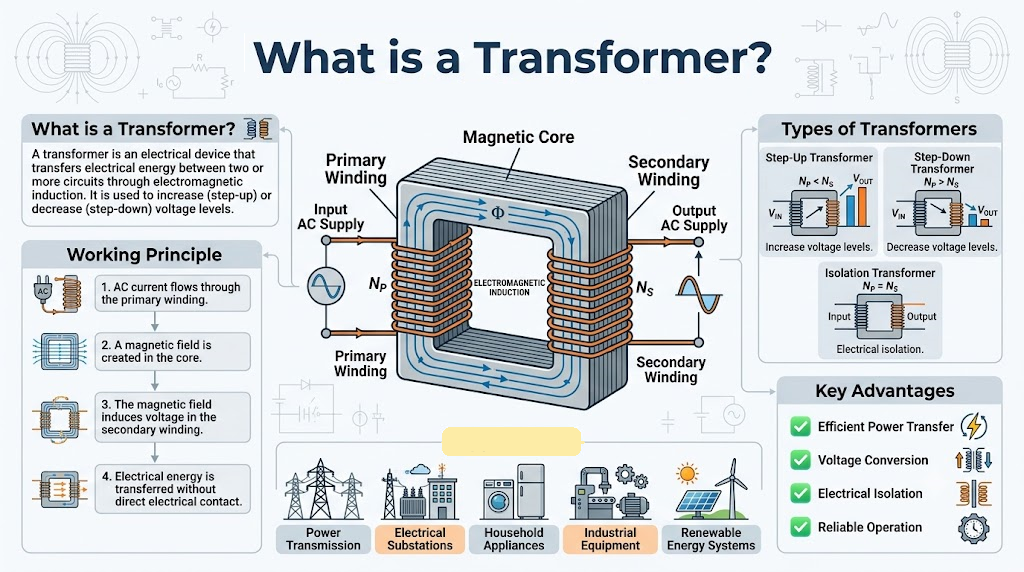
A transformer transfers electrical energy through a changing magnetic field. It can change AC voltage and current levels without changing the fundamental frequency in normal operation. Transformers are used in power networks, chargers, measurement systems and signal circuits.
Contents
How does a transformer work?
A changing current in the primary winding produces changing magnetic flux. Flux linking the secondary induces voltage there. A magnetic core can improve coupling, although some transformers use air cores. When a load is connected, primary current changes to support the transferred power.
A transformer needs changing flux. A steady DC voltage does not sustain normal transformer operation and can cause excessive winding current or saturation. Switching converters can use transformers because their switching creates time-varying winding voltage; this is different from connecting a conventional transformer directly to steady DC.
Turns ratio and a worked example
For an ideal transformer, using consistent RMS values, Vp/Vs = Np/Ns. The voltage ratio follows the turns ratio. Ideal power balance gives VpIp = VsIs, so current changes in the inverse ratio.
Suppose an ideal transformer has a 10:1 primary-to-secondary turns ratio and 120 V RMS at its primary. Its ideal secondary voltage is 12 V RMS. A 0.5 A secondary load receives 6 VA, and the corresponding ideal primary load current is 0.05 A. Real magnetizing current, losses, regulation and load power factor affect actual measurements.
A step-up transformer increases voltage but does not create power. Available current and losses must be considered. A real transformer’s rated secondary voltage is specified under stated operating conditions, and no-load voltage can be higher.
Common transformer types
| Type | Typical role | Important qualification |
|---|---|---|
| Power or distribution | Voltage conversion in electricity networks | Ratings include voltage, frequency, apparent power and cooling |
| Isolation | Separate primary and secondary conductive circuits | Safety depends on insulation, construction and the complete installation |
| Autotransformer | Voltage conversion using a shared winding | Does not provide galvanic isolation between input and output |
| Instrument | Provide measurement and protection signals | Current and voltage transformers have specific connection and safety requirements |
| High-frequency | Energy transfer in switching converters | Core material, waveform, frequency and insulation must suit the converter |
Losses, isolation and practical limits
Real transformers have winding resistance, core losses, leakage inductance and parasitic capacitance. Their efficiency depends on design and loading; a very high efficiency quoted for a large power transformer is not a guarantee for a small adapter.
Check rated voltage and frequency, VA rating, temperature rise, insulation and duty cycle. Applying a lower frequency at unchanged voltage can increase core flux and cause saturation. A transformer does not automatically regulate its output or make its secondary safe to touch.
Transformers make AC voltage conversion practical and support economical transmission at high voltages. They are not the only way to transmit electricity over long distances: HVDC systems use power converters for suitable routes and interconnections.
Safety and learning
Use an approved isolated low-voltage AC source or a simulator for beginner experiments. Do not connect an unidentified transformer to mains. High-voltage windings and stored energy in associated circuits can be hazardous. Instrument current-transformer secondaries require manufacturer-specified handling and must not be opened while primary current flows.
Frequently asked questions
Does every transformer provide isolation?
No. An autotransformer has a shared winding and does not provide galvanic isolation.
Does a transformer change frequency?
A conventional transformer normally preserves the input fundamental frequency. A frequency converter needs additional circuitry.
Can it run directly on steady DC?
No. Normal transformer action requires changing flux. A DC-powered switching converter creates that variation electronically.

Comments
Comments are currently closed.