
What Is VLSI Design? Design Flow, Applications and Careers
VLSI Design Explained: Design Flow, Tools, Applications, and Career Scope
Smartphones, laptops, satellites, and medical devices all rely on highly integrated circuits. The technology behind these compact, powerful chips is VLSI design.
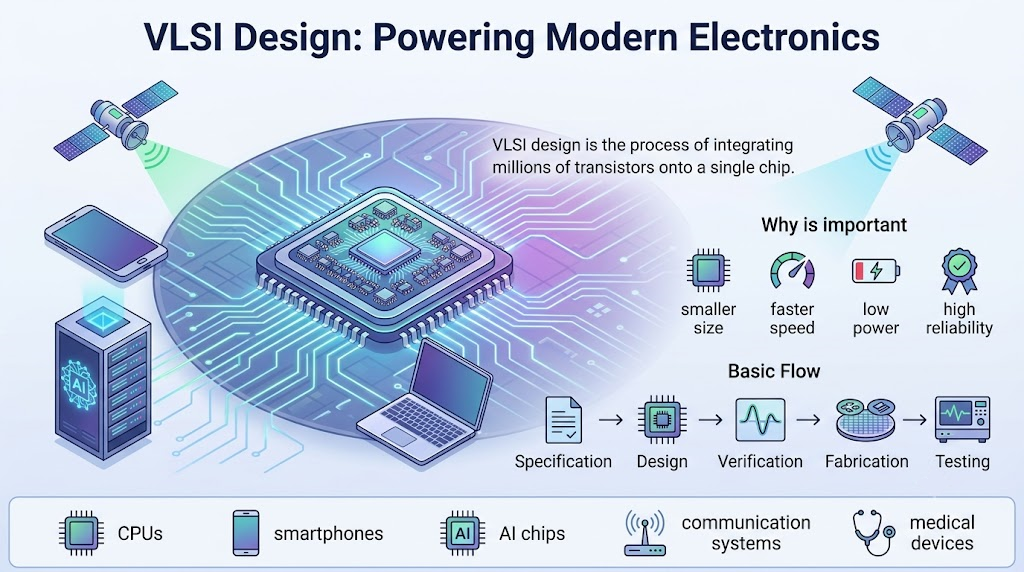
VLSI (Very Large Scale Integration) is the process of integrating thousands, millions, or billions of transistors onto a single silicon chip to build complex electronic circuits. It underpins microprocessors, microcontrollers, memory chips, and system-on-chip (SoC) devices. This guide explains the design flow, key concepts, tools, applications, and career opportunities.
Key takeaways
- VLSI design creates integrated circuits by placing very large numbers of transistors on one chip.
- The flow runs: specification, architecture, RTL design, verification, synthesis, physical design, fabrication, testing and packaging.
- Verification is one of the largest and most critical efforts in a project.
- Chips are designed using hardware description languages (Verilog, VHDL) and EDA tools from Cadence, Synopsys, and Siemens EDA.
- Career paths include design, verification, physical design, DFT, and FPGA roles.
Topics covered
- What is VLSI design?
- Why VLSI matters
- Evolution of integration levels
- Basic components of a VLSI system
- VLSI design flow
- Design styles: ASIC, FPGA, full-custom
- Tools used in VLSI design
- Applications
- Career scope
- Advantages and challenges
- Future of VLSI
- FAQs
What Is VLSI Design?
VLSI design is the process of creating integrated circuits (ICs) by combining a large number of electronic components, mainly transistors, on a single chip. In short: VLSI design is the technology of designing very complex integrated circuits with millions or billions of transistors on one semiconductor chip.
Why VLSI Matters
VLSI technology:
- Reduces the size of electronic systems
- Increases processing speed
- Can reduce power consumption per function
- Improves reliability by reducing external connections
- Enables whole systems on a single chip
- Supports modern computing and communication devices
Without VLSI, modern smartphones, computers, and IoT devices would not exist in their current form.
Evolution of Integration Levels
| Level | Full name | Approximate transistors per chip |
|---|---|---|
| SSI | Small Scale Integration | Up to tens |
| MSI | Medium Scale Integration | Hundreds |
| LSI | Large Scale Integration | Thousands |
| VLSI | Very Large Scale Integration | Hundreds of thousands to millions and beyond |
| ULSI | Ultra Large Scale Integration | Billions (term rarely used today) |
These boundaries are conventional, not formal standards. Modern processors with billions of transistors are still usually described as VLSI.
Basic Components of VLSI Systems
- Transistors: the building blocks for switching and amplification. CMOS technology using MOSFETs dominates.
- Logic gates: AND, OR, NOT, NAND, NOR, and others perform logical operations.
- Memory elements: SRAM, DRAM, and Flash store data and instructions.
- Interconnects: multiple metal layers connect components. At advanced nodes, interconnect delay and power are major design concerns.
- System blocks: ALU, control unit, registers, and cache memory.
VLSI Design Flow
The flow moves from idea to finished chip, with feedback loops between stages.
1. Specification
Define system requirements, performance, power, and area targets, and design goals.
2. Architecture Design
Plan the overall structure, identify functional blocks, and define data and control flow. For a CPU, this includes the ALU, registers, and cache.
3. RTL Design (Register Transfer Level)
Write the design in a hardware description language such as Verilog or VHDL, describing how data moves between registers and the logic that processes it.
4. Functional Verification
Simulate the design against a test plan, find bugs, and fix them. Verification is one of the most critical and time-consuming steps, and modern projects often use dedicated verification teams.
5. Logic Synthesis
Convert RTL into a gate-level netlist using a standard cell library, optimized for speed, area, and power under timing constraints.
6. Physical Design
Turn the netlist into a physical layout:
- Floor planning
- Placement
- Clock tree synthesis
- Routing
- Timing, power, and signal integrity checks
Final checks include DRC (design rule check), LVS (layout versus schematic), and static timing analysis.
7. Fabrication
The finished layout (GDSII) goes to a semiconductor fabrication plant (fab), where wafers are manufactured.
8. Testing and Packaging
Chips are tested for defects and performance, then packaged. Design for testability (DFT) features built into the chip make this possible.
Reality check: problems found late often send the design back to earlier stages, so the flow is iterative.
Design Styles: ASIC, FPGA, and Full-Custom
| Style | Description | Typical use |
|---|---|---|
| ASIC | Custom chip designed and fabricated for one purpose | High-volume products needing top performance and efficiency |
| FPGA | Reconfigurable chip programmed after manufacturing | Prototyping, low-volume products, changing requirements |
| Full-custom | Transistor-level hand-crafted layout | Analog blocks, memories, and performance-critical cells |
Tools Used in VLSI Design
- Cadence: design, simulation, and implementation tools
- Synopsys: synthesis, verification, and physical design tools
- Siemens EDA (formerly Mentor Graphics): verification and physical verification tools
- Xilinx Vivado (AMD): FPGA design suite
- ModelSim and Questa: HDL simulation
- Open-source options: Icarus Verilog, Verilator, Yosys, and OpenROAD for learning
Commercial EDA tools are expensive and usually accessed through companies or universities.
Applications of VLSI Design
- Microprocessors and CPUs: Intel, AMD, and ARM-based processors in computers and servers
- Mobile devices: smartphones, tablets, smartwatches
- Communication systems: routers, modems, 5G, satellite communication
- Consumer electronics: smart TVs, gaming consoles, digital cameras
- Automotive: engine control units, driver assistance and autonomous systems, infotainment
- Medical electronics: MRI and CT systems, wearable monitors
- Industrial automation: robotics, control systems, smart manufacturing
- Artificial intelligence: AI accelerators, machine-learning chips, GPUs, and TPUs
Career Scope in VLSI Design
Job Roles
| Area | Roles |
|---|---|
| Design | RTL design engineer, digital design engineer, ASIC designer |
| Verification | Verification engineer, functional test engineer |
| Physical design | Physical design engineer, layout engineer |
| Other | FPGA engineer, DFT engineer, embedded hardware engineer, analog and mixed-signal designer |
Skills Required
- Digital electronics
- CMOS technology
- Verilog, VHDL, and SystemVerilog
- C and C++ (and scripting in Python, Perl, or Tcl)
- Computer architecture
- Semiconductor physics
- EDA tools and Linux
Educational Path
- B.E. or B.Tech in electronics or electrical engineering
- M.Tech in VLSI design (optional but often preferred for design and verification roles)
- Specialized VLSI training programs and hands-on projects
Salary and Growth
Pay varies widely by country, company, role, and experience, and demand for skilled engineers has generally been strong. Check current salary surveys and job listings before making decisions.
Well-Known Companies in the Field
Intel, AMD, Qualcomm, NVIDIA, Broadcom, Texas Instruments, and Samsung Semiconductor, along with many fabless startups and EDA companies.
Advantages and Challenges
| Advantages | Challenges |
|---|---|
| Compact electronic systems | Very complex design process |
| Faster processing | High development and mask costs |
| Low power per function | Needs advanced tools and skills |
| High reliability | Heat dissipation and power density |
| Cost-effective mass production | Verification is time-consuming |
Future of VLSI Design
Growth is driven by:
- AI and machine-learning chips
- Quantum computing hardware (an emerging area that uses different technologies)
- IoT devices
- 5G and 6G communication systems
- Advanced microprocessors and chiplet-based designs
VLSI remains the backbone of semiconductor innovation.
Frequently Asked Questions
What is VLSI in simple words?
It is the technology of putting millions or billions of transistors on one chip to build complex integrated circuits.
What is the VLSI design flow?
Specification, architecture, RTL design, verification, synthesis, physical design, fabrication, then testing and packaging.
Which language is used in VLSI?
Verilog and VHDL are the main hardware description languages, and SystemVerilog is widely used for verification.
What is the difference between ASIC and FPGA?
An ASIC is a custom fabricated chip with the best performance and efficiency at volume, while an FPGA is reconfigurable after manufacturing and suits prototyping and low volume.
Is VLSI a good career?
It offers strong opportunities in the semiconductor industry for people with solid fundamentals, but it requires patient learning of digital design, tools, and verification.
What is the difference between VLSI and embedded systems?
VLSI is about designing the chips themselves. Embedded systems engineering uses chips such as microcontrollers to build products.
Do I need an M.Tech for VLSI?
Not always, but a master’s degree or specialized training is common for design and verification roles.
Conclusion
VLSI design enables modern integrated circuits by combining millions or billions of transistors on a single chip. Understanding the flow from specification through RTL, verification, synthesis, and physical design is the foundation for a career in semiconductors. Build strong fundamentals in digital electronics and CMOS, practice with Verilog or VHDL, and verify your work thoroughly.

Comments
Comments are currently closed.