


1. What is Wireless Charging?
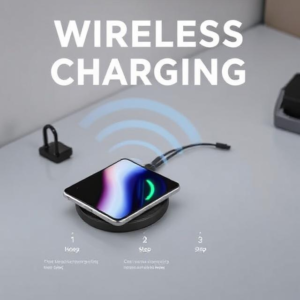
Wireless charging is a way to charge devices like smartphones, smartwatches, and even electric vehicles without needing to plug in any cables. Instead of physically connecting a charger to a device, you just place it on a special pad or surface, and the power is transferred wirelessly.
2. How Does Wireless Charging Work?
Wireless charging works using electromagnetic fields to transfer energy between two objects—one that is plugged into a power source (the charger) and one that needs to be charged (the device).
Here’s a simple step-by-step breakdown of how it works:
a. Inductive Charging:
The most common method of wireless charging is called inductive charging. It uses two coils: a transmitter coil in the charging pad and a receiver coil in the device.
- Step 1: When you place your device on the charging pad, the transmitter coil (in the charging pad) is connected to a power source.
- Step 2: The transmitter coil creates an electromagnetic field by sending an electric current through it.
- Step 3: This electromagnetic field transfers energy to the receiver coil in your device, which is then converted back into electrical energy to charge the device’s battery.
b. Resonant Charging:
Another way wireless charging can work is through resonant charging. This method uses a similar principle but allows for a little more flexibility in terms of distance and alignment between the charging pad and device. It’s useful for charging devices that don’t need to be in perfect contact with the charging pad.
3. Advantages of Wireless Charging:
- Convenience: No need to plug in your device, which reduces wear and tear on charging ports.
- Less Clutter: Fewer cables around your home or office, making the space cleaner and more organized.
- Ease of Use: Simply place the device on the charging pad, and it starts charging—no fiddling with cords.
4. Limitations of Wireless Charging:
- Slower Charging: Wireless charging tends to be slower than wired charging. This is improving, but it’s still a factor to consider.
- Limited Range: For now, wireless charging usually requires the device to be placed very close to the charger, typically in direct contact with the pad.
- Heat: Some wireless charging systems can generate heat, which might affect charging efficiency or the lifespan of your device’s battery over time.
5. Types of Wireless Charging Technologies:
There are a few different types of wireless charging technologies:
- Qi Charging (pronounced “chee”): This is the most common standard for wireless charging, used by most smartphones and other devices. It’s widely supported by many manufacturers.
- PMA and A4WP: These are other standards used by some companies, but Qi is by far the most popular.
- Resonant Charging: As mentioned, this method allows for charging over slightly longer distances or through obstacles, which is a bit more flexible than traditional inductive charging.
6. The Future of Wireless Charging:
The future of wireless charging looks exciting! Here’s what we can expect:
a. Faster Charging:
- Speed improvements are being made in wireless charging technology, so future systems will charge devices faster—close to or even as fast as wired charging.
b. Longer Distances:
- We might see charging technology that works over longer distances, so you won’t have to place your device directly on the pad. You could charge your phone or laptop from across the room!
c. More Devices:
- Wireless charging isn’t just for smartphones anymore. In the future, more devices will support wireless charging, including things like laptops, electric cars, and even home appliances.
d. Integration with Furniture and Public Spaces:
- Imagine being able to charge your phone just by placing it on a table or chair. Some companies are working on integrating wireless charging into furniture, public areas, and even walls, so charging your device will be as simple as setting it down on any surface.
e. Energy Efficiency Improvements:
- Researchers are working on making wireless charging more energy-efficient, reducing power loss and making the process cleaner for the environment.
7. Summary:
- Wireless charging uses electromagnetic fields to transfer energy between a charging pad and a device, eliminating the need for cords.
- It works most commonly through inductive charging, where coils in the charging pad and the device transfer power.
- The main benefits are convenience, less cable clutter, and ease of use, though it currently charges devices slower than wired methods.
- The future of wireless charging includes faster speeds, longer ranges, more devices supporting it, and integration into more everyday surfaces and spaces.
Tags: A4WP, cable-free charging, charging convenience, charging efficiency, charging innovation, charging pad, charging ports, contactless charging, cordless charging, device charging, electric vehicles, electromagnetic fields, embedded charging surfaces, Energy Efficiency, energy transfer, furniture integration, future charging technology, Heat Generation, inductive charging, less clutter, limited range, long-distance charging, next-gen charging systems., no cables, PMA, power loss reduction, public space charging, Qi standard, receiver coil, resonant charging, slow charging, smart furniture, smartphones, smartwatches, transmitter coil, wear and tear reduction, Wireless charging, wireless energy transfer, wireless power