


Layers of the Earth :
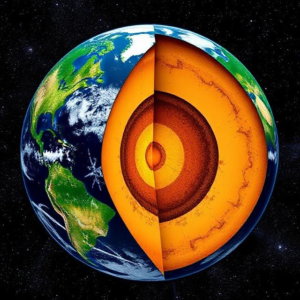
The Earth is made up of four main layers. These layers are like a giant onion, with each one covering the one beneath it. Here’s a simple breakdown:
- Crust (Outer Layer):
- The crust is the thinnest layer of the Earth. It’s the part we live on! It’s made up of rocks and minerals.
- There are two types of crust: the continental crust (under the land) and the oceanic crust (under the oceans).
- The crust is where we find mountains, oceans, and continents.
- Mantle:
- The mantle is the thick layer just below the crust. It’s made up of hot, semi-solid rock that can slowly flow.
- It’s about 2,900 km thick and is divided into the upper mantle (which is mostly solid) and the lower mantle (which is hotter and can flow slowly).
- The mantle is where most of the Earth’s heat is stored, and it causes the movement of tectonic plates that can lead to earthquakes and volcanic eruptions.
- Outer Core:
- The outer core is a layer of liquid metal (mostly iron and nickel) beneath the mantle.
- It’s about 2,200 km thick and is extremely hot (temperatures can reach up to 5,500°C).
- The movement of liquid metal in the outer core helps create the Earth’s magnetic field.
- Inner Core:
- The inner core is the very center of the Earth. It’s a solid ball made of iron and nickel.
- It’s extremely hot, even hotter than the outer core (around 6,000°C), but it remains solid because of the immense pressure at the Earth’s center.
- The inner core is about 1,200 km thick and plays a role in Earth’s magnetic field too.
Layers of the Earth’s Atmosphere
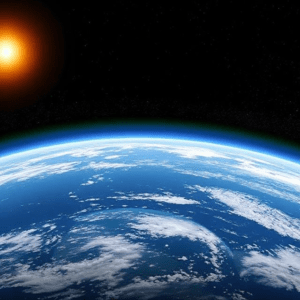
The atmosphere is a layer of gases that surrounds the Earth. It’s divided into five layers based on temperature and altitude:
- Troposphere (Closest to Earth):
- This is where we live and where all the weather happens (clouds, rain, etc.).
- It extends about 8-15 km above the Earth’s surface.
- The temperature decreases as you go higher in this layer.
- The troposphere contains about 75% of the atmosphere’s mass and most of the water vapor.
- Stratosphere:
- This layer lies above the troposphere and extends about 15-50 km above Earth.
- The ozone layer is found here, which protects us from harmful ultraviolet (UV) radiation from the Sun by absorbing most of it.
- In the stratosphere, the temperature increases as you go higher because the ozone layer absorbs heat from the Sun.
- Mesosphere:
- The mesosphere extends from about 50 km to 85 km above the Earth’s surface.
- This is where most meteors burn up when they enter the Earth’s atmosphere.
- In this layer, the temperature decreases as you go higher, making it the coldest layer of the atmosphere.
- Thermosphere:
- The thermosphere extends from about 85 km to 600 km above Earth.
- In this layer, the temperature rises dramatically with height and can reach up to 2,500°C.
- It’s where the Northern and Southern Lights (auroras) occur due to interactions between charged particles from the Sun and the atmosphere.
- The thermosphere also contains the International Space Station (ISS), and satellites orbit here.
- Exosphere (Outermost Layer):
- The exosphere is the outermost layer of the atmosphere, starting around 600 km and extending out to 10,000 km.
- This is where the atmosphere begins to transition into outer space.
- It contains very few particles, mainly hydrogen and helium, and they are so spread out that they can travel hundreds of kilometers before colliding with each other.
- Satellites and spacecraft can travel through this region.
So, in summary:
- The Earth has four main layers: crust, mantle, outer core, and inner core.
- The atmosphere has five layers: troposphere, stratosphere, mesosphere, thermosphere, and exosphere.
Each of these layers plays an important role in keeping the Earth and its environment functional and supporting life!
Tags: altitude, atmospheric transition, auroras, clouds, coldest layer, continental crust, core layers. Atmosphere layers, crust, Earth layers, Earth's center, Earth's Layers, Earth's structure, earthquakes, exosphere, extreme heat, gas particles, heat, helium, high pressure, high temperature, hydrogen, inner core, Iron, ISS, liquid metal, low density, lower mantle, magnetic field, mantle, mesosphere, meteors, minerals, nickel, northern lights, oceanic crust, outer core, outer layer, outer space, ozone layer, rain, rocks, Satellites, semi-solid rock, solid metal, Southern Lights, Spacecraft, stratosphere, tectonic plates, temperature decrease, temperature increase, thermosphere, troposphere, upper mantle, UV protection, volcanic eruptions, water vapor, weather