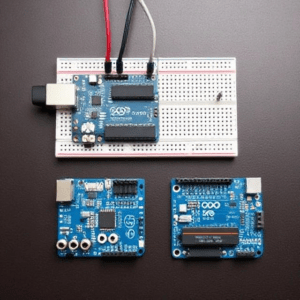
What it is: The Arduino Uno is the most popular and beginner-friendly Arduino board. It’s a small circuit board that can be programmed to control sensors, motors, lights, and other devices.
Key Features:
14 digital pins
6 analog pins
USB connection for programming
Use cases: Perfect for basic projects, such as controlling LEDs, creating simple robots, or reading sensors.
2. Arduino Nano
What it is: The Arduino Nano is a smaller, more compact version of the Uno. It has the same functionality, but it’s designed to fit into smaller spaces.
Key Features:
Same microcontroller as the Uno, but smaller and cheaper
22 digital pins, 8 analog pins
Use cases: Great for projects with limited space, like wearable electronics, small robots, or when you need to embed it into a device.
3. Arduino Mega
What it is: The Arduino Mega is a more powerful and larger board than the Uno. It has more pins and memory, making it suitable for complex projects.
Key Features:
54 digital pins
16 analog pins
256 KB of memory
Use cases: Ideal for advanced projects, like controlling large-scale robots, 3D printers, or handling many sensors and actuators at once.
4. Arduino Leonardo
What it is: The Arduino Leonardo is a special version of the Arduino that can act like a computer device (like a mouse or keyboard) when connected to a PC.
Key Features:
Can emulate mouse or keyboard input
20 digital pins, 12 analog pins
Use cases: Great for projects that need to simulate a mouse, keyboard, or game controller, like custom computer peripherals.
5. Arduino Due (for more advanced projects)
What it is: The Arduino Due is a more powerful board, designed for complex, high-performance tasks. It uses a 32-bit processor, which is much faster than the 8-bit processor used in other Arduino boards.
Key Features:
54 digital pins
12 analog inputs
84 MHz processor (faster than others)
Use cases: Perfect for advanced projects that require fast data processing, like advanced robotics, audio processing, or complex sensor systems.