


1. Concave and Convex Mirrors
Both concave and convex mirrors are types of curved mirrors. These mirrors are used in various applications like reflecting telescopes, car headlights, makeup mirrors, and more. The difference between them lies in their shape and how they reflect light.
Concave Mirror
A concave mirror is a mirror that curves inward (like the inside of a spoon). The reflective surface is on the inside of the curve.
- In simple terms: Imagine the shape of a bowl or a cave — that’s how the concave mirror looks. It “collects” light and makes it converge (come together) at a point.
- Key Features:
- Light reflects inward and converges at a point called the focus.
- Concave mirrors are used to magnify objects (make them look bigger), which is why they are often used in makeup mirrors and telescopes.
- Real and Virtual Images: Depending on the distance of the object from the mirror, concave mirrors can produce either real images (which can be projected on a screen) or virtual images (which appear to be behind the mirror and cannot be projected).
- Example: A makeup mirror often uses a concave mirror to magnify your reflection. If you hold the mirror close to your face, you will see a larger, virtual image. If you place an object further from the mirror, you may see a smaller, real image.
Convex Mirror
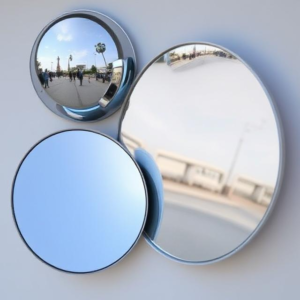
A convex mirror is a mirror that curves outward (like the back of a spoon). The reflective surface is on the outside of the curve.
- In simple terms: Imagine the outside of a ball — that’s how a convex mirror looks. It “spreads out” light, making it diverge (move apart).
- Key Features:
- Light reflects outward and diverges, meaning it spreads out. This creates a virtual image that is smaller than the object.
- Convex mirrors are used for wide-angle views (they can show a larger area), which is why they are commonly used in car side mirrors and security mirrors.
- Virtual Image: The image formed by a convex mirror is always virtual, erect (right-side-up), and smaller than the actual object.
- Example: The side mirrors of cars use convex mirrors to give drivers a wider field of view. Although the image in the mirror is smaller, it helps you see more of what’s around you.
2. Concave Lens
A concave lens is a lens that is thicker at the edges and thinner in the middle, making it curve inward. It’s often referred to as a diverging lens.
- In simple terms: Imagine looking through the bottom of a spoon (which is curved inward). When light passes through a concave lens, it spreads out (diverges).
- Key Features:
- Concave lenses spread out parallel light rays, which is why they are used to correct nearsightedness (myopia). They help in diverging light so that it focuses correctly on the retina.
- They form virtual images that are smaller and upright. The image appears to be located on the same side as the object and is always reduced in size.
- Example: If someone has nearsightedness, they might wear glasses with concave lenses. These lenses help spread out light entering the eye, allowing the image to be focused properly on the retina.
3. Differences Between Concave and Convex Mirrors
Concave Mirror vs. Convex Mirror
- Shape:
- Concave mirrors curve inward (like the inside of a bowl).
- Convex mirrors curve outward (like the back of a spoon).
- Reflection:
- Concave mirrors focus light inward, and can form real or virtual images.
- Convex mirrors scatter light outward, and always form virtual images that are smaller than the object.
- Use:
- Concave mirrors are used to magnify objects (like makeup mirrors or telescopes).
- Convex mirrors are used for wide-angle views (like car side mirrors or security mirrors).
Concave Lens vs. Convex Lens
- Shape:
- Concave lens is thinner in the middle and thicker at the edges.
- Convex lens is thicker in the middle and thinner at the edges.
- Effect on Light:
- Concave lenses diverge light rays, causing them to spread out.
- Convex lenses converge light rays, causing them to come together at a focal point.
- Use:
- Concave lenses are used to correct nearsightedness (myopia).
- Convex lenses are used to correct farsightedness (hyperopia).
Summary of Differences:
| Feature | Concave Mirror | Convex Mirror |
|---|---|---|
| Shape | Curves inward (like a bowl) | Curves outward (like the back of a spoon) |
| Reflection | Converges light to a point (focus) | Diverges light (spreads it out) |
| Image Type | Real or virtual images (depending on distance) | Virtual image, always smaller than the object |
| Use | Magnification (makeup mirrors, telescopes) | Wide-angle view (car side mirrors, security) |
| Feature | Concave Lens | Convex Lens |
|---|---|---|
| Shape | Thinner in the middle, thicker at the edges | Thicker in the middle, thinner at the edges |
| Effect on Light | Diverges light rays (spreads them out) | Converges light rays (brings them together) |
| Use | Corrects nearsightedness (myopia) | Corrects farsightedness (hyperopia) |
Tags: applications, car side mirror, collects light, Concave mirror, concave vs convex mirror, converging lens, converging mirror, diverging lens, diverging mirror, eyeglasses. Convex lens, focus point, focus vs spread., focuses light rays, hyperopia, image depends on distance, image type, inside of a spoon shape. Convex mirror, inward curve, inward curved, lens shape, light effect, magnification, magnification. Differences, magnify vs reduce, makeup mirror, myopia, Optics, outside of a ball shape. Concave lens, outward curve, outward curved, real image, real vs virtual images, reflecting telescope, reflection behavior, security mirror, smaller image, spreads light, spreads light rays, thicker at edges, thicker in middle, thinner at edges, thinner in middle, used for farsightedness correction, used for nearsightedness correction, virtual image, virtual image only, virtual upright image, vision correction, wide-angle view