


A bridge rectifier is a circuit that converts alternating current (AC) into direct current (DC). It’s commonly used in power supplies to provide DC for devices that need a steady, unidirectional current. Here’s an easy breakdown:
- AC Input: AC voltage from the wall (or any AC source) alternates between positive and negative values, like a sine wave.
- Four Diodes: A bridge rectifier uses four diodes arranged in a bridge configuration. Diodes are like one-way valves for electricity; they allow current to flow in only one direction.
- How It Works:
- During the positive half-cycle of the AC wave (when the input voltage is positive), two of the diodes conduct, allowing current to pass through.
- During the negative half-cycle (when the input voltage is negative), the other two diodes conduct, still allowing current to flow in the same direction.
- Output DC: Because of the diodes, no matter what part of the AC wave is coming in, the output current always flows in the same direction. This creates a pulsating DC output.
- Smoothing: Typically, after the rectifier, a capacitor is used to smooth out the ripples in the DC output, making it a more stable DC voltage.
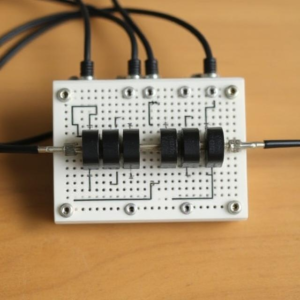
Why Use It?
- Efficiency: A bridge rectifier is simple, inexpensive, and efficient at converting AC to DC.
- Full-Wave Rectification: Unlike a single diode rectifier, the bridge rectifier uses both halves of the AC waveform, making it more efficient in converting power.
A bridge rectifier takes AC power, uses four diodes to convert it to DC, and then often smooths out the output for stable power supply.
Tags: AC to DC conversion, AC waveform, alternating current (AC), bridge rectifier, capacitor smoothing, cost-effective, current direction control, DC output, DC voltage stabilization, diode behavior, diode bridge, diode conduction, direct current (DC), electronic devices, Energy Conversion, four diodes, full AC cycle utilization, full-wave rectification, negative half-cycle, one-way current flow, positive half-cycle, Power Supply, pulsating DC, rectification efficiency, rectifier, rectifier circuit, ripple reduction, simple circuit design, sine wave, steady current, unidirectional current, voltage conversion, voltage regulation