


1. Angular Velocity:
Angular velocity is how fast something is rotating around an axis. Imagine you’re spinning a wheel. If the wheel completes one full rotation (360°) in 1 second, its angular velocity is
(or in radians, it would be
).
In simple terms, angular velocity tells you how quickly an object is spinning or rotating. It’s measured in radians per second (rad/s). So if an object is rotating more quickly, its angular velocity is higher.
2. Angular Acceleration:
Angular acceleration is the rate at which the angular velocity changes. If you speed up or slow down your spinning wheel, you’re changing its angular velocity, and the rate of that change is called angular acceleration.
For example, if you start a spinning wheel from rest and gradually increase its speed, the angular acceleration is how quickly you’re making the wheel spin faster. It’s measured in radians per second squared (rad/s²).
In simple terms:
- If the wheel’s speed increases or decreases, that’s angular acceleration.
- A higher angular acceleration means the object is speeding up or slowing down more quickly.
3. Moment of Inertia:
Moment of inertia is like mass for rotation. While mass measures how hard it is to move something in a straight line, the moment of inertia tells you how hard it is to rotate something. It depends on both the mass of the object and how the mass is distributed relative to the axis of rotation.
- The greater the moment of inertia, the harder it is to rotate the object.
- The moment of inertia depends on two factors:
- The mass: The heavier the object, the harder it is to rotate.
- The shape and size: If the mass is further away from the axis of rotation, it’s harder to rotate (e.g., it’s easier to spin a broomstick at the center than at the edge).
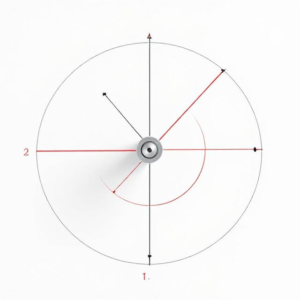
For example:
- A disk with most of its mass near the center has a smaller moment of inertia.
- A long, thin rod with mass spread out along its length has a larger moment of inertia if it rotates around one of its ends.
Summary:
- Angular Velocity: How fast something is spinning.
- Angular Acceleration: How quickly the spinning speed is changing.
- Moment of Inertia: How hard it is to make something rotate, based on its mass and shape.
Think of angular velocity as the speed of a spin, angular acceleration as how quickly you change that speed, and moment of inertia as how much effort it takes to get the object spinning or to slow it down.
Tags: angular acceleration, angular acceleration measurement, Angular Velocity, angular velocity measurement, Axis of rotation, change in angular velocity, full rotation, Mass distribution, mass effect, Moment of inertia, rad/s, rad/s², Radians per second, radians per second squared, rate of change, Resistance to rotation, rotation difficulty, rotation speed, Rotational dynamics, rotational effort, Rotational inertia, rotational mass, Rotational Motion, shape effect, slowing down, speeding up, spinning speed, spinning wheel, torque resistance