


What is the Parallel Axis Theorem?
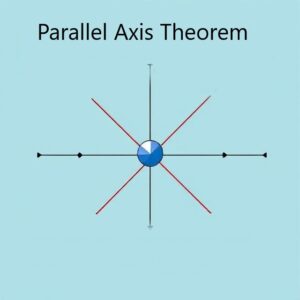
The Parallel Axis Theorem is a principle in physics and engineering that helps us calculate the moment of inertia of an object about an axis that is parallel to the object’s center of mass.The moment of inertia is a measure of how difficult it is to rotate an object about a specific axis, just like mass measures how hard it is to move an object in linear motion. The center of mass is the point where you can assume all the object’s mass is concentrated.
Why is the Parallel Axis Theorem useful?
Sometimes, we want to know the moment of inertia of an object about an axis that does not pass through its center of mass. But we might already know the moment of inertia about the center of mass. The Parallel Axis Theorem helps us calculate the moment of inertia about the new axis using the known value for the center of mass.
The Formula for the Parallel Axis Theorem
The theorem says that the moment of inertia about any axis parallel to the center of mass axis can be calculated as:
Where:
is the moment of inertia about the new axis (parallel to the center of mass).
is the moment of inertia about the center of mass axis.
is the mass of the object.
is the distance between the new axis and the center of mass.
How does it work?
Imagine you have a rotating object, like a rod, and you know its moment of inertia about its center. If you want to find the moment of inertia about a new axis that is parallel to the rod’s center (but not at the center), the Parallel Axis Theorem gives us a way to calculate it.
- First, you calculate the moment of inertia about the center of mass of the rod (which is a known value).
- Then, you add the mass of the rod multiplied by the square of the distance between the new axis and the center of mass.
Example to understand better:
Let’s take an example of a thin uniform rod of mass
and length
.
- The moment of inertia about the center of mass (which is at the middle of the rod) is given by:
Now, let’s say you want to know the moment of inertia about an axis that is at one end of the rod (a distance
from the center of mass).
Using the Parallel Axis Theorem:
So, substituting the values:
Simplifying this:
This is the moment of inertia about an axis at one end of the rod.
In short:
- The Parallel Axis Theorem allows you to calculate the moment of inertia of an object about any axis parallel to the one through its center of mass.
- The formula is:
- You need the moment of inertia about the center of mass, the object’s mass, and the distance between the axes to use this theorem.
Tags: axis, axis transformation, calculation, Center of Mass, distance 𝑑 d, Engineering, formula 𝐼 = 𝐼 𝑐 𝑚 + 𝑀 𝑑 2 I=I cm +Md 2, inertia about center of mass, inertia about new axis, inertia of extended bodies, Mass distribution, Moment of inertia, object mass, Parallel Axis Theorem, perpendicular distance, physics, real-life application, rigid body rotation., rod example, rotational axis shift, Rotational dynamics, Rotational mechanics., Rotational Motion, rotational resistance, shifted axis, thin uniform rod