


Railway Safety Technologies are systems and tools used to keep trains safe and prevent accidents. These technologies help make sure that the trains, tracks, and stations are monitored and managed effectively. Let’s break down some important safety technologies in easy terms:
1. Anti-Collision Devices and Their Implementation
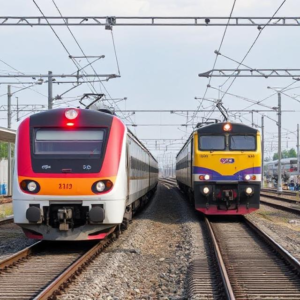
Anti-collision devices are systems designed to prevent train accidents, especially head-on collisions (when two trains crash into each other). These devices automatically stop a train if they sense a risk of collision. Here’s how they work:
a. What is an Anti-Collision Device (ACD)?
An Anti-Collision Device (ACD) is a safety mechanism installed on trains. It uses sensors to detect if two trains are on a collision course. If the device detects an incoming train on the same track, it sends a warning to the driver or automatically stops the train to avoid the crash.
b. How Does ACD Work?
- Sensors on the train detect other trains on the track or obstacles.
- If two trains are too close on the same track, the system activates and sends an alert to the train driver.
- If the driver doesn’t respond in time, the system automatically applies the brakes to stop the train before a collision happens.
c. Types of Anti-Collision Systems
- Train Collision Avoidance System (TCAS): This system is designed to reduce the risk of two trains colliding in areas where double tracks (tracks with two trains running in opposite directions) are not possible. TCAS helps monitor the positions of trains and ensures there’s enough distance between them.
- Train Protection and Warning System (TPWS): This is another anti-collision system that warns the driver about an approaching train and automatically applies the brakes if necessary to prevent a crash.
d. Where Are These Systems Used?
- These devices are especially useful in places with single-track sections, where two trains might be running in opposite directions.
- They are also used in mountainous or dense regions where it is harder to spot other trains due to weather or track layout.
2. GPS-Based Monitoring Systems for Trains
GPS-based monitoring systems help track the real-time location of trains to improve safety and efficiency. GPS stands for Global Positioning System, and it’s the same technology used in smartphones to track your location. Here’s how it’s used in trains:
a. What is GPS Monitoring?
GPS monitoring in railways uses satellites to track the location of trains in real-time. Every train is equipped with a GPS device that continuously sends data to the control center or railway stations. This helps the authorities know where each train is at any given moment.
b. How Does GPS Help in Safety?
- Real-time tracking: The control center can see exactly where each train is and monitor its speed, direction, and location. This helps in preventing collisions or unsafe train movements.
- Coordination of multiple trains: When there are multiple trains running on the same tracks, GPS monitoring helps the railway control room make sure there’s enough distance between them and avoid accidents.
- Emergency response: If a train is delayed or faces an emergency, the authorities can easily locate it and send help immediately.
- Signal and track management: GPS helps manage signals and tracks, ensuring that trains follow their routes and stop at the right stations without any errors.
c. GPS in Automatic Train Protection (ATP)
- Automatic Train Protection (ATP) is a system that uses GPS to help trains stay safe. The GPS tracks the position of the train and helps monitor its speed.
- If a train is going too fast or is about to cross a red signal, the system automatically applies the brakes to prevent accidents.
- ATP helps to stop accidents that could happen if the driver doesn’t notice a red signal or makes a mistake.
d. Benefits of GPS Monitoring
- Preventing collisions: GPS helps to keep trains at safe distances from each other, especially in high-traffic areas or single-track sections.
- Improved communication: The control center and the train operators can communicate easily using GPS tracking, making the railway system more organized and safe.
- Predicting delays: If a train is delayed or stuck on the tracks, GPS allows the railway authorities to track the exact location and work on rerouting or resolving the issue quickly.
e. Real-Life Example
In some areas, Indian Railways has implemented GPS-based train tracking systems on several important routes. These systems send the train’s data to the Centralized Train Control Room, so operators can monitor and manage train movement efficiently.
Conclusion
Anti-collision devices and GPS-based monitoring systems are key technologies that increase the safety of railway operations. Anti-collision devices automatically stop a train if it detects a risk of collision, while GPS-based monitoring systems help track trains’ real-time positions, ensuring smooth coordination and preventing accidents. These technologies, working together, help create a safer and more reliable railway system for passengers and goods, minimizing the risks of crashes and ensuring trains run efficiently.
Keywords: Railway Safety, Railway