


Train signaling and control systems are essential for ensuring that trains operate safely and efficiently. These systems help manage train traffic, avoid accidents, and ensure that trains follow the correct routes and schedules. Here’s an easy-to-understand breakdown of how they work:
1. Purpose of Train Signaling and Control Systems:
- Safety: The main goal is to prevent accidents by ensuring that trains are properly spaced, don’t run into each other, and follow the correct track routes.
- Efficiency: These systems also help manage train schedules and traffic, reducing delays and making the overall system more efficient.
- Communication: The systems communicate with train operators, informing them about the status of the track ahead and any potential hazards.
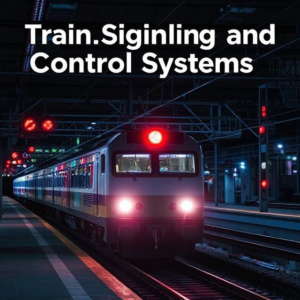
2. Types of Train Signaling:
There are several types of signaling systems, depending on the level of technology and the area of operation. Here are the main types:
- Mechanical Signals (Traditional):
- These are simple devices like levers or flags that control the movement of trains. They are now rarely used but are still found in some places.
- Semaphore signals: A kind of mechanical signal with a moving arm that shows whether a train should stop, proceed, or go slower.
- Color Light Signals:
- These are the most common today. They use colored lights (red, yellow, green) to communicate instructions to the train driver.
- Red: Stop.
- Yellow: Caution, prepare to stop or reduce speed.
- Green: Go, everything is clear ahead.
- Cab Signaling:
- This system uses signals inside the train (like lights or displays) to communicate with the driver, ensuring they are informed of track conditions even if they can’t see the signals outside.
- Automatic Train Control (ATC):
- This system automatically controls the speed of a train based on signals and track conditions. For example, it might slow the train down if it is approaching a red signal or sharp turn.
- Positive Train Control (PTC):
- A newer system in some countries, especially the U.S., that automatically stops a train if it is about to run a red signal, overspeed, or enter a dangerous area. It uses GPS, radio, and other technology to track the train’s position and speed.
3. Components of Train Signaling Systems:
- Track Circuits:
- These are used to detect the presence of a train on a particular section of track. They help the control center know whether a track section is occupied by a train or not, which helps in preventing accidents.
- Signals:
- Visual or electronic signals that tell the train operator whether they can proceed, need to slow down, or must stop.
- Interlocking:
- This is a system that prevents conflicting train movements. It ensures that signals and switches are coordinated so that a train cannot accidentally move onto the wrong track or collide with another train.
- Train Control Centers:
- These are the operations rooms where human operators monitor the movement of trains on the network. They can control signals, change routes, and track train positions.
4. How Train Signaling Works:
- When a train approaches a signal, the signaling system will inform the driver whether they can proceed or not.
- The signals may be controlled manually by operators in a control center or automatically by the system.
- If a train is approaching a red signal (stop), the system may also prevent the train from continuing (such as through automatic braking), ensuring safety.
- The signals can also change based on track conditions. For example, if there’s construction or maintenance ahead, the signal might show a warning.
- In some modern systems, signals are linked to GPS and real-time data, allowing the system to track train positions and speed and prevent accidents.
5. Communication Systems:
- Radio Communication:
- Train operators communicate with control centers and signal operators via radio to report issues, ask for permission to change tracks, or receive updated instructions.
- Automatic Train Location (ATL):
- A system that uses GPS or other technology to constantly track the location of the train. This helps the train control center know where each train is at all times and can be used to manage traffic and respond to emergencies.
6. Advantages of Modern Signaling Systems:
- Safety: Prevents collisions by providing clear instructions and controlling train movement automatically when necessary.
- Efficiency: Helps avoid delays by managing train schedules and preventing unnecessary stops.
- Automation: Reduces the chances of human error, as automatic systems can take over in case of a problem.
- Real-Time Control: Modern systems allow for real-time monitoring and control, which makes the railway network more adaptable to changing conditions.
In Summary:
Train signaling and control systems are like a “traffic control” system for trains, ensuring that each train is safely guided along its journey. These systems tell train drivers when to stop, slow down, or go, and also prevent accidents by ensuring trains don’t run into each other or take the wrong track. Modern systems use a combination of signals, track monitoring, and automatic controls to keep everything running smoothly and safely.
Keywords: Train, Railway